

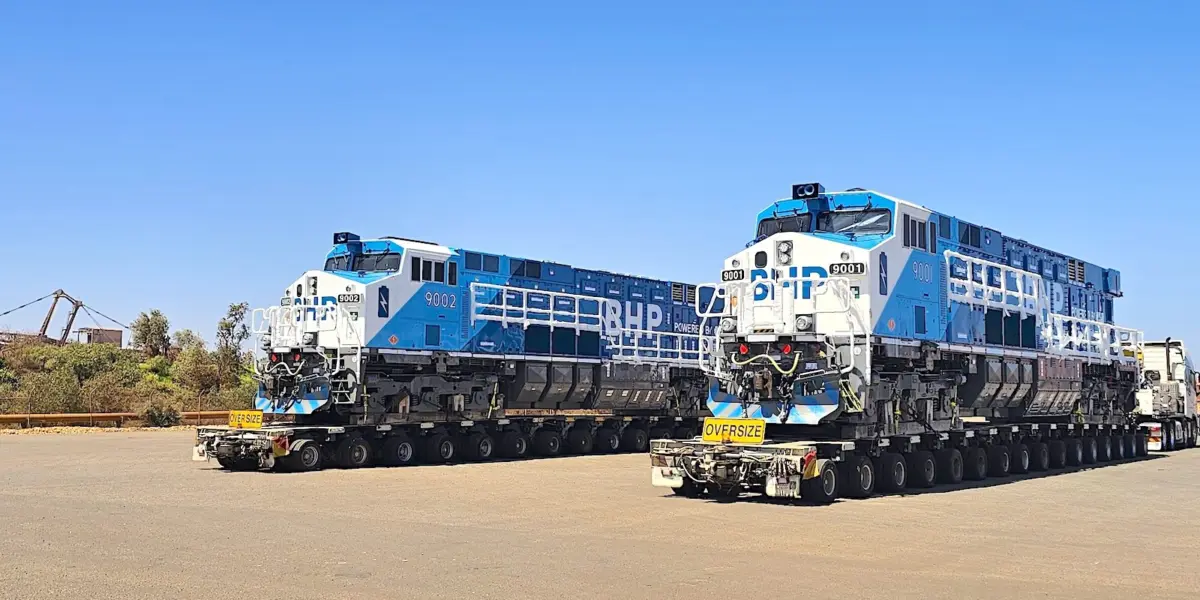
PORT HEDLAND, Australia — After nearly a full year of rigorous, real-world operation on a dedicated heavy-haul track line connecting the Jimblebar iron ore mine to the coastal port facilities of Port Hedland, mining giant BHP is demonstrating that heavy-duty rail decarbonization is no longer a distant theoretical goal. It is happening right now, operating under some of the most grueling climatic and industrial conditions on Earth.
The trial, centered around Australia’s first purpose-built battery-electric locomotives (BELs) manufactured by Wabtec, marks a watershed moment for the global mining and rail sectors. Combining sheer tractive power with cutting-edge energy storage and regenerative braking, these massive machines are fundamentally altering the economics and environmental footprint of bulk-commodity transport.
Main Facts: The Powerhouse of the Pilbara
At the heart of BHP’s ongoing trial are two Wabtec FLXDrive heavy-haul battery-electric locomotives. Delivering a staggering 4,400 horsepower, these units are not retrofitted diesel engines; they are purpose-built battery-electric workhorses engineered to withstand the punishing heat, dust, and continuous heavy-load demands of Western Australia’s Pilbara region.
Unlike traditional diesel-electric locomotives—where a massive diesel engine acts purely as an onboard electrical generator to supply torque to traction motors—the Wabtec BELs draw energy exclusively from colossal, onboard battery packs. Each locomotive features an unprecedented 7 megawatt-hour (MWh) energy storage system.
![E-quipment highlight: 4,400 hp Wabtec FLXDrive electric locomotive [update]](https://electrek.co/wp-content/uploads/sites/3/2026/08/BHP-battery-electric-locos-in-Port-Hedland-scaled-1.jpg?quality=82&strip=all&w=1600)
These heavy-haul beasts are tasked with hauling trains that can carry up to 35,000 tonnes of iron ore per consist. By substituting diesel combustion with pure battery-electric power, BHP is targeting massive reductions in greenhouse gas emissions across its sprawling supply chain, proving that heavy industry can successfully transition away from fossil fuels without sacrificing operational capacity or reliability.
Chronology: A Timeline of Zero-Emission Rail Innovation
The journey toward deploying Australia’s premier heavy-haul battery-electric locomotives spans years of engineering, strategic partnerships, and phased field testing:
- Pre-2025 (Development & Design): Wabtec refines its FLXDrive architecture, scaling up battery capacities and thermal management systems specifically for the extreme ambient temperatures and continuous heavy-haul profiles of Australian mining operations.
- November 2025: The first two purpose-built Wabtec FLXDrive BELs arrive at Port Hedland, generating significant industry fanfare as Australia’s debut dedicated battery-electric mainline locomotives.
- Late 2025 – Throughout 2026: BHP immediately integrates the locomotives into active service on the critical rail corridors between the Jimblebar iron ore mine and Port Hedland. The units undergo comprehensive performance, thermal, and durability testing under heavy loads.
- Mid-2026: BHP announces the arrival of two additional heavy-haul BELs—this time supplied by a competing original equipment manufacturer, Progress Rail—delivered to Perth ahead of transport to Port Hedland for commissioning.
- August – September 2026: BHP publishes comprehensive case studies detailing the early successes of the program ("Testing Tomorrow’s Technology"), followed closely by the public release of an in-depth video explainer highlighting the capabilities of the Wabtec FLXDrive units in the field.
Supporting Data: Engineering Physics and Regenerative Economics
To understand why these locomotives are capturing the attention of supply chain managers worldwide, one must examine the intersection of mechanical physics and electrical engineering at play in the Pilbara.
The Physics of Gravity and Regeneration
Mining operations in regions like the Pilbara often feature specific topographic profiles: empty trains travel uphill from coastal ports to inland mines, while fully loaded trains—weighing tens of thousands of tonnes—descend back toward the coast.
![E-quipment highlight: 4,400 hp Wabtec FLXDrive electric locomotive [update]](https://electrek.co/wp-content/uploads/sites/3/2026/08/260812_TTT.jpg?quality=82&strip=all)
The Wabtec FLXDrive locomotives leverage this geography through advanced regenerative braking systems. As a heavily laden train coasts downhill, the massive kinetic and potential energy of the descent is captured by the electric traction motors operating in reverse. Instead of dissipating this energy as waste heat through traditional dynamic or friction brakes, the system feeds the electricity back into the 7 MWh battery pack.
According to engineering projections and ongoing rail trials, a fully loaded train descending from mine to port can generate substantial amounts of electrical energy. In ideal topological loops, regenerative braking can recover enough charge to assist the train on its return uphill journey. In theoretical maximum-efficiency scenarios, a train could theoretically recharge sufficiently on the downhill run to complete its cycle back to the mine with minimal supplementary charging, pointing toward a future where certain heavy-haul routes approach energy self-sufficiency.
Side-by-Side Competitive Evaluation
BHP’s commitment to data-driven transition strategy is underscored by its dual-supplier approach. With the introduction of Progress Rail locomotives joining the two Wabtec units in the upcoming fiscal cycle, BHP is establishing a unique testing environment.
By running battery-electric locomotives from two different global manufacturers side-by-side on the exact same rail network, BHP will generate invaluable comparative datasets regarding battery degradation, thermal efficiency, charging infrastructure integration, and overall reliability. This accelerates institutional learning not just for BHP, but for the entire global heavy-rail sector.
![E-quipment highlight: 4,400 hp Wabtec FLXDrive electric locomotive [update]](https://electrek.co/wp-content/uploads/sites/3/2025/03/DES-1038_Electrek-Banners_EVs_0797c2.png)
Official Responses: Industry Leadership Weighs In
The transition has garnered strong endorsement from executive leadership across both the mining and manufacturing sectors, emphasizing regional ambition and technological partnership.
Peter Thomas, Wabtec’s Regional Senior Vice President for ANZ & SEA, highlighted the significance of the deployment in a demanding operational theatre:
"The Pilbara has always been a place of big ambition, and these locomotives represent the kind of innovation that is needed to keep the region firing. Wabtec is proud to partner with BHP on this important step toward decarbonising rail operations. These locomotives are purpose-built to perform in one of the world’s most demanding environments, combining advanced battery technology and regenerative braking to deliver high efficiency and lower emissions."
Reinforcing this collaborative momentum, BHP formally outlined its strategic testing roadmap for the upcoming fiscal periods within its corporate case studies:
![E-quipment highlight: 4,400 hp Wabtec FLXDrive electric locomotive [update]](https://electrek.co/wp-content/themes/ninetofive/dist/images/google-preferred-source-badge-dark.png)
"In FY2026, we commenced commissioning of two purpose-built Wabtec FLXdrive heavy-haul battery-electric locomotives in Port Hedland, marking the beginning of the trial program. Two further locomotives from Progress Rail were delivered to Perth in FY2026 and to be transported to Port Hedland for commissioning and testing in FY2027.
Once locomotives from both original equipment manufacturers are in trial, we expect to be one of the first mining companies globally to conduct side-by-side evaluations of battery-electric heavy haul locomotive technologies from two suppliers within the same operating environment. This creates a unique opportunity to compare [different products] and accelerate learning in large-scale rail applications."
Implications: The Macroeconomic and Industrial Aftershocks
The success of BHP’s battery-electric locomotive trials carries profound implications that extend far beyond a single iron ore operation in Western Australia.
1. Decarbonizing Heavy Industry’s Hardest-to-Abate Sectors
Heavy-haul rail and long-distance maritime shipping have long been considered among the most difficult transport sectors to decarbonize due to extreme energy density requirements. While passenger cars and light commercial vehicles rapidly adopt lithium-ion batteries, moving 35,000 tonnes of raw material requires immense, sustained power outputs. The successful deployment of 7 MWh battery packs proves that electrochemical energy storage can reliably deliver industrial-grade power in remote, high-temperature environments.
![E-quipment highlight: 4,400 hp Wabtec FLXDrive electric locomotive [update]](https://electrek.co/wp-content/themes/ninetofive/dist/images/google-preferred-source-badge-light.png)
2. Operational Cost Transformation
Fuel represents one of the single largest operating expenditures for mining enterprises worldwide. By cutting diesel consumption through a combination of grid charging and gravity-fed regenerative braking, mining corporations stand to save hundreds of millions of dollars annually. When paired with parallel innovations like electric haul trucks—which are similarly yielding massive operational savings across mining sectors—the economic incentive for complete site electrification becomes undeniable.
3. A Catalyst for Global Rail Evolution
Freight and Class I railroads globally, from North America to Eurasia, are watching the Pilbara trials closely. Mainline freight operations operate under strict margins where reliability is paramount. If battery-electric locomotives can prove their resilience and uptime in the abrasive, searing heat of Western Australia, mainstream adoption on international freight corridors will accelerate rapidly.
Furthermore, industry commentators and engineers are already looking toward downstream innovations. The integration of battery-electric rail cars, smart catenary charging hybrids, and automated energy-management software will likely form the next frontier of logistics engineering.
As BHP continues its multi-vendor trials through 2027 and beyond, the iron ore fields of the Pilbara are once again serving as an accidental crucible for the future of global industrial technology—proving that the heavy machinery of tomorrow can run cleaner, smarter, and more efficiently than ever before.
