

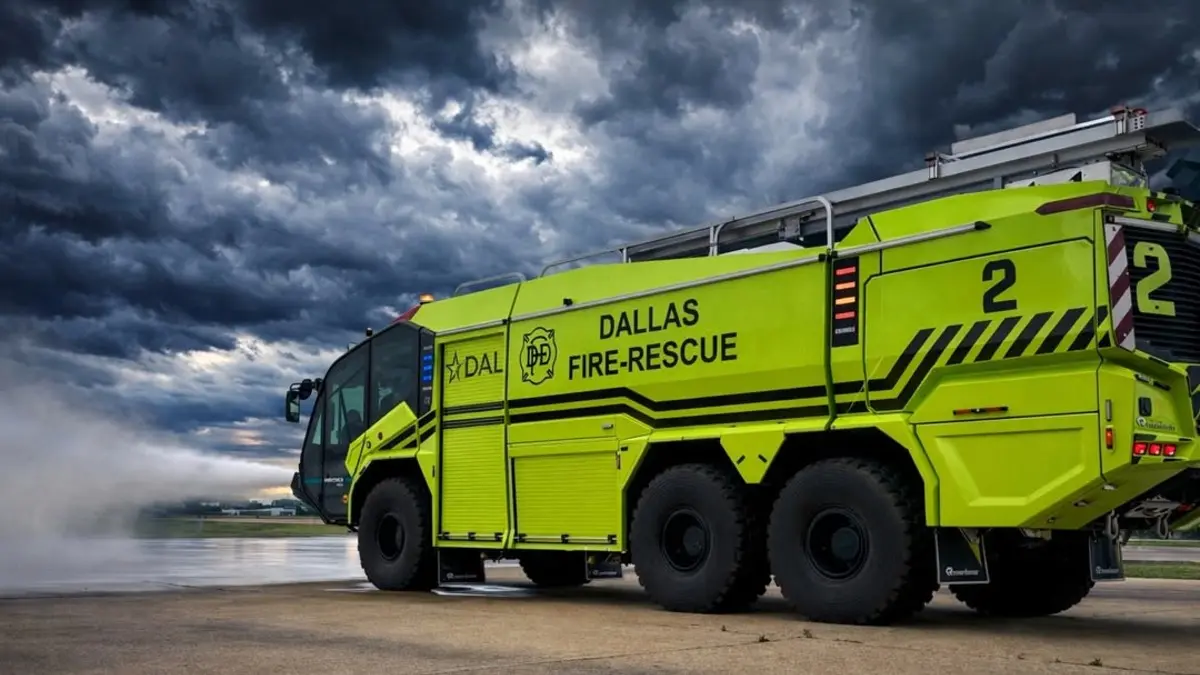
DALLAS — In a milestone moment for both aviation safety and municipal fleet electrification, Dallas Love Field Airport has officially integrated what is hailed as the world’s first electric aircraft rescue and firefighting (ARFF) vehicle into its active infrastructure. Powered by a newly installed 400 kW ultra-fast charging system, this heavy-duty technological marvel represents a paradigm shift in how high-stakes emergency services operate at some of the busiest transportation hubs in the United States.
The deployment of the vehicle marks the culmination of rigorous collaborative efforts between Dallas Fire-Rescue, global emergency vehicle manufacturer Rosenbauer, and EV charging infrastructure provider XCharge North America. Stationed at the newly minted, state-of-the-art Fire Station 21, the vehicle is currently undergoing an exhaustive real-world testing period designed to prove that heavy battery-electric commercial equipment can match—and frequently surpass—the performance of its diesel-guzzling predecessors under the most demanding conditions imaginable.
Main Facts: The Technology Driving Dallas Love Field’s Newest Guardian
At the heart of this deployment is the imposing Rosenbauer PANTHER 6×6 electric ARFF vehicle, a 91,000-pound titan designed to respond instantly to aviation emergencies. Far from being a mere symbolic nod to sustainability, the electric PANTHER boasts raw performance metrics that outclass traditional diesel-powered emergency trucks across nearly every critical operational category:
- Rapid Acceleration: The 91,000-pound vehicle can surge from 0 to 50 mph in under 25 seconds using standard electric power, a figure that drops to an astonishing under 20 seconds when engaged in "Boost Mode." For comparison, the airport’s legacy diesel-powered equivalent requires 28 seconds to reach the same velocity—a vital difference when seconds literally save lives during a runway incident.
- Superior Fire Suppression Range: The electric PANTHER can discharge water or firefighting foam up to 250 feet, representing a massive 40% increase over the 190-foot reach of conventional diesel trucks. This extended range allows fire crews to safely attack blazes from a greater distance.
- Unmatched Pumping Capacity: Equipped with an electric water pump capable of shifting up to 2,370 gallons per minute, the vehicle delivers water and foam with relentless pressure.
- Acoustic Advantages: During emergency responses, the electric motors reduce vehicle noise by approximately 50%. This dramatic reduction in ambient noise vastly improves internal crew communication, reducing errors during high-stress maneuvers.
- High-Powered Infrastructure: To keep the PANTHER primed for action, XCharge North America supplied its cutting-edge C7AM liquid-cooled 400 kW fast charger, installed directly at the newly opened Station 21.
Chronology: From Concept to Runway Reality
The journey of the electric PANTHER from a manufacturer’s blueprint to active duty at one of America’s premier medium-hub airports unfolded through a carefully coordinated timeline of development, testing, and infrastructure modernization.

The Partnership and Prototype Phase
Long before the vehicle touched down in Texas, Rosenbauer sought a forward-thinking municipal fire department willing to subject its revolutionary electric ARFF concept to rigorous, real-world operational testing. Dallas Fire-Rescue stepped forward to accept the challenge, provided that the supporting charging infrastructure could meet the uncompromising readiness standards required of an emergency-response agency.
The April Unveiling
In April, the Rosenbauer PANTHER 6×6 made its high-profile public debut at Dallas Love Field Airport. The unveiling signaled the beginning of a strict six-month evaluation window. During this phase, the vehicle has been subjected to everyday routines, specialized crew training exercises, and rigorous benchmarking comparisons against legacy diesel trucks in the airport’s existing fleet.
Station 21 Grand Opening
The finalization of this deployment phase arrived with the official opening of the brand-new, 33,400-square-foot Station 21 and Airport Operations building. Replacing an outdated fire station originally constructed in the 1960s—whose legacy location inadvertently added precious seconds to emergency response times—the new facility unifies Dallas Fire-Rescue and airport operations teams under a single, modern roof. It is here that the XCharge North America 400 kW liquid-cooled fast charger was successfully installed and brought online, ensuring the PANTHER and other emerging municipal EVs remain perpetually charged and ready for deployment.
Supporting Data: Operational Capacity and Airport Demographics
To truly understand the weight of this initiative, one must examine the scale of Dallas Love Field operations and the engineering behind the PANTHER’s power architecture.
Dallas Love Field is not a quiet regional airstrip; it is the busiest medium-hub airport in the United States. Annually, the facility handles nearly 18 million passengers and processes over 250,000 aircraft operations. This immense volume means the margin for error is razor-thin, and any emergency response vehicle stationed here must exhibit unwavering reliability.
Rosenbauer engineered the PANTHER’s onboard battery system to handle the realities of airport emergency cycles without flinching. The vehicle’s battery capacity is calibrated to cover the immediate drive to an emergency scene anywhere on the airfield, discharge the truck’s entire supply of firefighting agent to combat the fire, and still retain enough charge to safely return to the station. According to Rosenbauer, the electric drivetrain and battery configuration are robust enough to handle over 90% of the station’s daily operational routines and routine training exercises entirely on zero-emission electric power.
Furthermore, the XCharge C7AM charger acts as a flexible utility hub. Beyond keeping the massive fire truck ready, the liquid-cooled charger is engineered to support additional electric vehicles as Dallas Love Field systematically transitions more of its ground support and municipal fleets toward complete electrification.
Official Responses: Leadership Perspectives on Innovation and Safety
Municipal and corporate leaders have heralded the project as a monumental step forward for both environmental stewardship and urban emergency preparedness.

Dallas Fire Chief Justin Ball emphasized the uncompromising focus on safety that guided the project from its inception. In a statement regarding the integration of the new infrastructure, Chief Ball noted that the advanced XCharge system “ensures we are prepared to respond quickly and safely when duty calls.” By refusing to compromise on operational speed or pumping power, Dallas Fire-Rescue has demonstrated that green technology can successfully replace fossil fuels even in the most demanding, mission-critical safety applications.
Rosenbauer’s collaboration with the department has similarly yielded invaluable data. Feedback collected from Dallas firefighters throughout the six-month testing period is being fed directly back to the manufacturer’s engineering teams, allowing them to refine the vehicle’s software, ergonomics, and thermal management systems before the model enters widespread commercial fleet service globally.
Implications: A New Era for Municipal Fleets and Airport Resilience
The successful integration of the electric PANTHER and its 400 kW charging ecosystem at Dallas Love Field carries profound implications for the broader aviation and emergency services industries.
Proving Ground for Emergency EVs
For years, skeptics have argued that heavy-duty commercial, military, and emergency vehicles are unsuited for electrification due to weight penalties, range anxiety, and the need for instantaneous, high-torque power output under extreme environmental stress. By putting a 91,000-pound firefighting vehicle through its paces at a major commercial airport—handling real traffic patterns, live training, and simulated disasters—Dallas Love Field is providing the empirical proof needed to dispel these doubts. If an electric ARFF vehicle can safely and reliably protect an airport handling 18 million annual passengers, heavy electrification becomes viable for municipal fleets across the globe.

Urban Planning and Response Optimization
The construction of the new Station 21 highlights how the transition to electric vehicles often sparks broader, positive infrastructure updates. By moving away from a 1960s-era facility and centralizing operations in a modern, purpose-built structure equipped with high-capacity grid connections, Dallas has optimized its entire emergency response posture. The reduction in response times achieved by the new location, combined with the faster acceleration and improved communication of the quieter electric truck, creates a multiplier effect for airport safety.
Paving the Way for Broader Electrification
As airports face increasing pressure to meet corporate and municipal net-zero carbon goals, ground operations represent one of the last major hurdles. While passenger terminals and commercial aircraft decarbonization face long-term technological hurdles, municipal service vehicles, baggage tractors, and emergency trucks are ripe for immediate transformation. The XCharge C7AM installation at Dallas Love Field serves as a scalable template for how airports can build out heavy-duty charging corridors capable of sustaining high-demand utility vehicles without straining local power grids.
Ultimately, the partnership between Dallas Fire-Rescue, Rosenbauer, and XCharge North America proves that the future of emergency response is not only electric—it is faster, safer, quieter, and more efficient than ever before. As the six-month pilot program concludes and the electric PANTHER transitions into permanent, frontline service, Dallas Love Field stands proudly at the vanguard of a cleaner, high-performance aviation era.
