

By Tyler Graham
The landscape of the sub-$1,000 laptop market has undergone a dramatic transformation over the past year. When Apple disrupted the entry-level computing tier in March with the release of its budget-focused MacBook Neo, it immediately redefined consumer expectations. Powered by the iPhone’s formidable A18 Pro chip, the Neo debuted at an aggressive $599—dropping even lower when factoring in education discounts. It was widely hailed as an unbeatable value proposition for students and casual users alike.
However, the technology sector operates in a state of constant flux. In the months following the Neo’s launch, broader macroeconomic pressures, volatile component supply chains, and the cascading effects of what industry analysts call "RAMageddon"—the artificial intelligence boom’s strain on memory chip production—pushed prices upward. Apple’s budget offering has since crept closer to the $700 threshold.
While the MacBook Neo remains a compelling device, this price inflation has effectively cracked open the door for traditional PC manufacturers to mount a serious challenge. Dell has already fired its opening salvo with the refreshed XPS 13, Lenovo is gearing up to release the design-forward IdeaPad Vibe, and now, HP is officially entering the ring.
HP has announced its new $700 OmniBook 5 14 AI PC, positioning it as a heavyweight contender in the affordability championship. Alongside the OmniBook 5, HP also pulled back the curtain on a sleek new business companion: the ProBook 4 G2iS 14 AI PC.
The Main Facts: HP’s Newest Additions
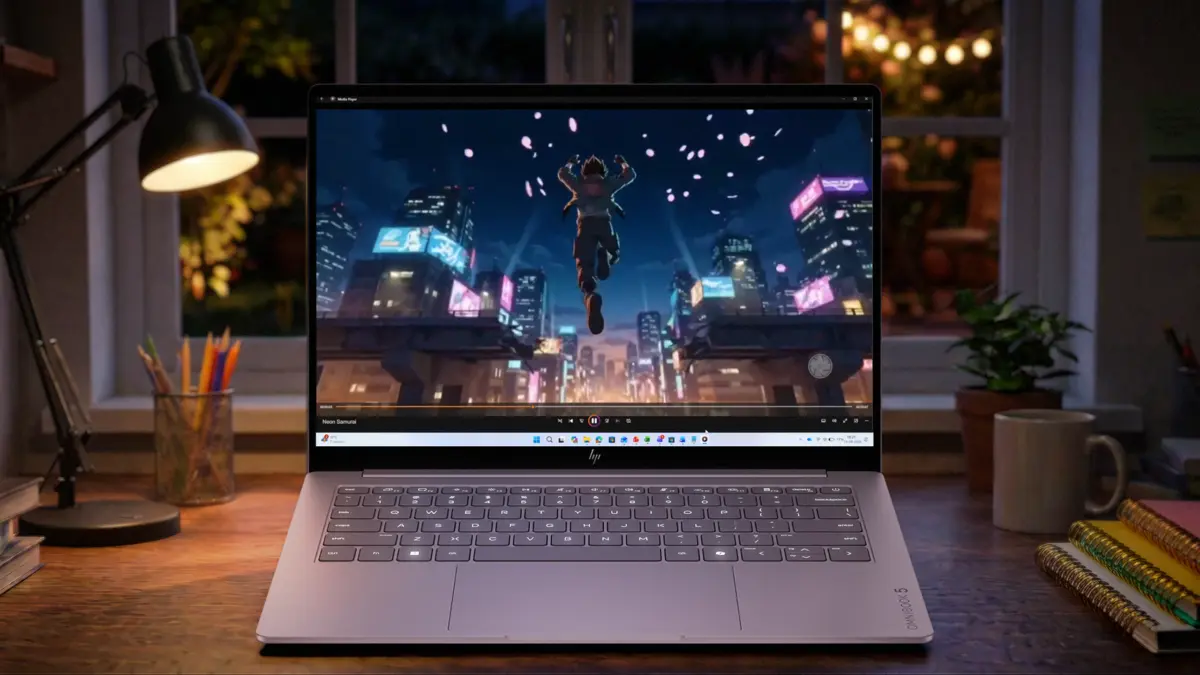
The centerpiece of HP’s latest hardware drop is undoubtedly the OmniBook 5 14 AI PC. Designed squarely to compete with Apple’s budget dominance and Lenovo’s upcoming offerings, the OmniBook 5 brings several high-end specifications down to a more accessible price point, though it comes with predictable compromises in its base configuration.

HP OmniBook 5 14 AI PC Specifications & Highlights:
- Starting Price: $700 (available in October via HP.com and Best Buy).
- Display: 14-inch 2K (1,920 x 1,200) OLED display, featuring 300 nits of max brightness (upgradeable to a 2.5K touchscreen).
- Processor (Base): Intel Core 5 315 (configurable up to Intel Core 7 350).
- Memory & Storage (Base): 8GB RAM and 256GB SSD (configurable up to 16GB RAM and 1TB SSD).
- Battery Life: Up to an astonishing 42 hours on local video playback tests.
- Design & Aesthetics: Aluminum chassis available in muted silver, blue, pink, and green pastel hues.
- Ports: Dual USB-C ports (lacking Thunderbolt 4 support) and zero USB-A connections.
Operating parallel to the consumer-focused OmniBook 5 is the HP ProBook 4 G2iS 14 AI PC, aimed squarely at enterprise users, remote professionals, and hybrid workers looking for a sleek, highly portable workstation.
HP ProBook 4 G2iS 14 AI PC Specifications & Highlights:
- Availability: Launching in October via HP.com and Best Buy (pricing yet to be announced).
- Build: Less than half an inch thick, weighing a meager 2.59 pounds.
- Display: 14-inch 3K (2,880 x 1,800) OLED display with up to 500 nits of brightness (non-touch).
- Internals: Intel Core 5 or 7 Wildcat Lake processors, up to 32GB RAM, and a 1TB SSD.
- NPU Performance: 17 TOPS (Trillions of Operations Per Second).
- Port Selection: Comprehensive array including two USB-A ports, two USB-C ports, and an audio combo jack.
Chronology of the Budget PC Shift
To understand why HP’s announcement matters right now, it is necessary to trace the timeline of recent developments in the laptop market:
- Early March: Apple releases the MacBook Neo at a base price of $599, leveraging mobile architecture (the A18 Pro chip) to drastically reduce manufacturing costs. It becomes the gold standard for budget computing overnight.
- Spring to Summer: Global supply chain constraints driven by AI infrastructure demands trigger "RAMageddon," steadily inflating component costs across the board. The MacBook Neo’s real-world market price drifts upward toward $700.
- Mid-2026: Competitors sense vulnerability. Dell refreshes its premier XPS 13 lineup, while Lenovo previews the IdeaPad Vibe, a machine heavily inspired by Apple’s pastel-tinted aesthetic.
- Late 2026: HP officially announces the OmniBook 5 14 AI PC and ProBook 4 G2iS, directly targeting the $700 price point and establishing a clear timeline for an October release through major retailers like Best Buy and HP’s direct storefront.
Supporting Data: Display, Battery, and Performance Analysis
When evaluating laptops in the $700 tier, consumers are conditioned to expect major compromises. HP has made calculated decisions regarding where to spend its manufacturing budget—and where to cut corners.
The Display Dilemma: Punching Above Its Weight Class
The most striking feature of the OmniBook 5 is its 14-inch 2K OLED display. At a starting price of $700, finding an OLED panel is rare; typically, budget laptops rely on washed-out, entry-level IPS LCD panels to keep costs down.
Measuring 14 inches, the OmniBook 5’s screen offers more real estate than Apple’s 13-inch MacBook Neo and even edges out the 13.6-inch MacBook Air. Furthermore, HP offers an upgrade path to a 2.5K OLED touchscreen for users willing to stretch their budget slightly.
However, specifications tell only part of the story. The display’s maximum brightness is capped at 300 nits. While perfectly adequate for indoor office spaces, classrooms, and dimly lit rooms, users attempting to work outside on a bright, sunny day will likely struggle with visibility.

Battery Life: Claiming Unprecedented Longevity
Battery life has historically been a major battleground for ultraportable laptops. Apple Silicon set a formidable benchmark for energy efficiency, making all-day computing the baseline expectation.
HP’s internal testing claims the OmniBook 5 can achieve up to 42 hours of local video playback on a single charge. While standardized laboratory testing using local video playback rarely translates 1:1 to real-world web browsing and active multi-tasking (such as CNET’s rigorous online streaming battery tests), the figure is nonetheless staggering. For context, the MacBook Neo clocked in at roughly 13 hours in standard testing, while HP’s own previous titleholder, the OmniBook 3 16, topped out eight hours lower than the new projection. If even half of HP’s estimated battery life translates to daily use, the OmniBook 5 will be a formidable travel companion.
Internal Specifications and the Windows Tax
This is where the OmniBook 5 faces its steepest uphill battle. The base model ships with an Intel Core 5 315 processor, paired with a meager 8GB of RAM and a 256GB solid-state drive.
In the modern era of computing, 8GB of RAM and 256GB of storage are the absolute bare minimum for functionality—and they tend to run out of headroom quickly. Crucially, macOS handles tight hardware constraints with extreme efficiency, meaning an 8GB Apple machine can often feel surprisingly snappy. Windows, conversely, is a much heavier operating system that demands more overhead. Running Windows 11 on 8GB of RAM will inevitably lead to performance bottlenecks under heavy multi-tasking.
While buyers can configure the OmniBook 5 with up to an Intel Core 7 350, 16GB of RAM, and a 1TB SSD, doing so pushes the price well past the initial $700 hook. At that point, industry analysts suggest consumers might be better served by jumping straight into a true midrange laptop.
Connectivity Limitations
To hit the $700 price point, HP also made compromises on input/output ports. The OmniBook 5 features dual USB-C ports that fall short of the robust Thunderbolt 4 standard. Worse for legacy peripheral users, traditional USB-A ports are completely absent. Buyers will need to invest in a USB-C hub or adapter dongle just to connect standard flash drives, mice, or wired keyboards.

Official Responses and Industry Context
HP’s marketing strategy for the OmniBook 5 is remarkably transparent. Rather than attempting to disguise its inspirations, the company leaned fully into the design language that made Apple’s budget machine so popular. The aluminum chassis of the OmniBook 5 will be offered in muted silver, blue, pink, and green—pastel hues that mirror the MacBook Neo’s visual identity.
Meanwhile, the introduction of the ProBook 4 G2iS highlights HP’s ongoing commitment to the enterprise sector, providing a featherlight profile (2.59 pounds, under half an inch thick) for business travelers.
However, tech analysts have raised eyebrows regarding the ProBook 4 G2iS’s neural processing unit (NPU) capabilities. Equipped with Intel Wildcat Lake processors, the ProBook 4 G2iS delivers a modest 17 TOPS (Trillions of Operations Per Second) for local AI tasks. This figure places it well below Microsoft’s minimum threshold of 45 TOPS required for its Copilot Plus PC platform. By comparison, Intel’s newer Panther Lake series hits 49 TOPS, while Qualcomm’s Snapdragon X2 series reaches a towering 809 TOPS. For business buyers looking to future-proof their hardware for heavy, on-device artificial intelligence workflows, the ProBook 4 G2iS may feel slightly dated out of the gate—though its traditional processing muscle, stellar 500-nit 3K OLED screen, and generous port selection (including dual USB-A and USB-C ports) will heavily appeal to corporate deployment managers.
Implications for Consumers and the Market
The arrival of the HP OmniBook 5 14 AI PC and the ProBook 4 G2iS signals a maturation in the post-"RAMageddon" laptop market. As component prices stabilize and manufacturers find clever ways to balance premium features—such as OLED displays and striking color palettes—with budget constraints, consumers are the ultimate beneficiaries.
For shoppers looking to spend around $700, the choice is no longer a simple binary between a used machine or a sluggish, plastic-bodied bargain laptop. Buyers now have legitimate choices:
- Apple MacBook Neo: Best for students and users embedded in the Apple ecosystem who prioritize macOS efficiency and battery optimization.
- Lenovo IdeaPad Vibe: A stylish alternative for those tracking lifestyle-oriented aesthetics.
- HP OmniBook 5: Ideal for media consumers who prioritize a gorgeous 14-inch OLED screen and long-haul battery life, provided they can live with 8GB of RAM or are willing to pay extra for an upgraded configuration.
As these machines roll out to HP’s website and Best Buy this October, the budget laptop wars will officially enter their next phase—proving that affordability no longer has to mean sacrificing every luxury a modern computer has to offer.
