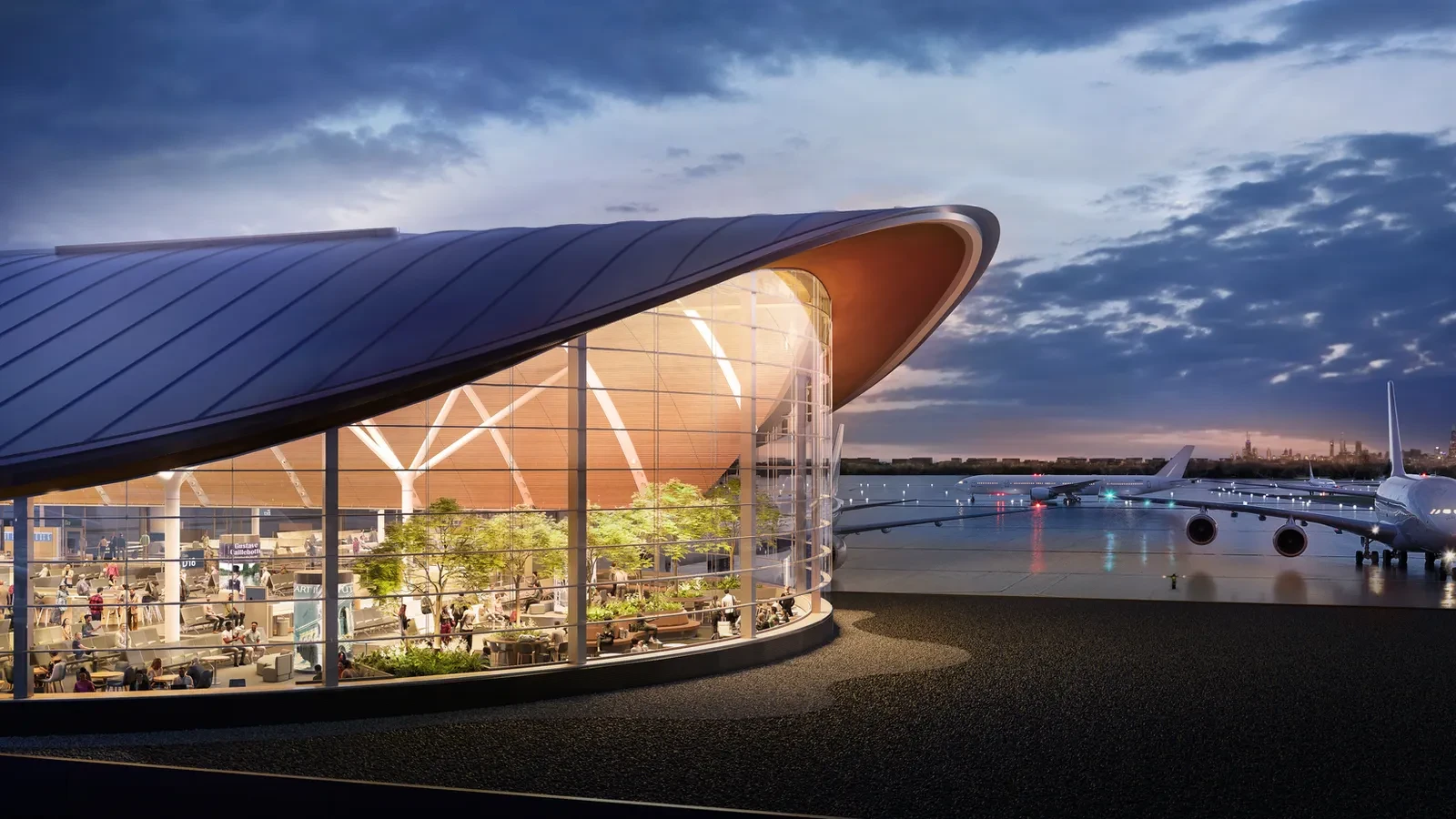
Chicago’s O’Hare International Airport—consistently ranked among the busiest aviation hubs on earth by total takeoffs and landings—is undergoing a historic metamorphosis. At the center of this monumental evolution is ORD Next, an approximately $8.8 billion capital infrastructure program designed to fundamentally modernize, expand, and future-proof the airport for decades to come.
The project is an engineering and logistical marvel. It calls for the addition of two brand-new concourses and the doubling of the physical size of a newly minted terminal. These upgrades are not merely cosmetic; they are vital to streamlining passenger traffic, reducing taxi delays, accommodating next-generation aircraft, and elevating the overall traveler experience at one of the premier international gateways in the United States.
However, executing an $8.8 billion capital overhaul in the middle of a hyper-active, 24/7 airfield presents an unprecedented logistical hurdle. Construction crews must perform major heavy civil engineering and vertical construction while ensuring that millions of passengers, hundreds of daily flights, and critical air traffic control operations experience zero interruptions.
Directing this massive undertaking is Zach Baughman, chief development officer and managing deputy commissioner for the Chicago Department of Aviation (CDA). Uniquely, Baughman is an attorney by trade rather than a traditional contractor or structural engineer. This unconventional background has provided him with a fresh vantage point on project management, challenging industry norms and demonstrating how cross-disciplinary leadership can drive massive public-works projects to success.
Chronology: Years of Planning for a Momentous Build
While vertical construction on landmark elements like the new Concourse D officially broke ground roughly a year ago, the timeline of ORD Next extends far deeper into the past. The success of the current phase is a direct result of meticulous, multi-year sequencing that began long before the first shovel ever touched the earth.
2018–2023: The Unseen Enabling Works
Before crews could even contemplate building new terminal structures or concourses, the CDA had to solve complex spatial puzzles across O’Hare’s sprawling footprint.
Taxiway Relocations: Years were spent shifting and rerouting taxiways to establish guaranteed, permanent traffic corridors for commercial airlines to navigate around upcoming construction zones.
The Underground Infrastructure Phase: One of the most critical engineering feats involved replacing a central stormwater management system without ever shutting down the airfield. The project team had to fill in a massive central detention basin (holding 600,000 cubic yards of stormwater) to make room for future taxiway pavement.
The Under-Airfield Tunneling Operation
To relocate the stormwater capacity safely, the CDA expanded the airport’s south detention basin by an equivalent 600,000 cubic yards. Connecting the two areas required digging a 1.5-mile-long, 14.5-foot-diameter tunnel directly underneath an active airfield. This subterranean project was completed while aircraft continued to land, taxi, and take off above the crews—a testament to the rigorous planning and coordination behind ORD Next.
Summer 2025 and Beyond: Interim Solutions
As vertical construction on Concourse D rose higher, engineers realized the building’s height would soon obstruct line-of-sight views from the Federal Aviation Administration (FAA) air traffic control towers to existing taxiways. Addressing this proactively, the CDA collaborated with airlines to fund and construct two interim taxiways, designated Tango and Romeo, just west of the active construction zone. Operationalized in the summer, these temporary paths ensure continuous aircraft flow as the permanent architecture takes shape.
Supporting Data: The Numbers Behind ORD Next
To truly understand the scale of the O’Hare modernization effort, the statistics speak for themselves:
Total Program Budget: Approximately $8.8 billion dedicated to capital improvements, terminal expansion, and airfield optimization.
Concourse D Footprint: Encompasses an 88-acre active construction site sitting directly in the middle of the airfield.
Stormwater Engineering: Involves the relocation of 600,000 cubic yards of water retention capacity.
Subterranean Engineering: Features a 1.5-mile stormwater drainage tunnel with a 14.5-foot diameter, bored directly beneath active taxiways and runways.
Global Ranking: O’Hare consistently competes for the title of the world’s busiest airport by aircraft movements, making every square foot of active pavement critical to the global aviation network.
Official Responses: Insights from CDA Leadership
In an exclusive interview, Zach Baughman shared his philosophy on leadership, construction management, and the realities of running a multi-billion-dollar infrastructure program without a traditional engineering background.
The Advantage of a Non-Traditional Perspective
When asked how his legal background influences his oversight of ORD Next, Baughman noted that it serves as a distinct advantage rather than a handicap.
"If my team, or if one of our contractors, can’t explain why we’re doing something to someone without a construction background, then they probably don’t understand it sufficiently enough themselves," Baughman explained. "They need to be able to translate everything to a non-construction person, and it has to make sense. It gives me the opportunity to challenge them."
Baughman emphasizes that removing ego from the equation allows him to question fundamental engineering and design decisions freely. By stripping away industry jargon, he ensures that every strategy is logically sound, transparent, and defensible to public stakeholders.
Cultivating Healthy Disagreement
Rather than enforcing top-down compliance, Baughman actively fosters a culture of debate among engineers, contractors, and city officials.
"I certainly encourage healthy disagreement within the team… I value having many different opinions to weigh before we make decisions," he said. "I actively encourage, in meetings and discussions, ‘Someone tell me the opposite of this. Someone disagree with this point. Why would this be untrue? What else should we be thinking through?’ I think that’s helpful in ultimately reaching consensus within a large group."
Navigating Multi-Agency Coordination
Balancing heavy construction with ongoing aviation operations requires daily, high-level synchronization with external stakeholders. Baughman credits the project’s smooth execution to deep partnerships with major commercial airlines, the Transportation Security Administration (TSA), and the FAA.
Whether adjusting security checkpoint lanes or safeguarding FAA pavement lines-of-sight, the CDA has institutionalized a collaborative protocol where every logistical shift is anticipated years in advance.
Implications: What ORD Next Means for Aviation and Construction
The lessons learned from the ORD Next initiative extend far beyond the borders of Chicago. As megaprojects become increasingly common in dense urban and operational environments, the O’Hare modernization blueprint offers several critical takeaways for the global construction and aviation sectors.
1. The Paramount Importance of Communication
Reflecting on his tenure, Baughman highlighted a surprising realization: technical execution alone does not guarantee a project’s success.
"What makes or breaks the project is how well we’ve translated to our stakeholders what the impacts are going to be, how prepared they are to manage through those impacts, to have contingency plans when things go wrong," Baughman stated.
For large-scale infrastructure, breaking out of professional silos is mandatory. Contractors, aviation workers, and government officials must ensure that the surrounding community and the flying public understand why construction is happening, what inconveniences to expect, and why the long-term benefits outweigh short-term growing pains.
2. Setting a New Standard for Airfield Engineering
The ability to build an 88-acre construction site, dig a mile-and-a-half-long drainage tunnel under active runways, and construct interim taxiways without losing a single foot of FAA pavement sets a new global benchmark. It proves that major hub airports do not need to shut down operations or compromise passenger capacity to undergo radical transformation.
3. Future-Proofing American Infrastructure
As air travel demand continues to scale upward globally, outdated terminal infrastructure remains a major bottleneck. ORD Next demonstrates how forward-thinking capital planning—backed by federal funds, local vision, and multi-agency cooperation—can successfully overhaul critical transit nodes. When completed, O’Hare will not only cement Chicago’s status as the heart of American aviation logistics, but it will also provide a shining template for how modern, complex megaprojects should be led, sequenced, and delivered.