

Main Facts
The landscape of corporate sustainability is undergoing a quiet, high-efficiency revolution, led not by sprawling solar farms on cleared acreage, but by the very roofs sheltering industrial innovation. A prime example of this industrial transformation is unfolding in Mendota, Illinois, where a collaborative effort between Kingspan Insulation North America, Dynamic Energy, and REC Solar has brought a state-of-the-art renewable energy system to life.
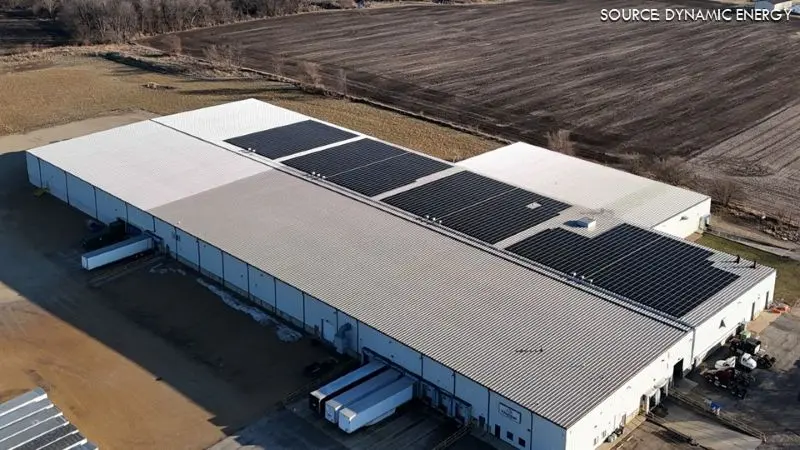
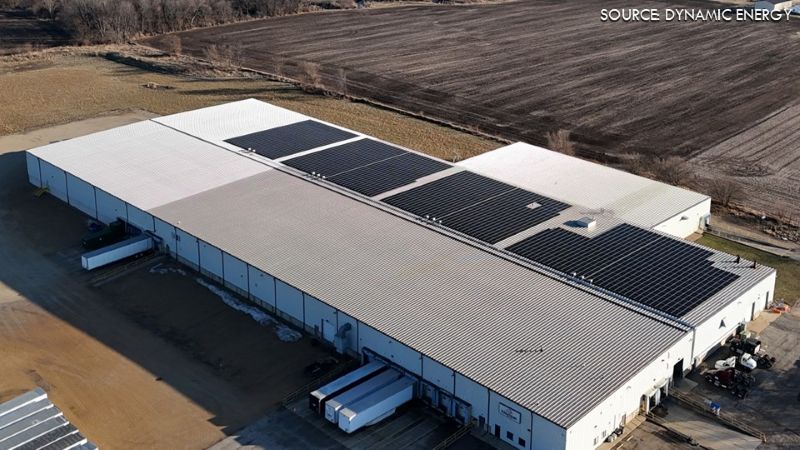
The centerpiece of this project is a robust, 881-kilowatt (kW) photovoltaic (PV) solar system spanning approximately 50,000 square feet of an existing standing seam metal roof at Kingspan’s premier manufacturing facility. Rather than utilizing traditional heavy ballasted systems or penetrating the building’s envelope, the installation relies on advanced, pressure-torqued seam clamps. These attach directly to the metal roof’s ribs, completely eliminating the risk of water leaks while securing the array against severe weather.
Financed, owned, and operated by REC Solar under a 25-year power purchase agreement (PPA), the installation is projected to generate roughly 1 million kilowatt-hours (kWh) of clean electricity annually. This output will offset approximately 700 metric tons of carbon dioxide ($CO_2$) emissions each year, marking a massive stride forward in Kingspan’s corporate sustainability roadmap. Dynamic Energy served as the engineering, procurement, and construction (EPC) firm, guiding the complex project from initial grid interconnection studies through to final commissioning.
Chronology of the Mendota Solar Project
The realization of the Mendota solar array was not an overnight endeavor; it required meticulous phasing, rigorous structural engineering, and seamless logistical execution.
Phase 1: Strategic Alignment and Feasibility Assessment
The project was greenlit as part of Kingspan’s broader "Planet Passionate" corporate sustainability initiative. Following the successful completion of a similar rooftop solar project at Kingspan’s manufacturing plant in Winchester, Virginia, the Mendota site was identified as the next logical candidate.
During the early development phase, Dynamic Energy deployed structural engineers to evaluate the facility’s standing seam metal roof. The primary goal was to verify whether the aging and load capacities of the roof could safely support the additional weight of the PV array. Engineers utilized specialized pull-test data from the proposed seam clamps to map out a structural design capable of withstanding local wind uplift, thermal expansion, and heavy seasonal snow loads. Simultaneously, the project team evaluated the local electric utility’s grid capacity—known as hosting capacity—to ensure the surrounding infrastructure could handle the influx of distributed solar generation.
Phase 2: Engineering, Permitting, and Design
Once baseline feasibility was confirmed, a site-specific design was engineered to comply with strict local and national codes, including guidelines established by the National Fire Protection Association (NFPA). This meant carving out precise perimeter setbacks, equipment clearances, and inter-row walkways to guarantee safe, unhindered roof access for local emergency responders.
To protect Kingspan’s existing building warranty, a formal waiver was filed with the roof warrantor. Independent, certified roofing specialists conducted thorough pre-installation inspections to document baseline conditions.
Phase 3: Construction and Interconnection
Construction kicked off with material staging on the ground. Because the work took place over an active manufacturing facility, minimizing disruption to daily operations was paramount. Heavy equipment, including cranes and telehandlers, hoisted pallets of solar modules onto the roof in tightly coordinated windows.
Installers then secured the modules using pressure-clamped mounting systems bolted directly to the standing seam ribs. The final critical phase involved a brief, carefully scheduled electrical outage during off-hours—typically over a weekend—to safely tie the new system into the facility’s internal electrical grid without halting weekday production schedules.
Supporting Data and Technical Specifications
The success of industrial rooftop solar relies heavily on technical synergies between building materials and photovoltaic technology. The Mendota facility capitalized on several distinct engineering advantages:
- System Capacity: 881 kW DC.
- Roof Coverage: Approximately 50,000 square feet of standing seam metal roofing.
- Annual Energy Generation: ~1,000,000 kWh of clean electricity.
- Carbon Offset: ~700 metric tons of $CO_2$ equivalents per year.
- Financial Framework: 25-year Power Purchase Agreement (PPA) owned and operated by REC Solar.
- Mounting Technology: Non-penetrating seam clamps torqued to specific inch-pound thresholds to match local wind uplift standards.
- Spatial Efficiency: The flush-mounted profile on the standing seam roof allowed for tighter inter-row module spacing, yielding a higher power density ($kW/sq. ft.$) compared to standard ballasted flat-roof membrane systems.
Furthermore, the project capitalized on external financial tailwinds, leveraging lucrative state-level incentives in Illinois alongside federal tax credits to optimize the overall return on investment.
Official Responses and Stakeholder Perspectives
The collaborative nature of the Mendota installation was frequently highlighted by project leaders as the secret behind its seamless execution.
Christopher Davis, Kingspan Insulation’s Director of Strategic Projects and Continuous Improvement, emphasized the strategic alignment driving the initiative:
"Rooftop solar was the right fit for the Mendota facility because it allowed us to leverage existing, unused roof space to generate clean energy onsite, reduce reliance on grid power, and immediately advance our sustainability and cost-management goals without impacting operations or requiring additional land use."
Reflecting on the engineering and execution side, Neal Brewster, Director of Project Delivery at Dynamic Energy, pointed out the unique benefits of the Mendota roof structure:
"Mendota has a large, unobstructed roof area in an electric utility zone with favorable renewable energy incentives and regulations… The Mendota project was a typical rooftop installation as it relates to standing seam roof installs, although it also benefited from being a large single elevation roof that is rectangular-shaped with minimal obstructions."
Brewster also addressed the technical safeguards taken during construction:
"This is a tried and true, tested solution to minimize the risk of water leakage during both installation and for the life of the system… Doing a feasibility assessment with a structural engineer is always an important first step to verify the site is a suitable candidate for solar."
Robb Jetty, CEO of REC Solar, elaborated on the long-term mechanics of the partnership from an independent power producer’s (IPP) perspective:
"REC Solar worked closely with Dynamic to help ensure the system is set up for long-term success and is well-positioned to deliver reliable performance over its life. In this role, we bring the perspective of a long-term owner and operator, with a focus on performance, reliability, and operational efficiency over time."
Implications for Corporate Sustainability and the Metal Construction Industry
The completion of the Mendota solar array carries significant broader implications, both for Kingspan’s corporate trajectory and the wider industrial construction sector.
Advancing Corporate Decarbonization Goals
For Kingspan Insulation, Mendota marks the third major North American solar installation, following successful deployments in DeLand, Florida, and Winchester, Virginia. These projects are crucial stepping stones toward the company’s aggressive "Planet Passionate" targets, which mandate installing solar PV systems on all wholly owned manufacturing facilities and achieving a 60% direct reliance on renewable energy by the year 2030. By actively converting dormant roof surfaces into clean energy generators, Kingspan is aggressively tackling its Scope 1 and Scope 2 emissions without sacrificing manufacturing output or industrial footprint.
The Superiority of Standing Seam Metal Roofs for Solar
From a construction and architectural standpoint, the Mendota project underscores why standing seam metal roofs are rapidly becoming the gold standard for commercial and industrial (C&I) solar applications. Unlike single-ply membrane roofs—which often require heavy concrete ballast blocks that add massive dead loads to the building structure, or mechanical penetrations that increase long-term leak risks—standing seam roofs offer an ideal substrate.
By utilizing non-penetrating seam clamps, building owners preserve their roof’s structural integrity and weather-tightness. Additionally, the flush-mounted nature of these installations minimizes wind drag and allows for tighter panel configurations, maximizing electrical generation per square foot. As Brewster noted, provided a roof is less than 10 years old and structurally sound, pairing a standing seam metal roof with a commercial solar array represents one of the most reliable, tested practices in the modern construction industry.
The Power Purchase Agreement (PPA) Model as a Catalyst
The financial structuring of the Mendota project via REC Solar’s 25-year PPA illustrates a growing trend in corporate clean energy adoption. By eliminating the upfront capital expenditure hurdle for the facility owner, third-party ownership models allow manufacturing companies to focus on their core competencies—making insulation products—while letting energy experts handle the financing, engineering, operation, and maintenance of the power plant overhead.
As federal and state incentives continue to evolve, projects like the Mendota solar installation serve as a blueprint for how manufacturers can seamlessly blend heavy industrial activity with aggressive environmental stewardship—proving that green energy and heavy manufacturing can not only coexist, but thrive together under one roof.
