

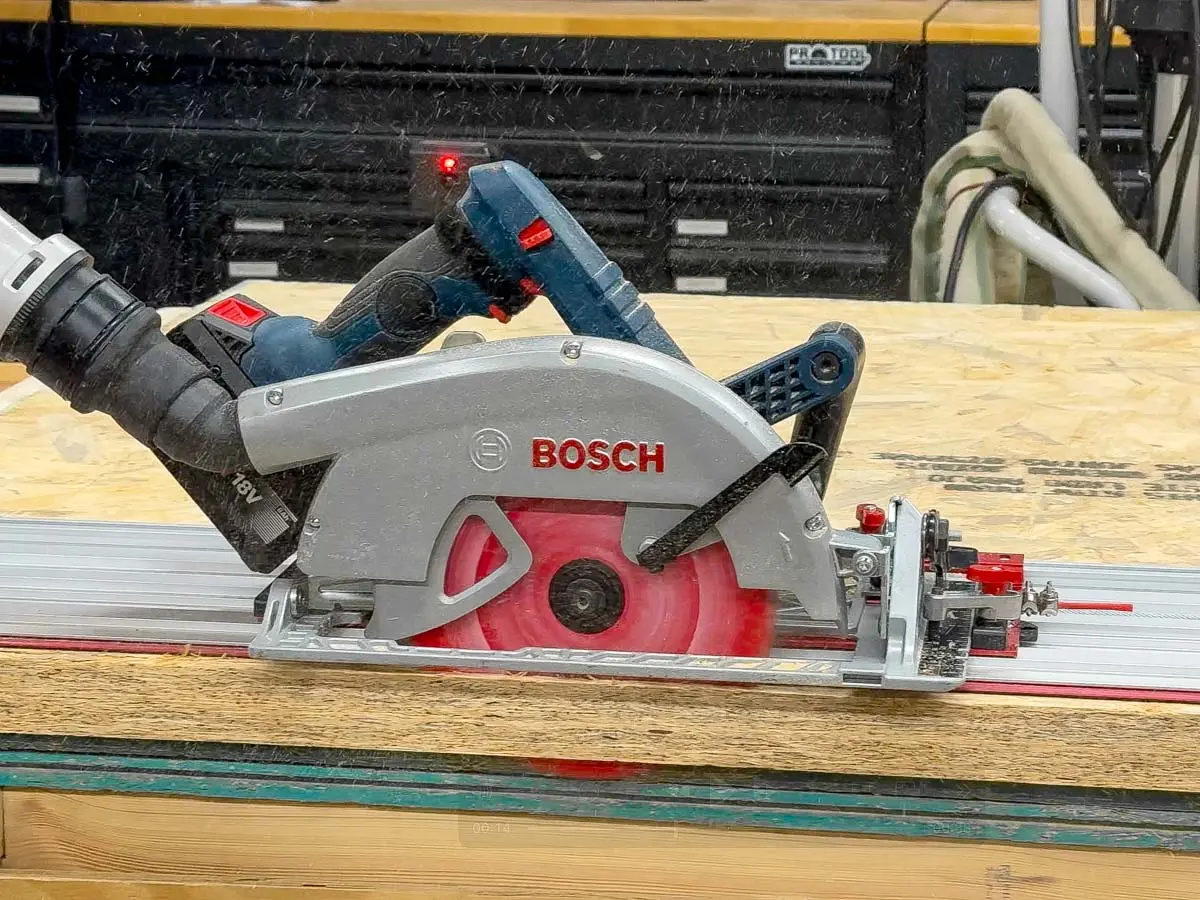
When professionals evaluate a circular saw, the metric of raw speed is often the first thing that comes to mind. How quickly can a blade rip through a dense piece of framing lumber? How effortlessly does it clear knots? But in the high-stakes environment of a modern jobsite, speed tells only part of the story.
User experience, ergonomics, sightlines, dust management, and behavior during complex, compound applications dictate how a tool performs over an eight-hour shift. To see how Bosch’s flagship cordless offering stacks up against the heavy hitters of the industry, our testing team put the Bosch GKS18V-25N 18V ProFactor 7 1/4-inch Circular Saw through a grueling series of hands-on tests. We pitted it directly against 11 other flagship saws from top-tier brands, measuring every aspect of its cutting performance and usability.
So, how did Bosch’s premier cordless circular saw fare? Let’s dive deep into the data, examine the head-to-head metrics, and break down where this tool shines—and where it leaves room for improvement.
Main Facts: The Anatomy of the Bosch GKS18V-25N
At the heart of the Bosch GKS18V-25N lies a robust, high-efficiency brushless motor powered by the company’s ProFactor battery platform. Paired with an 8.0Ah Expert battery during our testing, the motor churns out a respectable top speed of 5,000 RPM.
In terms of physical cutting capacity, the saw delivers a maximum cut depth of 2 1/2 inches at a 90-degree angle, dropping to 1 13/16 inches when tilted to a 45-degree bevel. It features a maximum bevel capacity of 50 degrees, complete with positive stops at standard framing angles like 22.5 and 45 degrees.
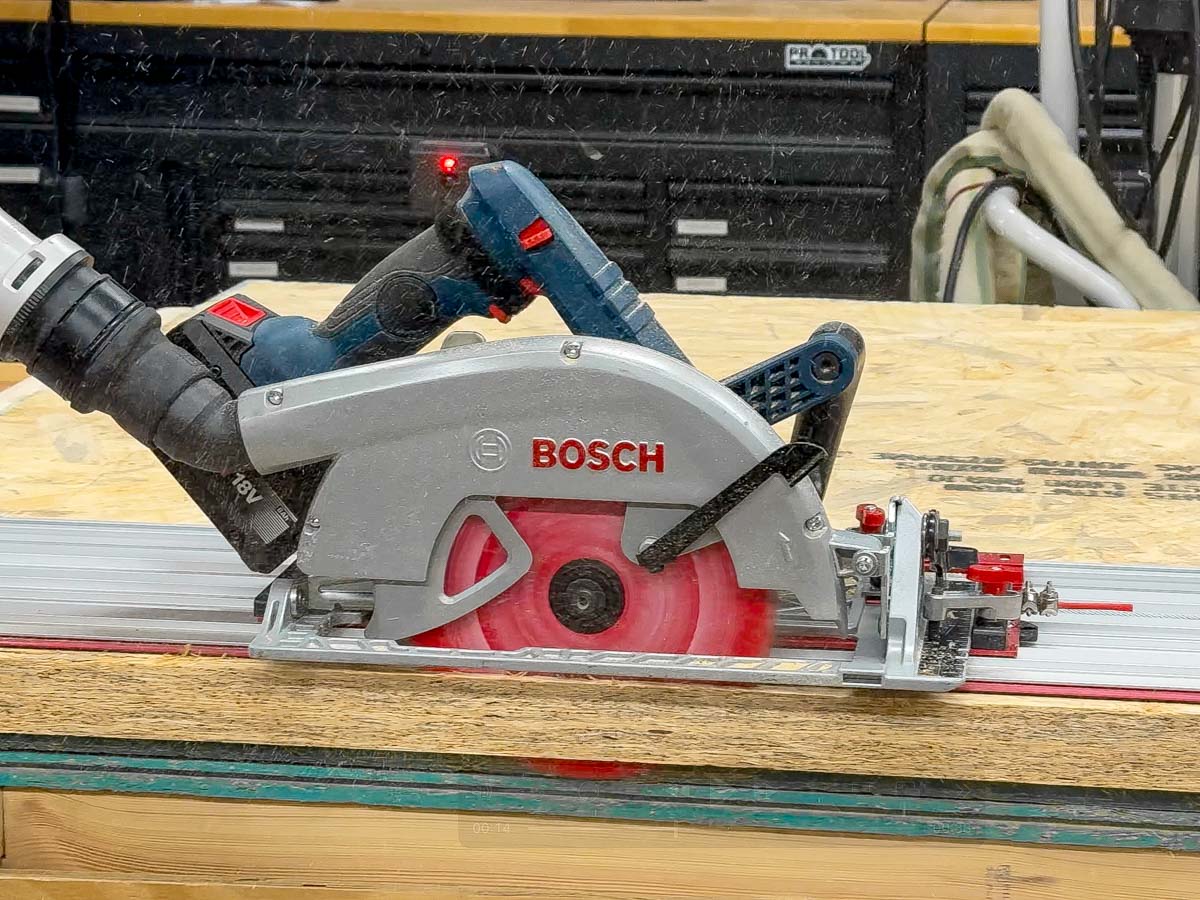
As a bare tool, the saw weighs 8.99 pounds, climbing to 11.28 pounds when loaded down with the recommended 8.0Ah battery. Retailing at approximately $285 for the bare tool, the GKS18V-25N is backed by Bosch’s generous 5-year limited warranty and a 180-day money-back guarantee, signaling the manufacturer’s confidence in its durability.
Chronology of the Evaluation: How the Testing Unfolded
To ensure absolute fairness and consistency, our testing protocol was structured to test every saw across identical, demanding media.
Phase 1: Rip Cutting and Speed Trials
The evaluation commenced in the shop with a standardized rip-cutting test. Each saw was mounted with its stock blade, paired with its designated high-capacity battery, and run through two stacked sheets of Oriented Strand Board (OSB) subflooring.
Phase 2: Full-Depth and Multi-Sheet Stress Tests
Following the initial rip cuts, the test rig was expanded to include additional sheets of OSB to test the saws at maximum cutting depth. This phase was designed to see how well the motors maintained RPM under heavy loads and whether thermal throttling or torque drop occurred during extended cuts.
Phase 3: Cutting Characteristics and Geometry
The third phase shifted from engineered wood to solid pine ($2times10$ dimensional lumber). Technicians executed a series of cross cuts, bevel cuts, and compound miter cuts. This stage was critical for observing two major elements: the physical sightlines down to the cutting line and the behavior of the lower blade guard under various entry angles.
Phase 4: Jobsite Usability and Ergonomics
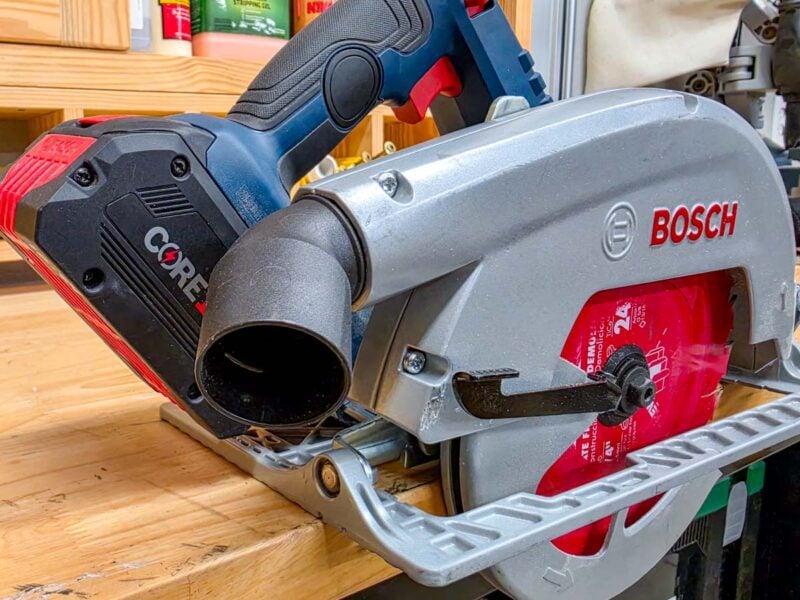
Finally, the saws were subjected to real-world framing tasks, including cutting $2times4$ stakes, managing sawdust evacuation via a rotating dust port, and evaluating the comfort, switch placement, and shoe friction during continuous operation.
Supporting Data: Head-to-Head Performance Breakdown
While specs on paper give you a baseline, empirical data on the testing track reveals the true character of a tool. Here is how the Bosch GKS18V-25N performed across our comprehensive rubric:
| Test Category | Bosch GKS18V-25N Result | Performance Context |
|---|---|---|
| Rip Cut (2 Sheets OSB) | 19.64 seconds | Last place among the 11-tool lineup; limited by the 5,000 RPM ceiling. |
| Full Depth Cut (4 Sheets OSB) | 25.53 seconds | 11th place, narrowly edging out competing models due to shallower cutting geometry. |
| Stake Cutting ($2times4$) | 1 out of 3 successful starts | Lower guard geometry required manual intervention on multi-angle stake trims. |
| Dust Collection | 2 out of 3 | Average performance; innovative rotating port helps direct debris away. |
| Guard Action | 7 out of 9 | Excellent on standard cross-cuts; prone to hanging up on right-hand compound angles. |
| Sight Lines | 5 out of 6 | Outstanding visibility at 90 degrees; minor obstructions noted at 45 degrees. |
| Shoe Friction | 3 out of 3 | Flawless low-friction glide across various material surfaces. |
Speed and Cutting Power Analysis
The 5,000 RPM ceiling proved to be the GKS18V-25N’s primary bottleneck in timed speed trials. In our OSB rip-cutting test, Bosch posted a time of 19.64 seconds, placing it at the bottom of our 11-saw lineup. Competing flagships—such as the Milwaukee M18 Fuel 2834, which operates at a blistering 6,000 RPM with a 2 9/16-inch max cut depth—simply chewed through the material faster.
However, when we moved to the full-depth cut by adding two more sheets of OSB, Bosch clocked a time of 25.53 seconds. This slight shift moved it out of dead last place, ahead of saws like the Skil CR5440. Paradoxically, Bosch’s slightly shallower max cutting depth worked to its mechanical advantage here, keeping the motor from bogging down as severely as some of its deep-cutting rivals.
Sightlines and Guard Behavior
Where the Bosch saw reclaimed significant ground was in its cutting characteristics. The blade-right configuration provided exceptional sightlines. While alignment notches on the shoe are standard, our testers pay closer attention to the direct line of sight to the blade itself. Bosch delivered a near-perfect score at 90 degrees, offering an unobstructed view of the blade meeting the material. At 45 degrees, visibility was only minimally obstructed.
Conversely, the lower blade guard yielded mixed results. During standard cross-cuts and left-hand compound cuts, the guard retracted smoothly. But during right-hand compound cuts, the guard’s leading edge—which angles downward toward the right side of the tool—frequently hung up on the edge of the board. This resulted in jerky starts and required operators to manually lift the lower guard. While seasoned framing professionals do this out of habit, it compromises control by forcing the user to take a hand off the secondary grip.
Official Perspectives and Design Innovations
Bosch’s engineering team clearly focused heavily on ergonomics and modular jobsite integration when designing the GKS18V-25N, introducing several features that merit attention from professional contractors.
Ergonomic Triumph: The D-Handle Foregrip
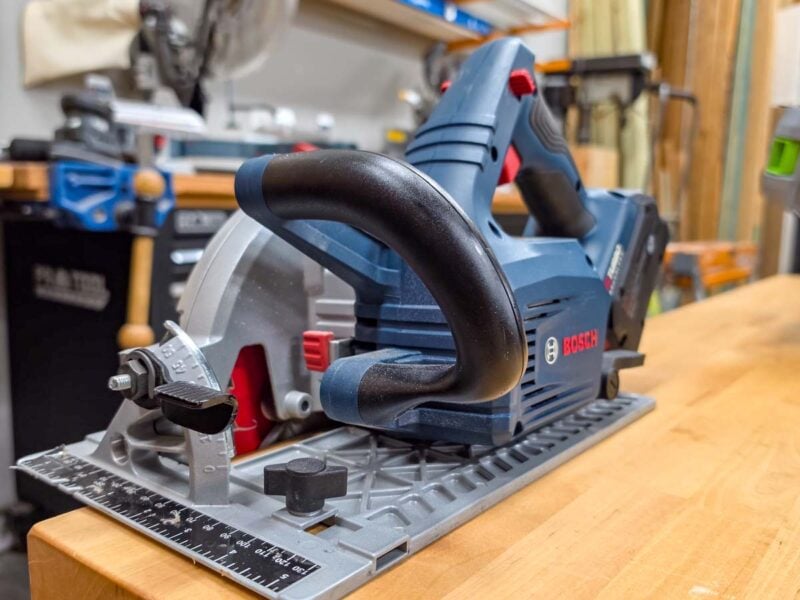
While the saw faced criticism for its speed, our testing panel was unanimous in praising its handle ergonomics. Moving away from the traditional vertical pommel found on most circular saws, Bosch incorporated a curved D-handle foregrip wrapped in a comfortable rubber overmold.
This design allows for a much more natural, biomechanically sound wrist angle for the user’s non-dominant hand. During long rip cuts, the foregrip drastically reduces fatigue and improves tracking accuracy. For purists who prefer the traditional grip style, the housing design still leaves ample room on top to grip the saw conventionally.
Dust Management and Adjustments
Jobsite air quality and cleanliness are major focal points for modern contractors. Bosch addressed this by outfitting the GKS18V-25N with a rotating dust port. Similar to the inline design seen on the Flex 24V 6 1/2-inch saw, this rotating port allows contractors to attach a vacuum hose or dust bag and swivel it entirely out of the way of the workpiece and the operator’s line of sight.
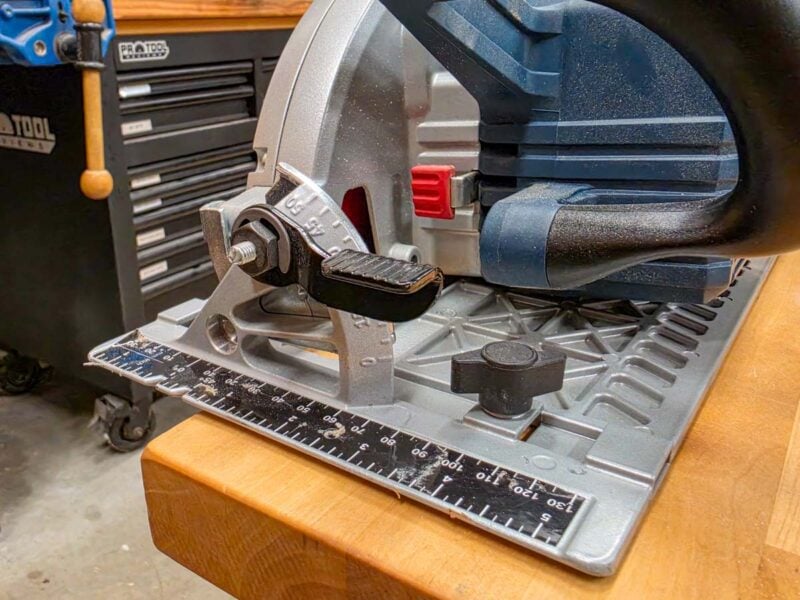
Furthermore, depth and bevel adjustments received smart placement updates. The depth adjustment lever is positioned on the exterior of the tool body rather than crammed awkwardly between the rear handle and the upper blade guard, making on-the-fly adjustments significantly faster and less frustrating.
Implications for the Jobsite: Should You Buy It?
The evaluation of the Bosch GKS18V-25N reveals a tool of distinct contrasts. It is undeniably a rugged, Pro-grade circular saw built to withstand the rigors of commercial construction, and its low-friction shoe and phenomenal ergonomics make it a joy to hold during long cuts. However, its lower RPM ceiling and occasional guard hangups mean it lags behind the absolute fastest models in its class during head-to-head speed tests.
Who is this saw for?
- General Remodelers and Finish Carpenters: If your work revolves around straight cross-cuts, sheet goods, and standard dimensional lumber where extreme right-hand compound angles are rare, the GKS18V-25N will easily replace a corded saw in your trailer.
- Framing Professionals: If you execute heavy, rapid-fire compound miter cuts all day long, you may find the lower guard’s tendency to catch on right-hand bevels to be an annoyance.
Ultimately, at a retail price of $285 for the bare tool, the Bosch GKS18V-25N is a capable, highly comfortable performer backed by an industry-leading 5-year warranty. For those heavily invested in the Bosch 18V ProFactor ecosystem, it is a reliable workhorse—though those seeking raw cutting speed might want to look at alternative flagship options or explore Bosch’s broader lineup, which includes track-compatible (GKS18V-25GCN) and blade-left (GKS18V-26LN) variants.
