

Main Facts
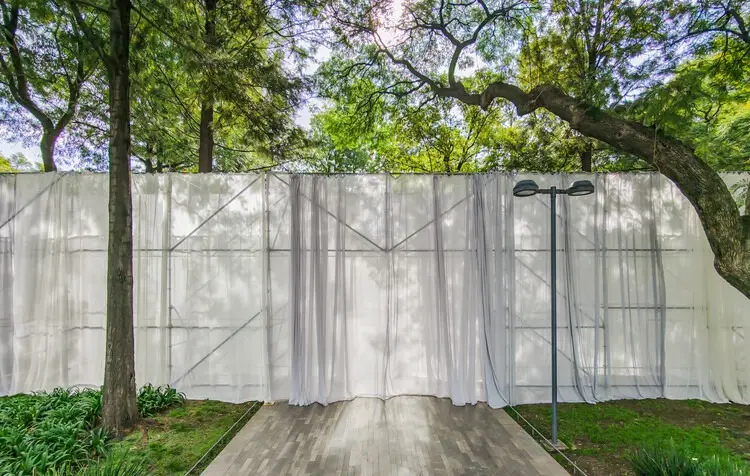
The architectural landscape of Mexico City has once again become a canvas for bold, conceptual exploration. "El Muro"—the striking winning pavilion of the prestigious 28th edition of the Arquine competition—stands as one of the most provocative and discussed installations of the MEXTRÓPOLI 2026 Festival. Designed through a collaborative powerhouse comprising ARQLIQ arquitetura, Entremeios Arquitetura, Márcio Flávio Motta, and Ismael Torrano, the pavilion challenges conventional notions of physical space, urban segregation, and architectural intent.
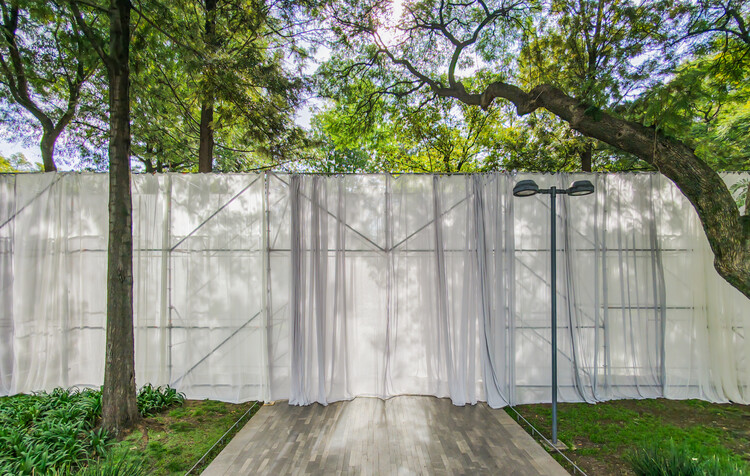
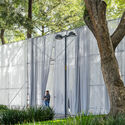
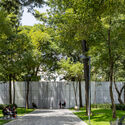
Anchored in the historic and bustling Alameda Central, near the iconic Fountain of Mercury, El Muro is deceptively simple in its geometry yet profoundly complex in its philosophical execution. The core intervention consists of a single, decisive line that cuts straight across the park’s carefully manicured grounds. Intersecting three major pedestrian pathways, the installation immediately subverts a typology historically associated with division, hostility, and isolation: the wall. Instead of blocking movement or creating exclusion, this wall acts as an engine of connection, transforming a barrier into a dynamic spatial experience of passage, interaction, and unexpected human encounter.
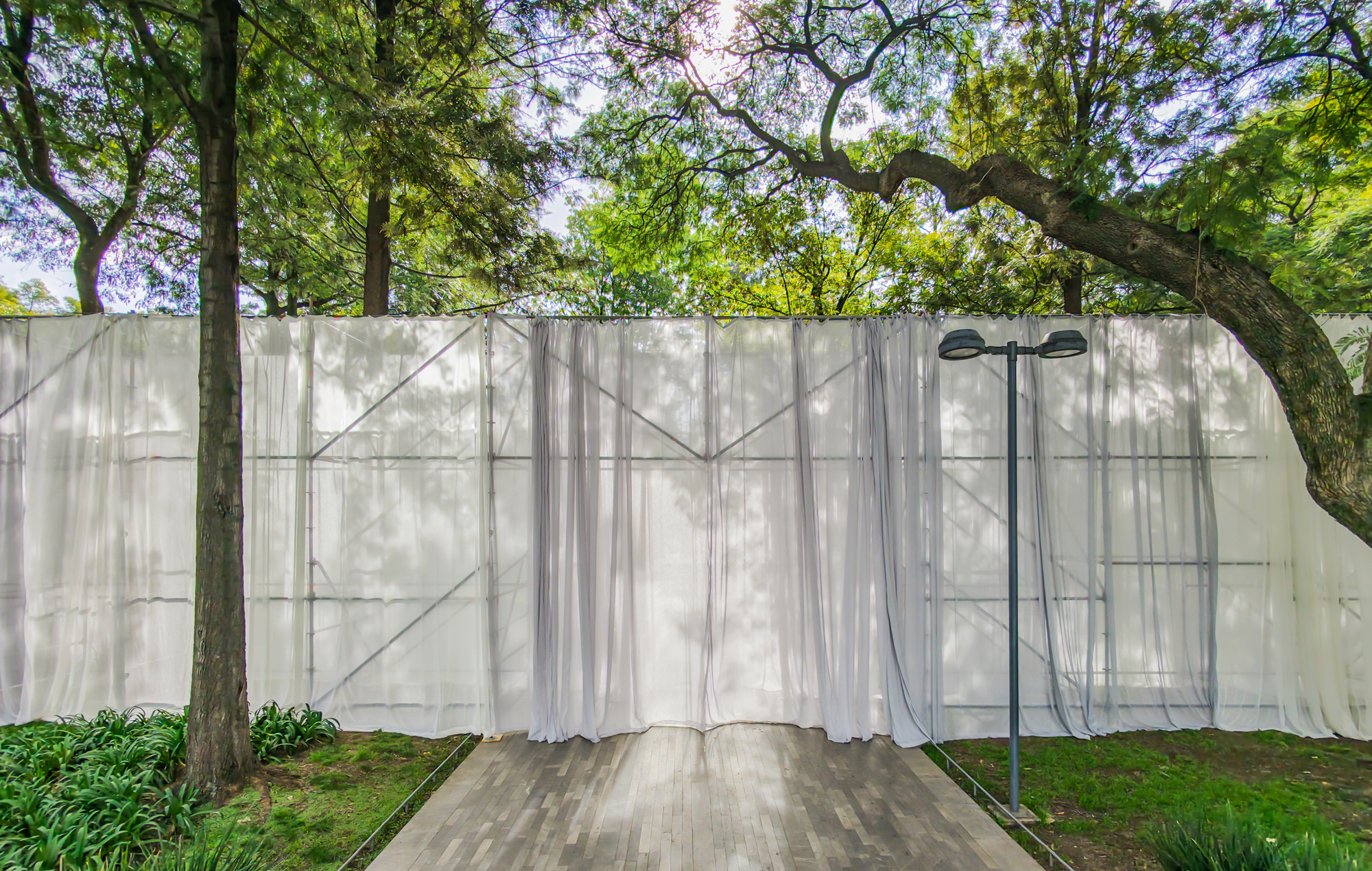
Captured brilliantly through the lens of architectural photographer André Miguel Coronha, the pavilion features across dozens of perspectives in its extensive project gallery, showcasing how light, shadow, scale, and materiality converse with Mexico City’s oldest public park. Curated by Susanna Moreira, El Muro highlights the collaborative potential of international design teams pushing the boundaries of temporary urban architecture.
Chronology: From Concept to Urban Landmark
The journey of El Muro from a conceptual sketch to a reality within the Alameda Central follows a rigorous timeline typical of the world-renowned Arquine competition and the MEXTRÓPOLI festival circuit:
- Late 2025 (The Call for Entries): The 28th edition of the Arquine competition launches, challenging architects, urbanists, and designers globally to conceptualize a temporary pavilion for Mexico City. The brief calls for interventions that actively engage with the urban fabric, fostering dialogue between the public sphere and experimental design.
- Early 2026 (Selection of the Winner): Following an intensive evaluation process by a panel of international architecture and design experts, the joint proposal by ARQLIQ arquitetura, Entremeios Arquitetura, Márcio Flávio Motta, and Ismael Torrano is selected as the winning entry. Judges praise the team’s ability to address socio-political themes through minimalist gestures.
- Mid-2026 (Fabrication and Site Integration): Prefabrication and structural engineering coordination take place, ensuring the installation can be rapidly assembled in a sensitive, heritage-protected public space like the Alameda Central without causing permanent disruption.
- September 2026 (The MEXTRÓPOLI Festival & Public Unveiling): El Muro officially opens to the public alongside the commencement of the MEXTRÓPOLI 2026 Festival. Thousands of visitors, critics, and architecture enthusiasts stream through its passages, testing its spatial qualities.
- September 29, 2026 (Global Publication): ArchDaily officially publishes the project details, introducing the global architectural community to the design’s intricate spatial mechanics, accompanied by photography by André Miguel Coronha.
Supporting Data & Project Specifications
Temporary pavilions deployed for events like MEXTRÓPOLI operate under strict architectural constraints. They must be lightweight yet structurally sound, ephemeral yet impactful, and completely reversible to preserve the integrity of host sites like the Alameda Central.
- Project Name: El Muro Pavilion (Pavilhão El Muro)
- Collaborating Practices & Designers: ARQLIQ arquitetura, Entremeios Arquitetura, Márcio Flávio Motta, and Ismael Torrano
- Event & Context: MEXTRÓPOLI 2026 Festival (28th Arquine Competition Winner)
- Location: Alameda Central (near the Fountain of Mercury), Mexico City, Mexico
- Curator: Susanna Moreira
- Primary Photographer: André Miguel Coronha
- Publication Date: September 29, 2026
- Typology: Temporary Architecture / Urban Pavilion / Public Installation
- Intervention Scale: A linear wall structure intersecting three major park pathways
Official Responses and Curatorial Perspectives
The conceptual core of El Muro has drawn widespread praise from critics and curators who view it as a timely architectural statement on contemporary sociopolitical dynamics.
Curator Susanna Moreira noted that the pavilion succeeds precisely because it tackles one of humanity’s oldest architectural motifs—the wall—and completely inverts its purpose. "We live in an era marked by rising borders, physical fences, and ideological walls," design theorists associated with the project have emphasized. "El Muro takes that exact symbol of hostility and folds it back onto itself. By threading it through the paths of the Alameda Central, the wall ceases to keep people apart; instead, it forces them to look at one another, to share a threshold, and to rediscover the public square as a place of negotiation."
The collaborative design collective—spanning multiple creative inputs from ARQLIQ, Entremeios, Motta, and Torrano—explained in their official design statement that the project stemmed from a "simple gesture: a line that cuts across the Alameda Central." By stripping away unnecessary ornamentation, the architects relied entirely on spatial compression, linear progression, and the sensory contrast between solid mass and open parkland.
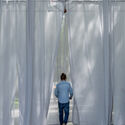
Users navigating the installation experience shifting acoustics, framing of the sky, and sudden moments of compression as they pass through the strategic openings cut into the wall’s trajectory. These apertures transform the linear barrier into a porous membrane, prompting pedestrians to rethink how architecture dictates movement within historical green spaces.
Implications for Urbanism and Temporary Architecture
El Muro’s success at MEXTRÓPOLI 2026 resonates far beyond its brief lifespan as a temporary festival installation. It speaks directly to the evolving role of ephemeral architecture in modern cities.
1. Reclaiming Public Space through Conceptual Art
Public parks like Mexico City’s Alameda Central—established in the 16th century—are historically layered spaces laden with civic memory. Introducing a controversial archetype like a "wall" into such a democratic space could easily have backfired if handled with heavy-handedness. However, by turning the wall into a permeable corridor and a point of convergence, the designers demonstrated that temporary architecture can act as a catalyst for urban critique without alienating the everyday park-goer.
2. The Power of Collaborative Design
The multi-firm collaboration between ARQLIQ arquitetura, Entremeios Arquitetura, Márcio Flávio Motta, and Ismael Torrano underscores a growing trend in contemporary architecture: collective intelligence. By pooling cross-disciplinary skills, the team produced a refined, highly conceptual architectural language that triumphed over dozens of international submissions in the Arquine competition.
3. A Timely Metaphor for a Divided World
At a time when global politics are frequently dominated by discussions of border security, immigration barriers, and social fragmentation, El Muro offers an optimistic architectural counter-narrative. It reminds the public that walls do not have to be instruments of exclusion. When re-imagined through creative design, a wall can become a space for convergence, shared shelter, and human solidarity.
As the MEXTRÓPOLI 2026 Festival concludes its run, El Muro leaves behind a powerful legacy. It proves that the most profound architectural statements often arise not from massive, permanent megastructures, but from a single, well-placed line that forces us to look differently at the world—and each other—around us.
