

By Global News Wire Service
Updated: August 26, 2026
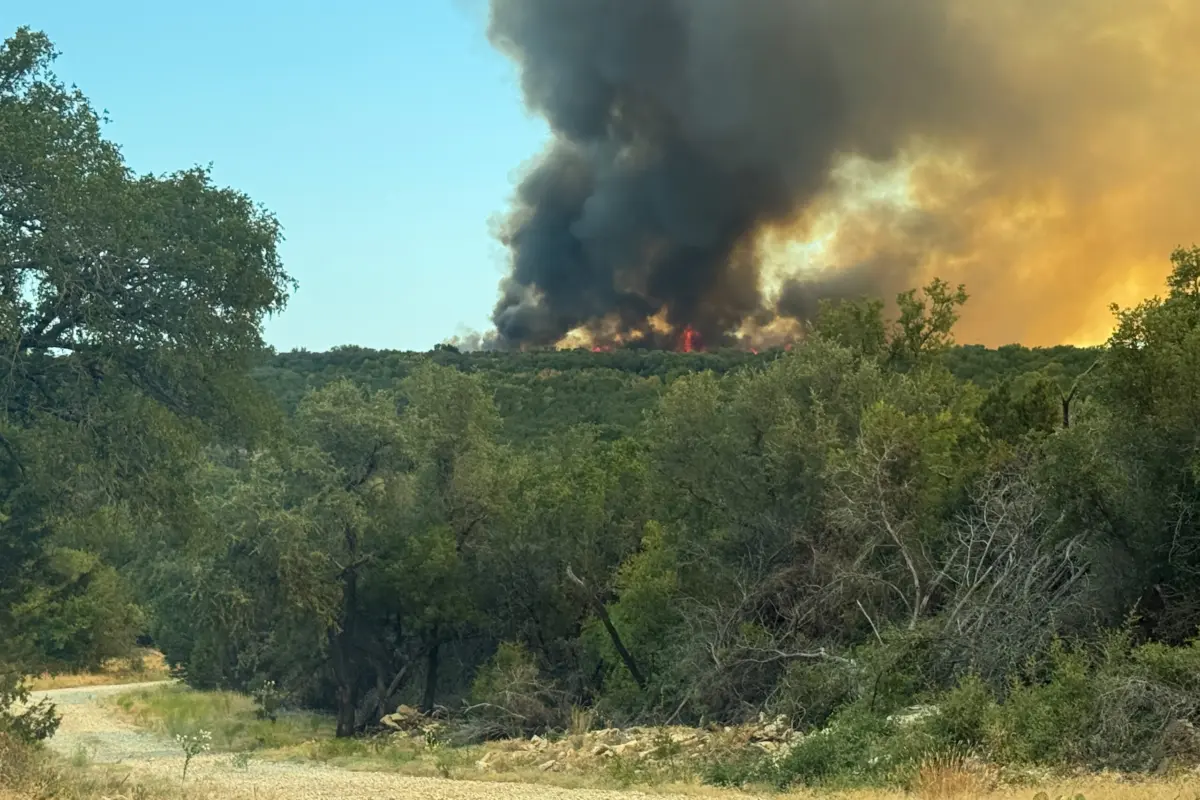
FORT WORTH, Texas — Whipped by erratic, tornadic winds and sustained by extreme, unrelenting heat, a fast-moving wildfire exploded across wide expanses of lightly populated ranchland in north-central Texas this week. Dubbed the Ross Fire, the ferocious blaze scorched more than 78 square miles (200 square kilometers) in less than twenty-four hours, reducing historic properties to ash, devouring infrastructure at a beloved regional youth camp, and forcing widespread evacuations and school closures across multiple counties.
As firefighting crews on the ground and in the air battled the wall of flames with minimal containment, the disaster served as a glaring focal point for a broader national crisis. From the parched rangelands of the American South to the dry canyons of Southern California and the smoke-choked neighborhoods of northern Nevada, an extraordinary convergence of extreme weather conditions has ignited a relentless wave of destructive wildfires across the United States.
Main Facts: The Destruction of the Ross Fire
The Ross Fire erupted early Monday afternoon, tearing through Palo Pinto and Jack counties roughly 60 miles west of Fort Worth. Fueled by tinder-dry vegetation, low humidity, and high temperatures, the blaze moved with terrifying speed, easily leaping across natural barriers like creeks and rivers that typically act as firebreaks.
While a full structural damage assessment remains ongoing as hot spots continue to flare, local officials confirmed that at least five primary structures have been destroyed in Palo Pinto County alone. Among the casualties is the historic Worth Ranch, a Scouting America youth camp situated on the southern edge of the fire zone. Flames swept through the property on Tuesday, destroying multiple camp buildings. Fortunately, no campers or guests were on the grounds, and all staff personnel were safely evacuated before the fire reached the perimeter.
The human toll, while mercifully lacking in reported fatalities so far, has been measured in heartbreak and the loss of generational heritage. Katie Rochelle, whose family has operated a local canoe rental business for five generations since 1969, watched in horror as the fire consumed her livelihood.
"It just took off way too fast," Rochelle said, describing winds that swirled in erratic, destructive patterns. "The wind was going in a tornado motion."
While her husband—a local volunteer firefighter—worked tirelessly overnight to protect their personal residence, the flames claimed other irreplaceable family property, including a historic family home built on the land approximately a century ago. Several of the business’s transport buses and trailers were also reduced to twisted metal, though the rental canoes themselves miraculously survived the initial onslaught.
"I don’t know what we’re going to do now," admitted her father, Buddy Rochelle, surveying the charred remains of a century-old family legacy.
Chronology of the Disaster
Monday, August 24: The Sudden Eruption
- Early Afternoon: The Ross Fire ignites in north-central Texas under a combination of high temperatures, low humidity, and stiff, gusty winds.
- Late Afternoon: Fueled by bone-dry rangeland, the fire experiences extreme explosive growth, charring tens of thousands of acres in a matter of hours. The blaze crosses county lines, threatening remote homesteads and local infrastructure.
- Nightfall: Emergency services scramble to establish evacuation centers. Local school districts announce preemptive closures for Tuesday, while area ranchers and livestock commissions open barns to shelter displaced cattle and horses.
Tuesday, August 25: Unstoppable Momentum
- Morning: Firefighters report that standard containment tactics are failing against the erratic winds. The fire jumps natural water barriers.
- Midday: Flames sweep into Worth Ranch youth camp, destroying multiple structures. Staff members have already been safely evacuated.
- Afternoon: Texas Governor Greg Abbott announces federal intervention, securing resources from the Federal Emergency Management Agency (FEMA).
- Evening: Palo Pinto County emergency officials report that the Ross Fire remains at a meager 8% containment. Fire Chief Danny Watkins tells reporters, "We’ve thrown everything at this, and we’re still having minimal effect."
Official Responses and Resource Deployment
Faced with a disaster that outpaced standard local resources, municipal, state, and federal agencies mobilized a massive multi-tiered response.
Texas Governor Greg Abbott held an emergency briefing on Tuesday, confirming that FEMA had authorized assistance to support local first responders battling the Ross Fire. Abbott issued a stern warning to residents across the Lone Star State, urging them to immediately suspend any outdoor activities—such as welding, burning brush, or operating heavy machinery—that could inadvertently spark new blazes under the hazardous weather conditions.
On the front lines, tactical efforts were pushed to the absolute limit. Palo Pinto County emergency services district personnel, bolstered by state forestry aircraft dropping thousands of gallons of water and retardant, focused heavily on defending structures near the tiny town of Palo Pinto.
Despite these aggressive air and ground tactics, Palo Pinto County Fire Chief Danny Watkins expressed the profound frustration shared by emergency crews. "We’ve thrown everything at this, and we’re still having minimal effect," Watkins said, highlighting the daunting reality of fighting a fire driven by extreme atmospheric dynamics. As of Tuesday evening, the fire’s containment hovered at an alarming 8%.
To alleviate community distress, emergency management teams opened multiple evacuation centers. Local communities stepped up with communal solidarity: area school districts canceled classes to keep roads clear for emergency vehicles, while regional ranchers and agricultural commissions coordinated efforts to provide temporary shelter, feed, and trailers for displaced livestock and farm animals.
Supporting Data: A Historic Wildfire Season
The Ross Fire is not an isolated incident; rather, it is part of a punishing national trend of extreme wildfire activity driven by severe drought and climate volatility across the American South and West.
According to data released by the National Interagency Fire Center (NIFC), wildfire activity across the United States has reached staggering proportions this year. Nationally, firefighters have responded to more than 50,000 individual wildfires so far this year. This figure represents the highest cumulative number of blazes recorded over the same ten-year period, underscoring a lengthening and intensifying fire season.
The NIFC reported that a dozen new large-scale blazes erupted nationwide on Sunday alone. These incidents are stretching emergency response capabilities thin across multiple geographic regions:
- Nevada: Firefighters made significant progress containing the destructive Hawk Fire, which forced the mandatory evacuation of thousands of residents near Reno over the weekend. Beginning Saturday and expanding aggressively on Sunday, the fire charred roughly 23 square miles (60 square kilometers) and destroyed at least 47 homes near the California state line. Local authorities confirmed that the blaze reached 85% containment by Tuesday evening, allowing evacuation orders to be scaled back. At least seven individuals—including three first responders and four civilians—sustained injuries. Local fire officials determined the Hawk Fire was human-caused, either intentional or accidental.
- California: The National Weather Service issued urgent red flag warnings for Southern California, north of Los Angeles, forecasting high risks of rapid fire spread fueled by high temperatures, low relative humidity, and fierce seasonal winds through the end of the week.
- Regional Disasters: Simultaneously, fire crews across neighboring Texas counties battled at least four other smaller, concurrent wildfires, while emergency services across the broader Western U.S. remained on high alert.
Wider Implications: Preparedness, Climate, and Community Resilience
The cascading emergencies in Texas, Nevada, and California highlight profound long-term implications for emergency management, infrastructure resilience, and public policy in wildfire-prone regions.
1. Escalating Suppression Costs and Strain on Personnel
With over 50,000 fires burning nationwide this year, federal and state firefighting budgets are being severely drained. The compounding nature of simultaneous multi-state emergencies means that aerial assets, specialized Hotshot crews, and incident management teams must be constantly triaged, leaving some communities vulnerable when fires experience sudden, explosive growth like the Ross Fire.
2. The Human and Economic Toll on Rural Economies
While major urban interface fires routinely command national headlines, disasters like the Ross Fire expose the immense vulnerability of rural, agricultural communities. The loss of multigenerational family businesses, century-old homesteads, and agricultural infrastructure threatens the economic fabric of rural Texas. For families like the Rochelles, rebuilding goes beyond replacing physical timber and drywall; it requires restoring an entire livelihood rooted in the land.
3. Human Behavior and Prevention
With investigators confirming that human activity sparked the destructive Hawk Fire in Nevada, and state officials in Texas pleading with citizens to halt spark-producing activities, public education remains a critical frontline defense. As prolonged drought conditions make landscapes increasingly explosive, public negligence or accidental sparks can instantly translate into catastrophic natural disasters.
4. Climate Realities and the "New Normal"
Emergency management experts increasingly view the severity and frequency of these out-of-season and fast-moving blazes not as anomalies, but as a systemic "new normal." Extended drought periods, erratic wind patterns, and record-breaking heat waves are transforming traditional grasslands and rangelands into volatile tinderboxes.
As night fell over Palo Pinto County, residents like Katie Rochelle could do little more than wait and watch the horizon. With temperatures forecasted to rise further and containment remaining stubbornly low, the battle to tame the Ross Fire stands as a stark reminder of nature’s raw power—and the harrowing endurance required of those standing in its path.
