

By Terrence O’Brien
Published September 5, 2026
Main Facts
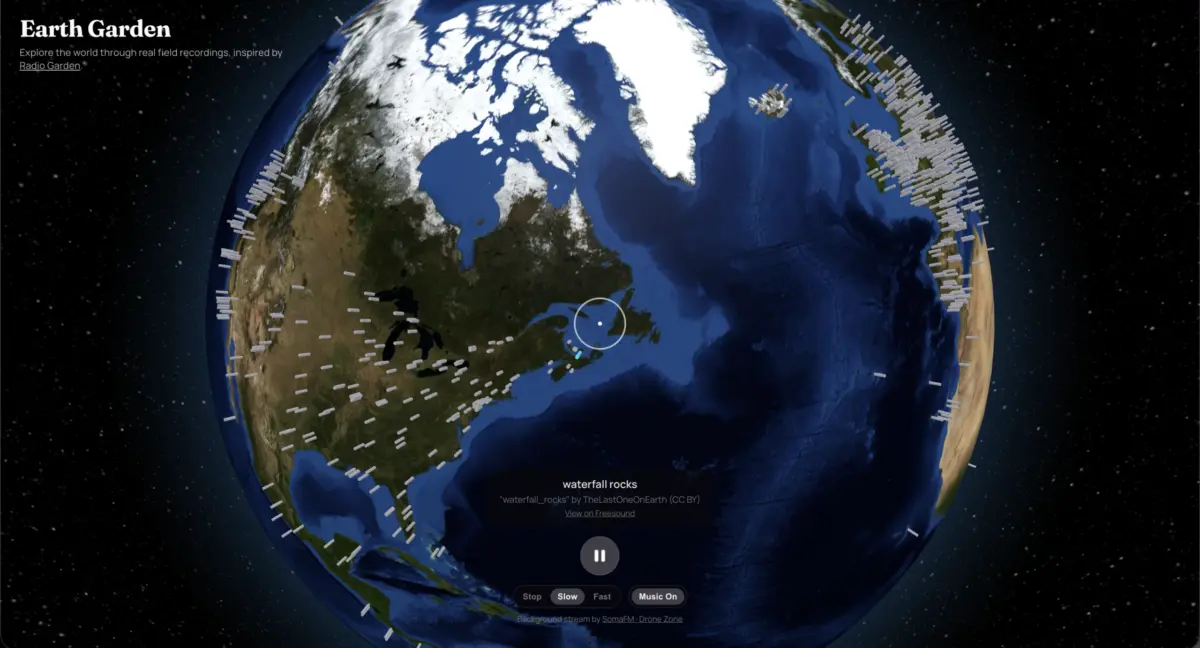
In an era defined by hyper-visual digital interfaces and relentless screens, a new web-based project is inviting internet users to close their eyes and experience the planet through pure acoustic ecology. Titled Earth Garden, the platform serves as an interactive globe that allows users to travel the world virtually, not by tuning into local radio stations, but by listening to authentic environmental audio captured in the wild, in cities, and across remote ecosystems.
Inspired by the cultural phenomenon Radio Garden—which lets users explore global FM, AM, and streaming radio broadcasts by spinning a digital 3D Earth—Earth Garden swaps human speech and music for field recordings. The platform sources its vast audio library directly from Freesound, a collaborative database of Creative Commons-licensed audio snippets.
As users navigate the interactive globe, a targeting reticle locks onto specific geographical points, instantly fading in the ambient soundscapes native to that region. Listeners might hear the rhythmic lapping of waves against the shores of a remote Atlantic island, a dense, layered chorus of crickets humming through the Tanzanian night, or the steady, rhythmic pitter-patter of rainfall on the concrete streets of Manhattan. For those seeking an extra layer of relaxation, the platform also features an optional toggle that blends the environmental sounds with generic, soothing ambient synthesizer drones.
While the project offers an imaginative, immersive way to engage with acoustic geography, its reliance on crowdsourced audio introduces distinct quirks. Because the underlying clips are drawn from Freesound, sound quality and volume levels can vary dramatically from one location to the next. Furthermore, geographic representation reflects user submission trends, resulting in a higher concentration of audio snippets clustered across the United States and Western Europe, particularly the United Kingdom. Nevertheless, whether used as soothing background noise for productivity, a tool for deep sleep, or an instrument for active, mindful listening, Earth Garden opens up a refreshing auditory window to the world.
Chronology
The genesis of Earth Garden and the broader cultural appreciation of digital field recording did not happen overnight. It represents the convergence of web-mapping technology, open-source audio communities, and a post-pandemic hunger for environmental immersion.
- The Early 2000s (The Rise of Freesound): Freesound.org is established as a collaborative database for Creative Commons-licensed audio snippets, laying the technical and legal groundwork for creators, sound designers, and artists to share raw environmental audio samples globally.
- December 2016 (The Launch of Radio Garden): Developed by the Studio Puckey and Moniker in collaboration with the Netherlands Institute for Sound and Vision, Radio Garden debuts. It captures the global imagination by allowing users to click around a 3D globe and listen to live radio broadcasts from thousands of cities worldwide, establishing the interactive geographic audio format.
- 2020–2021 (The Ambient and Field Recording Boom): During global pandemic lockdowns and extended periods of quarantine, public interest in ambient music, nature sounds, and restorative audio surges. Artists and remote workers increasingly turn to field recordings as a psychological refuge from confinement.
- Late August to Early September 2026 (The Debut of Earth Garden): Earth Garden officially launches, adapting the interactive geographic model of Radio Garden specifically for environmental audio, pulling its extensive sonic catalog from Freesound.
- September 5, 2026: Tech and culture publications spotlight the platform, drawing widespread attention from ambient music producers, remote workers, and sound designers eager to explore the globe acoustically.
Supporting Data
To fully understand the scope and mechanics of Earth Garden, it is helpful to look at the underlying ecosystem of open-source sound distribution and the mechanics of interactive web audio platforms.
Platform Mechanics & Features
- Interface Model: Interactive 3D globe with automatic rotation and manual click-and-drag navigation.
- Audio Integration: Real-time crossfading between regional field recordings as the central reticle passes over geographic coordinates.
- Secondary Audio Layer: Optional ambient drone generator designed to complement and smooth out transitions between disparate field recordings.
- Primary Source Database: Freesound.org (utilizing Creative Commons-licensed audio files uploaded by a global community of amateur and professional recordists).
Geographic and Quality Variances
- High-Density Regions: The United States, Western Europe (particularly the United Kingdom), and urban centers with active local recordist communities.
- Low-Density Regions: Developing nations, deep oceanic zones, vast desert expanses, and the polar ice caps, where local audio uploads are sparse.
- Acoustic Diversity: Renders everything from biophonics (animal sounds like bird songs and insect hums) and geophonics (wind, rain, ocean waves) to anthrophonics (traffic, footsteps, urban murmur).
Official Responses
While Earth Garden is an independent passion project rather than a corporate product with a massive public relations apparatus, the initial public reception and commentary from critics, sound designers, and audio engineers highlight its unique charm and technical limitations.
In reviews and community discussions, field recording enthusiasts have praised the project for bridging the gap between passive relaxation and active listening. Industry critics have noted:

"Field recordings are great background noise for working or sleeping, but they are also wonderful for active listening—focusing in on the fine nuances of burbling brooks or urban chaos. Earth Garden gives you a globe to explore with real field recordings taken from various locations."
At the same time, technical observers have pointed out the inherent hurdles of utilizing crowdsourced audio databases:
"Because the recordings are all pulled from Freesound, quality can vary, and volume between clips can be inconsistent. It also means that recordings tend to be more concentrated in the US and Europe, especially the UK. But it’s still quite fun and soothing to set the globe to rotate automatically, and as the reticle nears points on the Earth, it transitions to those new sounds."
Implications
The launch of Earth Garden carries broader implications for how we interact with digital maps, how we conceptualize global geography, and the psychological role of sound in the modern digital age.
1. Shifting from Visual to Acoustic Geography
For decades, digital cartography has been dominated by visual paradigms—satellite imagery, street-view photography, political borders, and topographical heat maps. Platforms like Radio Garden and now Earth Garden suggest that our mental map of the world can be just as powerfully anchored by sensory data. By mapping the planet acoustically, these platforms remind users that environments have distinct voices, capturing cultural atmospheres, biodiversity levels, and urban pulses that pixels alone cannot convey.
2. The Democratization and Vulnerability of Open-Source Audio
By relying on Freesound, Earth Garden demonstrates the immense power of crowdsourced, open-access digital repositories. Anyone with a portable field recorder can upload the sound of a rainstorm in their backyard, effectively adding their local ecosystem to a global map. However, this reliance also exposes the digital divide inherent in crowdsourcing: wealthy nations with high smartphone and recording equipment penetration are disproportionately represented, while vast swaths of the Global South remain acoustically quiet on the platform. This serves as a micro-example of broader archiving biases in digital media.
3. Therapeutic Soundscapes and Remote Escapism
As urban environments become increasingly noisy and stress levels tied to digital connectivity rise, tools that offer restorative, natural soundscapes are finding a permanent home in daily wellness routines. Earth Garden acts as a form of auditory escapism, allowing an office worker in a dense metropolis to instantly transport their ears to a desolate beach in the Atlantic or a rainforest in Tanzania.
Whether it serves as a creative tool for ambient music producers looking for authentic textures, a calming backdrop for deep focus, or simply an entertaining way to spend an afternoon spinning a virtual globe, Earth Garden proves that sometimes the most compelling way to see the world is to close your eyes and listen.
