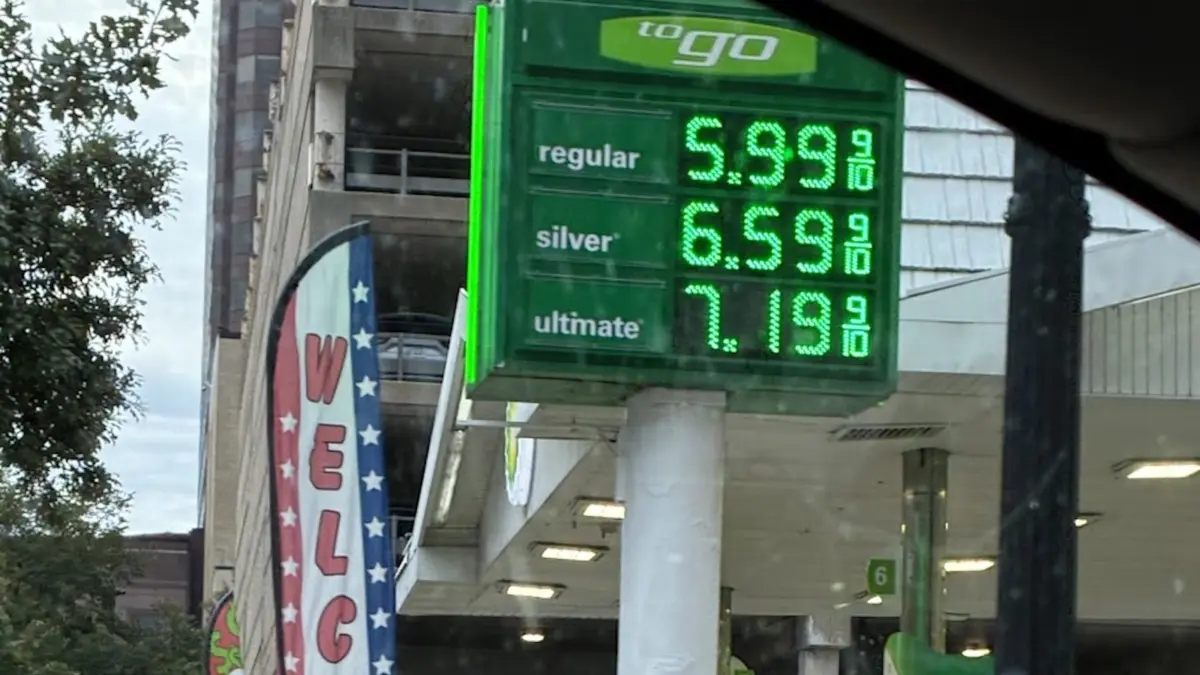
The debate over electric vehicle (EV) adoption has long centered on the economics of fueling versus charging, but recent economic milestones have transformed theoretical debates into harsh everyday realities. In late September 2026, motorists pulling up to a downtown Chicago BP station were greeted by a staggering price point: $7.19 per gallon for premium 93-octane gasoline. What was once framed as an exaggerated hypothetical scenario in automotive surveys has materialized at urban fuel pumps, forcing a re-evaluation of how American drivers respond to cost-of-living pressures.
Back in April 2026, automotive publication Electrek conducted a sidebar survey asking over 2,800 readers a pointed question: As fuel prices climb, how high would a gallon of gas or diesel need to go to convince the most dedicated internal combustion engine (ICE) loyalists to finally make the jump to a plug-in hybrid or fully electric vehicle? At the time, a $7-per-gallon threshold felt safely distant—the outer limit of financial absurdity. More than half of the survey’s respondents expressed skepticism, concluding that a segment of the driving population would never transition, regardless of the financial strain.
Now that $7-plus gasoline has arrived in major American metropolitan areas, those predictions are facing a stern real-world audit. While surging fuel costs typically act as a catalyst for EV and hybrid shopping sprees, the intersection of vehicle ownership costs, future utility rate projections, and entrenched consumer habits reveals a far more complex landscape than simple supply-and-demand economics.
Chronology of a Pricing Milestone
To understand how the market reached this juncture, it is helpful to trace the timeline of consumer sentiment and economic shifts throughout 2026:
April 2026:Electrek launches a reader survey addressing the psychology of anti-EV sentiment amidst fluctuating fuel markets. Over a seven-day window, 2,800 responses are logged. The prevailing sentiment among readers is deep skepticism; 48% of participants assert that no price point is high enough to compel the most ardent gas-car supporters to switch.
April to August 2026: Global supply chains, geopolitical friction, and shifting energy policies drive continued volatility in petroleum markets. Observers note that while fuel prices experience localized spikes, long-term projections remain murky, leading many consumers to view price hikes as temporary anomalies rather than permanent shifts.
September 19, 2026: Analysts highlight the wider macroeconomic factors driving global oil wars and supply disruptions, noting that electric vehicle adoption offers a long-term buffer against localized fuel shocks—though immediate consumer inertia remains high.
September 26, 2026: The milestone is crossed in practice. A gallon of BP ultimate 93-octane gasoline hits $7.19 in downtown Chicago. Observers from the passenger seats of plug-in vehicles document the historic pricing at urban pumps, prompting renewed questions about whether the psychological barrier of high fuel costs is finally enough to alter consumer behavior.
Supporting Data and Reader Insights
The original April survey yielded critical qualitative data that sheds light on why high gas prices alone may not be enough to reshape the American automotive fleet overnight. Rather than a simple refusal to save money, respondents pointed to multi-layered economic calculations.
The European Benchmark
Many participants noted that American drivers have yet to experience the true upper limits of fuel taxation. Citing conditions in Western Europe—specifically the Netherlands—readers pointed out that petrol prices have hovered at or above the equivalent of $11.34 per gallon for years.
In a detailed breakdown submitted during the survey, European reader Jos Hoogerwaard calculated that even with high electricity rates ($0.30 per kWh or $0.00 via residential solar), running a plug-in hybrid or EV translates to roughly $4.80 in equivalent energy costs compared to an $11.34 petroleum baseline. Yet, despite half a decade of extreme fuel pricing, a dedicated contingent of European drivers has refused to switch willingly, suggesting that financial penalties alone cannot override lifestyle preferences or political ideological stances without government mandates.
Total Cost of Ownership vs. Pain at the Pump
Another dominant theme from the survey data involves the broader math of vehicle ownership. Jacob Nelson, an Electrek reader, highlighted the reality facing many budget-conscious motorists:
"I love EVs, but as long as my current paid off car works, I’ll probably keep using it. Even if my fuel costs go from $90 up to $200 per month it’s still cheaper for me to keep what I have rather than buy one of the EVs available to me currently (new or used). When my car stops being reliable, then the math changes and I’ll go buy an EV."
This sentiment underscores a fundamental truth of the automotive market: a reliable, paid-off internal combustion vehicle often represents a lower monthly cash outlay than taking on a new auto loan, even when fuel expenses double or triple.
Furthermore, consumer expectations regarding the longevity of fuel spikes play a pivotal role. Reader Erik pointed out that modern cars easily last two decades, and consumers frequently gamble on high gas prices being transient. Compounding this hesitation is the simultaneous rise in residential and commercial electricity rates, which some motorists fear will eventually erode the per-mile cost advantage of driving electric.
Official Perspectives and Industry Responses
Industry insiders argue that critics focusing solely on rising electricity rates are missing the transformative potential of home energy independence. While grid electricity prices are climbing in many regions, the ability to generate one’s own fuel fundamentally alters the economic equation.
Jim Reilly of GM Energy articulated this paradigm shift when discussing life with an integrated home ecosystem consisting of solar panels, a residential battery storage system, and an electric vehicle:
"This is Energy Dominance. I own the refinery and the delivery system. While the world reacts to the price at the pump, my costs are a flat line. Are you looking at solar and an EV as an expense, or are you ready to lock in your energy costs for the next few decades?"
This "vertically integrated" approach to personal energy removes the consumer from the volatility of both global oil markets and localized utility rate hikes. Extreme examples—such as Tesla drivers utilizing solar-charging setups while stranded in remote environments like the Atacama Desert—demonstrate the ultimate resilience of off-grid mobility. However, industry advocates emphasize that this resilience is equally valuable in suburban driveways, where daily commuting costs can be decoupled from geopolitical events.
Broader Implications
The arrival of $7-per-gallon gasoline in major American cities serves as a stress test for the ongoing transition to electrified transportation.
The Limits of Price Coercion: Traditional economic theory suggests that high taxes or high market prices for a commodity will automatically suppress demand and drive consumers toward substitutes. However, the psychological attachment to internal combustion vehicles—combined with the high upfront capital cost of purchasing a new or certified pre-owned EV—creates a stubborn friction point. For many households, stretching the life of an existing gas vehicle remains the rational economic choice, regardless of pump prices.
The Decentralization of Energy: The most significant implication of the current pricing environment is the acceleration of home energy independence. As solar and residential storage technologies drop in cost and integrate more seamlessly with plug-in vehicles, the value proposition shifts from simply avoiding high gas prices to permanently locking in energy generation costs. Drivers who invest in domestic solar ecosystems effectively opt out of the fossil fuel market entirely.
Future Market Realities: As metropolitan areas across the United States adjust to sustained high fuel costs, automakers and policymakers must navigate a divided consumer base. While early adopters and financially flexible households continue to embrace electrification, a significant block of motorists remains unpersuaded by pump shock alone. Whether the next phase of market evolution will be driven by further infrastructure maturation, used-market accessibility, or regulatory pressure remains the definitive open question of the mid-2020s automotive landscape.


![Survey rewind: how much pain at the pump will it take to switch to EV? [update]](https://electrek.co/wp-content/uploads/sites/3/2026/04/IMG_7201.jpg?quality=82&strip=all&w=1600)
![Survey rewind: how much pain at the pump will it take to switch to EV? [update]](https://electrek.co/wp-content/uploads/sites/3/2026/04/ev-numbers.png?w=1024)
![Survey rewind: how much pain at the pump will it take to switch to EV? [update]](https://electrek.co/wp-content/uploads/sites/3/2025/03/DES-1038_Electrek-Banners_EVs_0797c2.png)
![Survey rewind: how much pain at the pump will it take to switch to EV? [update]](https://electrek.co/wp-content/themes/ninetofive/dist/images/google-preferred-source-badge-dark.png)
![Survey rewind: how much pain at the pump will it take to switch to EV? [update]](https://electrek.co/wp-content/themes/ninetofive/dist/images/google-preferred-source-badge-light.png)
