

By Global Industry News Desk
Published: April 2026
Main Facts
The global construction industry is undergoing a high-stakes, capital-intensive technological transformation, driven by an acute shortage of human labor and rapid breakthroughs in "physical AI." Once viewed as a futuristic novelty confined to science fiction and heavily choreographed trade shows, robotics has officially arrived on active jobsites.
A wave of massive financial backing has swept through the sector over the last year. Three prominent construction robotics pioneers—Bedrock Robotics, Gravis Robotics, and FieldAI—have collectively raised nearly $1 billion in venture capital and strategic investments. Tech titans and legacy venture firms, including SoftBank, Microsoft founder Bill Gates, chipmaking giant Nvidia, and prominent real estate developer Tishman Speyer, are pouring billions into these startups.
This capital influx is directly addressing an existential threat to the construction sector: the widening labor deficit. As infrastructure demands soar and massive earthmoving, grading, and civil engineering projects multiply, contractors are struggling to find enough workers. Automated machinery, autonomous excavators, and specialized task robots are stepping into the breach.
According to the latest 2026 Equipment & Robotics Benchmarking report from Chicago-based research firm BuiltWorlds, actual jobsite adoption is finally catching up to industry optimism. Year-over-year usage of construction robotics grew by an impressive 45%, while the cohort of contractors deploying pilot programs nearly tripled.
Despite these explosive gains, industry experts emphasize that construction robotics remains in its relative infancy. The sector faces distinct structural hurdles, chief among them a pervasive "data crisis" where unstructured and underutilized historical information hinders machine learning models. Nevertheless, the trajectory is clear: physical AI is reshaping the traditional jobsite, creating a new operational reality for general contractors, specialized trades, and mega-EPC (Engineering, Procurement, and Construction) firms alike.
Chronology
The rapid acceleration of construction automation did not happen overnight; it is the culmination of years of iterative technological development, spiked heavily by post-pandemic labor shortages and the generative AI boom.
2023–2024: The Incubation and Pilot Phase
For years, construction robotics existed primarily in controlled research environments or tentative pilot programs. While companies like Dusty Robotics (specializing in automated layout and floor plan printing) and Canvas (providing drywall-finishing robots) demonstrated the viability of small-form-factor task automation, mainstream heavy civil contractors remained hesitant to commit capital. Industry surveys consistently showed high enthusiasm paired with very low field deployment rates.
Late 2024: The "Robot Brain" Breakthroughs
The paradigm began to shift as foundational AI models spilled over from software into physical machinery. In late 2024, "robot brain" developer FieldAI captured industry headlines by securing a massive $405 million across two consecutive funding rounds. Backed by heavyweights like Nvidia and Bill Gates, FieldAI demonstrated that software could make disparate pieces of heavy machinery autonomous, effectively granting off-the-shelf equipment cognitive operating systems.
Early 2025: The Rise of Heavy Autonomous Machinery
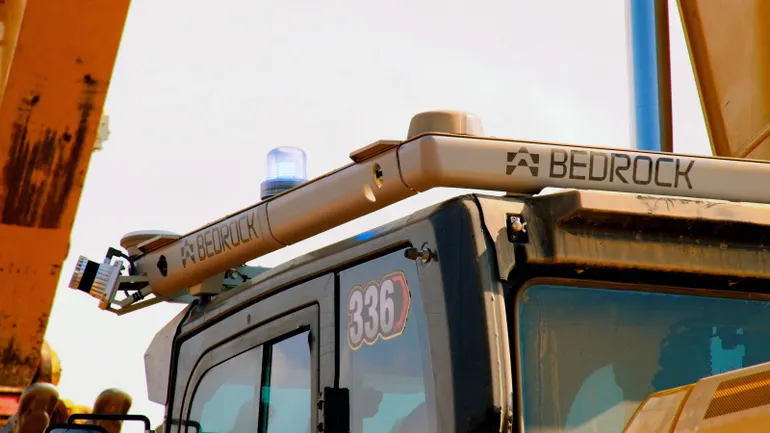
As software matured, hardware startups founded by veterans of autonomous driving and robotaxi firms (such as Waymo) began pivoting toward industrial jobsites. Bedrock Robotics emerged as a dominant player in autonomous earthmoving, deploying robotic excavators capable of handling millions of cubic yards of dirt without human operators in the cab. In February 2025, Bedrock closed a blockbuster $270 million Series B funding round.
Q1 2026: The Billion-Dollar Milestone and Mainstream Deployment
The first quarter of 2026 marked a watershed moment for construction automation.
- March 2026: Panelists at the New York Build conference warned attendees about the critical necessity of clean data, popularizing the mantra "garbage in, garbage out" as contractors integrated automated systems.
- Early April 2026: Bedrock Robotics announced that its autonomous excavators had transitioned from isolated tests to active commercial work on real jobsites for tier-one contractors, including Sundt Construction and Zachry Construction.
- Monday of Current Week: Global investment behemoth SoftBank threw its financial weight behind Zurich-based Gravis Robotics in a staggering $200 million Series A funding round, explicitly citing a commitment to "physical AI."
Supporting Data
The commercialization of construction robotics is backed by a robust framework of quantitative metrics, market research, and financial disclosures compiled by leading analysts and benchmarking firms.
- $1 Billion Milestone: Three pure-play construction robotics startups—Bedrock, Gravis, and FieldAI—have collectively raised close to $1 billion in recent funding rounds.
- 45% Year-Over-Year Growth: According to BuiltWorlds’ 2026 Equipment & Robotics Benchmarking report, contractor utilization of robotics on active jobsites increased by 45% compared to the previous year.
- Tripling of Pilot Programs: The same report noted that the number of construction firms running dedicated robotics pilot programs nearly tripled year-over-year, indicating a massive pipeline of upcoming commercial deployments.
- Venture Capital Giants: Financial backing has transcended traditional construction venture funds. Noteworthy investors include SoftBank ($200M into Gravis), Nvidia and Bill Gates (backing FieldAI), and Nvidia’s venture arm, Nventures, alongside Tishman Speyer (backing Bedrock).
- Massive Earthmoving Demands: According to Bedrock CEO Boris Sofman, modern civil projects routinely require the movement of millions of cubic yards of earth—volumes that far outstrip current human labor capacity, making automation an operational necessity rather than a luxury.
Official Responses and Industry Perspectives
Key figures from venture capital, technology development, general contracting, and third-party consultancy have offered candid insights into the opportunities and challenges presented by this technological wave.
The Investor Perspective: SoftBank and Physical AI
In announcing its $200 million Series A investment in Gravis Robotics, global investment behemoth SoftBank emphasized its long-term strategic pivot toward "physical AI." This technological framework empowers machines to perform complex, unscripted physical actions in unpredictable, real-world environments—the exact capability required to navigate the chaotic, ever-changing landscape of a heavy construction site.
The Startup Perspective: Boris Sofman, CEO of Bedrock Robotics
Reflecting on the operational realities driving contractors to adopt autonomous heavy machinery, Bedrock CEO Boris Sofman highlighted the sheer scale of modern infrastructure needs.
"We are seeing increasing projects with millions of cubic yards of earth to be moved," Sofman told industry publication Construction Dive. By partnering with established contractors like Sundt Construction and Zachry Construction, Bedrock is proving that autonomous heavy equipment can function reliably in high-stakes commercial environments.
The Consultant Perspective: Daniel Ahmoye, McKinsey & Company
Daniel Ahmoye, a partner at global management consulting firm McKinsey & Company, views the construction sector as the next major frontier for automation-driven value creation.
"There’s been a huge amount of advancements in robotics overall, and I think the industry is waking up to seeing construction as a next frontier to where value could be created," Ahmoye noted.
Addressing the spectrum of task-specific versus heavy machinery automation, Ahmoye pointed to smaller units like Dusty Robotics (for automated layout) and Canvas (for drywall finishing).
"I think we’ve seen a lot of positive experimentation around the smaller robots that are doing the blueprinting, drilling, painting, bricklaying, things like that, where it’s a repetitive task. It has a form factor that is able to move around a site in a controlled environment."
The General Contractor Perspective: Vincent Poon, Structure Tone
While enthusiasm is high, operational leaders are acutely aware of the technical prerequisites required to make robots function effectively. Vincent Poon, VDC (Virtual Design and Construction) department manager at New York City-based general contractor Structure Tone, addressed the fundamental data challenge during the New York Build conference. Summarizing the dependency of AI models on clean historical inputs, Poon invoked a classic tech adage:
"Garbage in, garbage out."
Implications
The rapid scaling of construction robotics and physical AI carries profound structural, economic, and operational implications for the built environment.
1. Easing the Chronic Labor Shortage
The primary catalyst for automation is not merely cost-reduction, but survival. With an aging workforce, a persistent skills gap, and an insufficient influx of younger tradespeople, the construction industry faces a severe capacity bottleneck. Robots, autonomous excavators, and automated layout tools do not replace the skilled tradesperson entirely; rather, they act as mechanical apprentices. By absorbing repetitive, physically taxing, and dangerous tasks—such as earthmoving, grading, drywall finishing, and floor layout—machines allow human workers to focus on higher-level problem-solving, project management, and specialized craftsmanship.
2. The Polarization of Contractor Business Models
According to McKinsey’s Daniel Ahmoye, the advent of robotics will fundamentally alter the competitive landscape for contracting firms, dividing them into two distinct operational camps:
- Specialized Trade Specialists: Firms that focus intensely on a single vertical (such as electrical, mechanical, or concrete work) and deeply integrate trade-specific robotics to achieve hyper-efficiency.
- Fully Integrated EPC Contractors: Large-scale Engineering, Procurement, and Construction firms that own and oversee the entire project lifecycle, leveraging fleet-wide robotics platforms across all phases of development.
Mid-sized contractors who fall between these two extremes face significant strategic challenges. Lacking the massive capital reserves of mega-EPCs or the hyper-focused expertise of specialized subcontractors, mid-tier firms will be forced to adopt a cautious "wait-and-see" approach. They are unlikely to fund proprietary software development, but will instead be compelled to adopt third-party robotics technologies only after their commercial viability, reliability, and return on investment have been thoroughly proven in the field.
3. The Data Crisis and the Need for Digital Hygiene
As Vincent Poon of Structure Tone underscored, advanced robotics and physical AI are only as effective as the data fed into them. Historically, the construction industry has suffered from siloed information, fragmented project documentation, and poor digital record-keeping. To successfully deploy autonomous machinery and AI-driven platforms, construction firms must undergo a parallel digital transformation. Standardizing data collection, adopting Building Information Modeling (BIM) best practices, and ensuring clean, structured information pipelines will determine which contractors thrive in the age of robotics—and which ones struggle with costly operational failures.
4. Long-Term Outlook: Humanoids on the Horizon
While current jobsite deployments focus heavily on modifying existing heavy machinery (like excavators) or utilizing specialized wheeled robots (for layout and drywall), the horizon points toward even more radical form factors. McKinsey’s recent research indicates that builders should already be planning for the commercial introduction of humanoid robots. Designed to navigate standard human environments, climb stairs, and manipulate standard tools, humanoid robots could eventually bridge the final gap in full jobsite automation.
For now, however, the nearly $1 billion poured into Bedrock, Gravis, and FieldAI represents a pragmatic, highly targeted push. By solving specific bottlenecks—such as moving millions of cubic yards of earth or automating repetitive layout and grading—the construction industry is slowly, deliberately building a more resilient, technology-driven future.
