

By Patrick Holland
Director of Content, Hardware
At a time when the broader smartphone industry is moving in a singular, frustrating direction—raising retail prices, scaling back included memory, and passing the exorbitant costs of AI infrastructure onto the consumer—one company is stubbornly and brilliantly swimming upstream.
Clicks Technology, widely recognized for its polarizing yet popular physical keyboard accessories for iPhones, is officially doubling down on value. Ahead of the anticipated December launch of the BlackBerry-inspired Clicks Communicator, the company has announced a series of unexpected, consumer-friendly hardware upgrades. Rather than hiking prices to offset rising global component costs, Clicks is actually increasing the phone’s core specifications, offering more RAM and a larger battery than originally promised, all while preserving its introductory preorder price point.
For mobile enthusiasts weary of the endless march of sterile, glass-slab phones prioritizing generative AI gimmicks over tactile utility, the Communicator represents a refreshing return to functional efficiency. Designed by a former BlackBerry engineer, the device merges the nostalgia of old-school physical typing with modern Android capabilities. With preorders currently open and a hard cutoff approaching, the tech world is taking notice.

Main Facts: What You Need to Know About the Clicks Communicator
The Clicks Communicator is an unlocked Android smartphone that bridges the gap between retro productivity devices and modern mobile operating systems. Originally teased at the Consumer Electronics Show (CES) in January, the handset has evolved rapidly due to an unexpectedly robust wave of consumer demand.
The most striking upgrade revealed in Clicks Technology’s latest product showcase centers on raw performance and longevity. The unreleased phone will now ship with 12GB of RAM, a substantial bump from the initially promised 8GB. Furthermore, the internal battery capacity has been increased to 4,350 mAh, up from the original 4,000 mAh specification.
Despite these hardware enhancements, the company is maintaining its early-bird pricing structure. The phone carries an eventual retail price of $649, but consumers can secure it via a preorder discount for $499 until September 30.
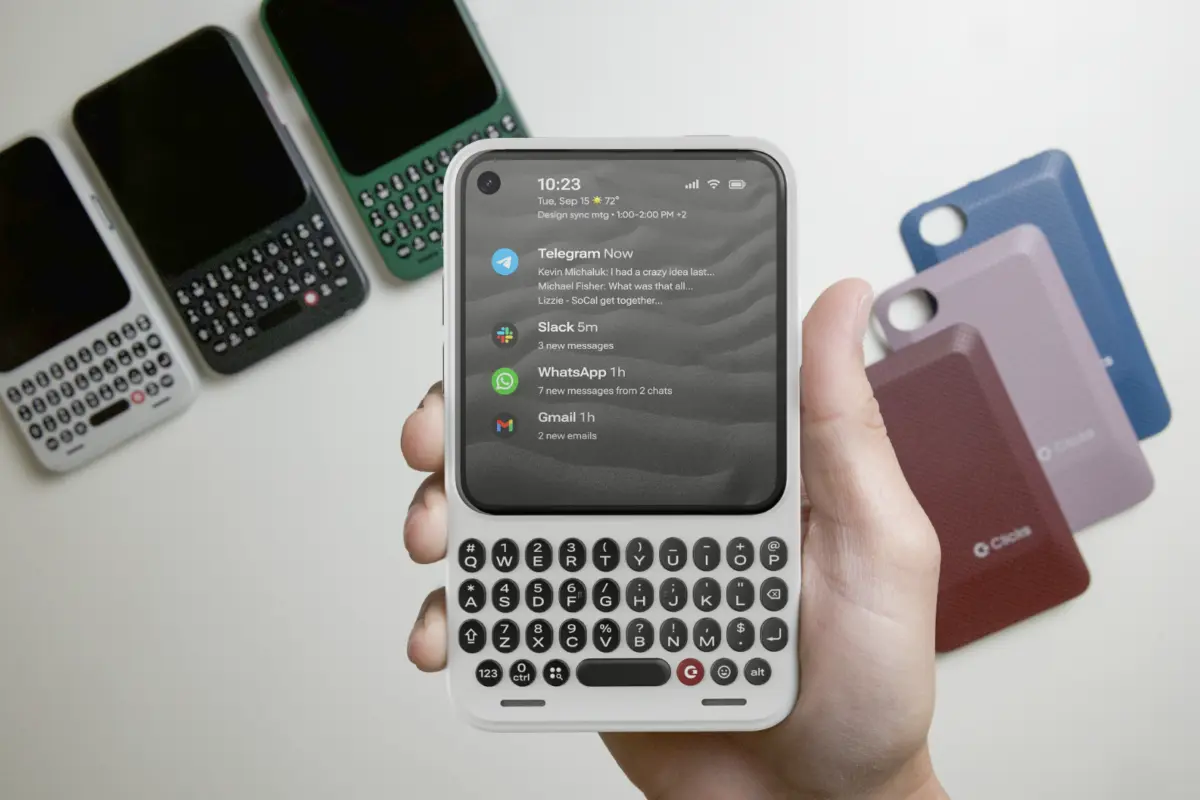
Beyond its foundational specs, the Communicator proudly retains classic design elements that have been systematically purged from modern flagships. It features a physical QWERTY keyboard, a dedicated notification LED loop (dubbed the Signal Light), a headphone jack, and expandable storage or dual-SIM capabilities. Operating on a specialized version of the minimalist Niagara Launcher, the device is explicitly engineered for messaging, calls, and streamlined communication rather than passive media consumption.

Chronology: From CES Teaser to December Launch
The journey of the Clicks Communicator reflects a nimble startup responding directly to a passionate niche market.
- January (CES): Clicks Technology officially announces the Communicator concept at CES, showcasing its vision for a dedicated hardware-keyboard phone. The design draws heavy inspiration from the company’s previous keyboard cases, famously utilizing a Motorola Razr cover screen nestled within a Clicks casing during early prototyping phases.
- Spring: Initial interest blows past internal projections. Buoyed by unexpectedly high preorder volumes, Clicks secures the financial leverage needed to optimize the phone’s architecture, including upgrading its internal processor and memory limits.
- September: Clicks drops an exhaustive feature video detailing late-stage hardware upgrades, software integrations, and customization options. Preorder customers are given access to the online configuration portal to select colors, layouts, and charging covers.
- September 30: The deadline for the $499 promotional preorder price. After this date, the price shifts closer to the standard $649 retail threshold.
- December: The Clicks Communicator is officially scheduled to begin shipping to consumers worldwide.
Supporting Data: Bucking the "RAMageddon" Trend
To truly understand how radical the Clicks Communicator’s pricing and specification strategy is, one must examine the current macroeconomic landscape of the smartphone industry.
Throughout recent release cycles, nearly every major original equipment manufacturer (OEM) has adjusted pricing upward. Google, Motorola, Samsung, and Apple have all implemented notable price hikes across their flagship lineups—such as the iPhone 18 Pro and Pro Max. Industry analysts trace this inflationary wave directly to a global component crunch colloquially known as "RAMageddon."
Driven by the insatiable appetite of AI data centers gobbling up dynamic random-access memory chips, the cost of raw hardware components has skyrocketed. Rather than absorbing these costs or trimming corporate margins, mainstream tech giants have passed the financial burden directly onto buyers, often pairing higher prices with stagnant or restricted memory tiers.

Clicks Technology, however, is defying this industry-wide squeeze. By leveraging direct-to-consumer preorders and bypassing traditional carrier-subsidized retail channels, the startup has managed to pack 12GB of RAM into a sub-$650 device. In a market where competitors use component shortages to justify charging upwards of $1,000 for baseline models, Clicks’ decision to enhance specifications while holding the line on price is nothing short of revolutionary.
Deep Dive: Key Features and Ecosystem Additions
The September hardware showcase provided an in-depth look at how the Communicator operates day-to-day. Several distinct software and hardware features set the device apart from standard Android offerings:
The Prompt Key and On-Device AI
While the physical QWERTY keyboard serves as the primary navigation tool, the dedicated Prompt Key acts as a gateway for modern conveniences. A quick press initiates an on-device speech-to-text engine for rapid dictation. When not interacting with a text field, the Prompt Key summons Google Gemini for AI-driven queries.
The Signal Light LED Loop
Surrounding the Prompt Key is a customizable LED loop designed to keep users informed without demanding screen time. The Signal Light pulses in distinct colors and flashing patterns to differentiate between calendar alerts, incoming tasks, calls, and text messages. This granular notification system mirrors what users have long requested from mainstream devices—such as Google’s underutilized Pixel HiLight feature, which critics note remains largely dormant on newer Pro models.

Message Hub and Quick Replies
Efficiency is the core philosophy of the Communicator’s software suite. The Message Hub curates incoming alerts based on user-defined priority settings. Owners can read and reply to message previews directly from the home screen using keyboard shortcuts, entirely bypassing the need to open individual applications or touch the display.
Customization and Hardware Accessories
Clicks is embracing modular personalization. The phone supports 15W Qi2 wireless charging via swappable magnetic backplates, including two distinct Saffiano leather charging covers priced at $79. Furthermore, accessory giant Dbrand is launching a minimalist "MNML" case for $39 alongside a $35 screen protector, while Clicks will offer its own retro-styled bumper case for $49.
For connectivity, the phone is sold unlocked, functioning seamlessly with traditional nano-SIM cards or eSIMs. Alternatively, users can opt into Clicks Mobile, a dedicated voice and data service operating on AT&T towers in the United States and Vodafone in the United Kingdom. Additionally, for peace of mind, Clicks Care offers a two-year extended warranty and accidental damage replacement plan for $129 in the US and Canada.
Implications: What the Communicator Means for the Future of Mobile Design
The existence and enthusiastic reception of the Clicks Communicator signal a deeper, underlying fatigue among smartphone consumers. For over a decade, the industry has marched toward a homogenous design philosophy: monolithic glass rectangles devoid of tactile feedback, physical keys, or distinctive visual flair.

By proving that a vibrant market still exists for specialized, ergonomics-first communication devices, Clicks Technology is sending a powerful message to Silicon Valley. Consumers are increasingly exhausted by iterative spec bumps focused solely on heavy cloud-based AI processing and microscopic camera upgrades. Instead, a vocal segment of the market desperately wants devices that prioritize typing accuracy, repairability, battery longevity, and intentional minimalism.
If the Clicks Communicator successfully delivers on its promises when it ships this December, it could pave the way for a broader counter-movement in mobile hardware. It demonstrates that startups—unshackled by the massive bureaucratic bloat of legacy tech conglomerates—can listen directly to enthusiast communities, absorb industry headwinds, and deliver exceptional value where legacy giants refuse to tread. For anyone who misses the tactile efficiency of the golden era of mobile messaging, December cannot come soon enough.
