

By Stevie Bonifield
Consumer Tech News Writer
Main Facts
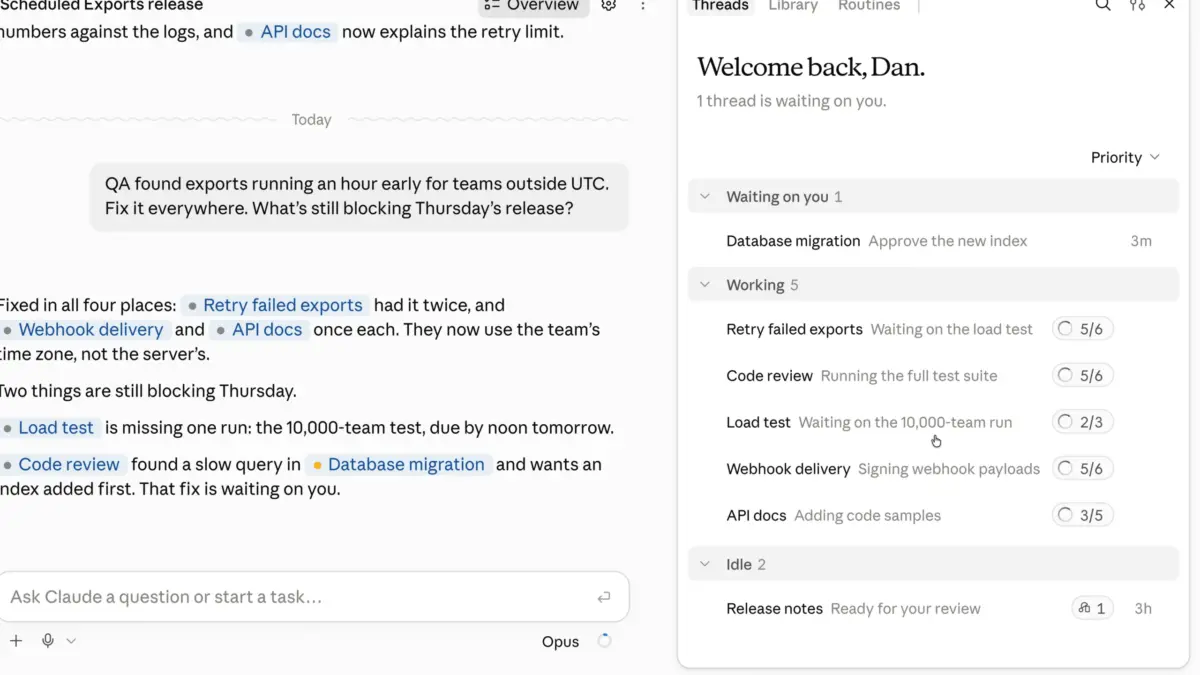
Anthropic has introduced a major overhaul to the "Projects" feature within Claude Code, fundamentally transforming how developers and technical users interact with artificial intelligence for software engineering. The revamped system enables users to run multiple AI agents simultaneously under a unified workspace, sharing common memory, overarching goals, and an integrated library of files and project artifacts.
Operating similarly to multi-agent group management tools—such as Grok Bot and other collaborative AI frameworks—each Claude Code project is now structured around individual "threads." These threads function as autonomous entities running distinct tasks in parallel, all governed by a central "coordinator" agent that directs workflow, tracks progress, and keeps objectives aligned.
Under the hood, every thread operates as an isolated Claude Code cloud session working on its own dedicated branch and repository copy. If multiple threads alter the same underlying code base, overlaps are managed through standard merge conflict resolution processes, mirroring traditional pull requests (PRs) in human software development environments. To further accelerate complex assignments, individual threads can split their delegated workloads into granular pieces using secondary subagents, looping mechanisms, and customized workflows.
Currently rolling out in beta for select Claude Pro and Max subscribers, the updated feature will soon expand its availability across all Pro, Max, Team, and Enterprise accounts, as well as extending into Cowork and regular Claude chat interfaces. While cloud-based execution is the standard for the initial launch, Anthropic has confirmed that local tool and code support is slated to arrive in the near future.
Chronology: The Evolution of Agentic Coding
The journey toward true multi-agent orchestration in software development tools has been swift, marked by continuous iteration on how large language models (LLMs) interact with codebases.
- Early AI Code Assistants: Initially, coding assistants operated primarily as single-turn text generators or inline autocomplete tools (such as early iterations of GitHub Copilot). Developers asked isolated questions or requested small snippets of code within a single chat window.
- The Shift to Workspace Context: Platforms began introducing project-level context, allowing models to read entire directories or specific file repositories. However, these interactions were still largely linear, requiring a user to prompt an AI sequentially through multi-step engineering tasks.
- The Rise of Autonomous Coding Agents: Tools like Claude Code emerged to bridge the gap between chat interfaces and local command-line environments, allowing AIs to execute shell commands, run tests, and manipulate files autonomously. Yet, these agents typically worked on one task at a time.
- The Multi-Agent Horizon (Present Day): With the latest Claude Code update, the paradigm shifts from single-threaded execution to parallel agent teams. By introducing hierarchical structures—where a coordinator oversees multiple independent threads—Anthropic has aligned AI coding workflows closer to traditional human engineering teams, where multiple developers tackle different branches of a project concurrently.
Supporting Data and Technical Architecture
To understand the scale of this update, it is helpful to examine how the technical architecture operates beneath the user interface.
Thread Isolation and Version Control
Each thread is not merely a different prompt window; it is a fully provisioned cloud session possessing:
- An Isolated Environment: Its own working copy and branch of the repository.
- Parallel Execution Pathways: The ability to execute long-running tasks without blocking other ongoing operations within the same project.
- Granular Sub-Delegation: Support for spawning subagents, which can handle repetitive, highly specialized sub-tasks (such as writing unit tests or running lint checks) while the primary thread focuses on core logic.
Merge Conflict Management
Because multiple agents can theoretically modify related files, Anthropic has integrated standard version control logic into the orchestration layer. When threads complete their tasks, the central coordinator attempts to integrate the changes. If conflicts arise, they are surfaced as standard merge conflicts, requiring either coordinator resolution or user intervention via pull request workflows.

Rollout Timeline and Access Tiers
- Phase 1 (Current Beta): Restricted to select Claude Pro and Max subscribers.
- Phase 2 (Broad Expansion): General rollout to all Pro, Max, Team, and Enterprise tier users.
- Phase 3 (Cross-Platform Integration): Expansion into Cowork spaces and standard Claude chat environments.
- Future Roadmap: Implementation of native local tool and repository support to complement cloud sessions.
Official Responses and Perspectives
Anthropic’s positioning of the revamped Projects feature emphasizes collaboration, efficiency, and scale. In official documentation and release statements, company representatives have highlighted the cognitive load reduction for human developers.
By offloading the management of sub-tasks to a coordinator agent, human engineers transition from active coders to technical directors or project managers. Instead of writing boilerplate code or debugging minor errors sequentially, a developer can assign broad objectives—such as "refactor the authentication module while updating the documentation and writing comprehensive test suites"—and watch distinct threads tackle each pillar simultaneously.
Industry observers and early testers have drawn parallels to competing frameworks, noting that the race toward multi-agent systems is rapidly heating up across the tech sector. While tools like Grok Bot have explored agent grouping for general tasks, Anthropic’s deep integration with code repositories and Git-style branching represents a distinct maturation tailored specifically for software engineers.
Implications for the Future of Software Development
The introduction of multi-agent cloud sessions in Claude Code carries profound implications for the software engineering industry, altering everything from individual productivity to organizational workflows.
1. Amplified Developer Productivity
The most immediate impact is the amplification of individual output. A single developer can effectively direct a "virtual team" of AI agents working across different branches of a codebase. Tasks that previously required days of sequential work—such as migrating a database schema while simultaneously updating API endpoints and front-end components—can theoretically be compressed into parallel workflows executed in minutes.
2. Shifting Skill Sets: From Coding to Architecture
As AI agents become more autonomous and capable of handling complex, multi-file changes across parallel threads, the day-to-day role of the software engineer is evolving. The emphasis is shifting away from syntax memorization and routine boilerplate writing toward high-level system architecture, code review, and prompt orchestration. Developers must become adept at spotting architectural flaws, resolving complex merge conflicts produced by AI agents, and guiding coordinator models toward secure, maintainable code.
3. Security and Quality Control Challenges
Running multiple autonomous cloud sessions introduces new governance challenges. When several threads are modifying code concurrently, the risk of introducing subtle bugs, security vulnerabilities, or technical debt increases if the coordinator fails to adequately harmonize the output. Robust automated testing pipelines and rigorous peer review practices will become even more critical when managing AI-generated codebases at scale.
4. The Broader AI Ecosystem
Anthropic’s move underscores a broader industry trend: the transition from chat-based assistants to agentic platforms. As local tool support rolls out alongside cloud sessions, developers will have unprecedented flexibility in choosing how and where their AI agents execute code. This evolution points toward a future where human-AI collaboration is not a series of isolated prompts, but an integrated, continuous dialogue between human strategists and fleets of specialized autonomous agents.
