

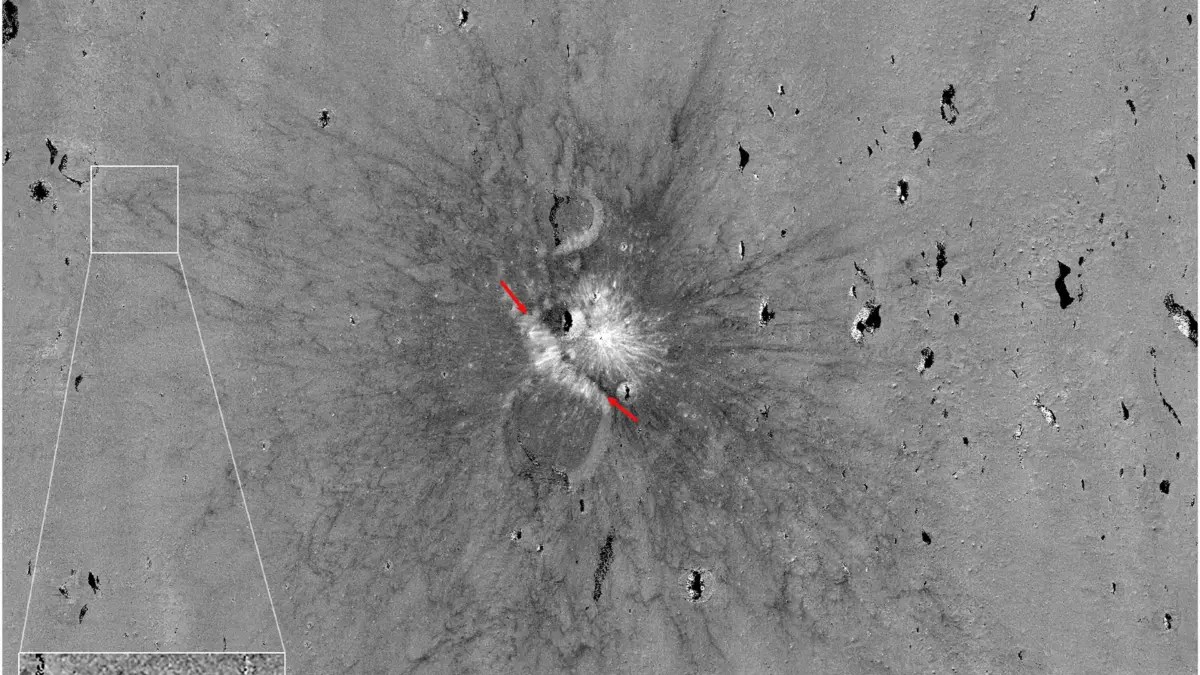
WASHINGTON — While the Moon’s heavily scarred visage bears the silent testimony of over two million cataloged craters, the vast majority of these ancient depressions formed billions of years ago, long before the dawn of human astronomy. Consequently, when astronomers and planetary scientists detect a freshly minted impact scar of significant proportions, it represents a rare and pivotal event in modern space science.
This rare phenomenon occurred recently when NASA’s Lunar Reconnaissance Orbiter (LRO) identified a massive, brand-new impact crater unlike anything previously recorded in the spacecraft’s nearly two-decade operational history. Spanning more than twice the length of a football field and plunging deeper than three school buses stacked end-to-end, the colossal dent has officially been designated as the largest new impact crater ever documented by the LRO.
Published in the peer-reviewed journal Science Advances, the discovery not only underscores the dynamic and hazardous nature of our solar system’s inner neighborhood, but it also provides researchers with an unprecedented, real-time glimpse into hypervelocity impacts on planetary bodies devoid of atmospheric protection.
Main Facts: Anatomy of a Cosmic Cataclysm
The newly discovered scar—officially christened McGetchin Crater in honor of the late planetary scientist Tom McGetchin, who directed the Lunar Science Institute prior to his untimely passing in 1979—is an engineering marvel of natural destruction.
According to data analyzed by NASA scientist Robert Wagner, who first spotted the anomaly during a routine data-quality check, the parameters of the impact are staggering:
- Width: 728 feet (approximately 222 meters)—more than twice the length of a standard American football field.
- Depth: 141 feet (roughly 43 meters)—deep enough to swallow a 14-story building, or equivalent to the length of three yellow school buses parked nose-to-tail.
- Impactor Size: Scientific models suggest the rogue asteroid or space rock responsible for the cataclysm was roughly the size of a six-story building.
- Statistical Rarity: Based on current lunar crater production models, an impact of this sheer magnitude occurs on the Moon only once every 132 years.
Unlike Earth, which relies on a thick, nitrogen-oxygen atmosphere to burn up incoming meteors before they can reach the surface, the Moon possesses virtually no atmosphere to cushion celestial blows. As a result, objects ranging from microscopic space dust to building-sized asteroids strike the lunar surface unhindered at hypervelocity speeds, vaporizing rock, melting regolith, and violently excavating deep basins in fractions of a second.
Chronology of Discovery: Spotting the Unseen
The chain of events leading to the identification of McGetchin Crater highlights the meticulous, often serendipitous nature of modern planetary monitoring.
The Strike Window (April 11 – May 22, 2024)
By cross-referencing high-resolution imaging archives captured by the LRO, researchers were able to narrow down the exact window in which the cosmic collision occurred. Because the LRO maps the entire lunar surface once every 14 days, scientists possess a high-frequency temporal record of surface alterations. Comparative analysis revealed that the pristine terrain imaged on April 11, 2024, was entirely absent of the crater, while subsequent imaging on May 22, 2024, revealed the massive fresh scar.

The Accidental Discovery
The find was far from a planned observation. Robert Wagner, a researcher at Arizona State University working extensively with LRO data, was performing standard data-quality checks when an unusual patch of surface reflectance caught his eye.
"I just stopped, dropped everything, and started looking into what that spot was," Wagner recalled in an official NASA statement.
Upon closer inspection, the "spot" revealed itself to be a colossal, fresh explosion crater defined by bright, high-albedo ejecta blankets—freshly churned lunar material thrown outward from the blast center, which has not yet been darkened by millions of years of space weathering caused by solar wind and micrometeorite bombardment.
Supporting Data: Seventeen Years of a Pockmarked Moon
To understand the true significance of McGetchin Crater, planetary scientists look to the broader operational legacy of the Lunar Reconnaissance Orbiter. Launched in June 2009, the LRO has served as the tireless cartographer of Earth’s sole natural satellite for more than 17 years.
During its extensive service, the orbiter’s powerful instruments—most notably the Lunar Reconnaissance Orbiter Camera (LROC)—have fundamentally altered our understanding of the Moon’s active surface environment:
- 1,000+ New Craters: The LRO has definitively mapped approximately 1,000 newly formed impact craters since it began operations.
- 100,000+ Surface Changes: Beyond distinct craters, the spacecraft has cataloged over 100,000 other transient changes, including landslides, debris flows along steep crater walls, and secondary impact clusters.
- The Resolution Barrier: Because the LRO can reliably detect and resolve new craters only if they are roughly 30 feet (9 meters) wide or larger, countless smaller impacts escape detection. This leaves the true, cumulative frequency of micrometeoroid and small asteroid bombardments as an ongoing statistical mystery.
The discovery of McGetchin Crater also arrives during a remarkably active era for lunar exploration and activity. The Moon has recently captured global headlines not only through automated scientific discoveries, but also through renewed human ambition—exemplified by the Artemis II mission, which marked the first time human visitors orbited the Moon in 50 years. Additionally, the lunar surface has occasionally felt the heavy footprint of human spacefaring debris, such as the high-profile crash-landing of an abandoned SpaceX rocket stage, though that artificial impact left a crater vastly smaller than the natural devastation wrought by the six-story-building-sized asteroid that created McGetchin.
Official Responses and Scientific Consensus
The publication of the findings in Science Advances has elicited widespread excitement across the planetary science community. Researchers emphasize that observing a "once-in-a-century" impact in real-time is akin to winning a scientific lottery.
"Crater production models indicate that an impact of this magnitude is expected to occur only once every 132 years on the Moon," Wagner wrote in the study. "As such, this event constitutes a statistically rare, effectively one-in-a-lifetime observation."

Dr. John Keller, LRO project scientist at NASA’s Goddard Space Flight Center, noted that captures like McGetchin validate decades of theoretical modeling regarding impact mechanics and energy distribution in a vacuum. When an object hits at speeds often exceeding 10 miles per second (16 kilometers per second), the kinetic energy released is equivalent to tactical thermonuclear weapons. Studying the depth-to-diameter ratio of McGetchin allows geologists to test equations that scale down from planetary cataclysms to laboratory-scale hypervelocity physics.
Furthermore, colleagues in the broader astrophysical community point out that tracking contemporary impact rates on the Moon helps refine models of near-Earth object (NEO) populations. Because the Moon and Earth share a similar neighborhood in space, understanding the frequency with which large objects strike the lunar surface offers vital insights into the background asteroid flux that our own planet continuously navigates.
Implications: Preparing for Future Exploration and Planetary Defense
While the discovery of McGetchin Crater is fundamentally a triumph of pure science, its implications stretch far into the practical realms of future space exploration and planetary defense.
Implications for Artemis and Permanent Habitats
As space agencies and private aerospace firms prepare for sustained human presence on the lunar surface—exemplified by NASA’s Artemis program and international proposals for lunar bases—understanding the modern impact hazard is no longer just an academic exercise.
While the statistical probability of a human outpost or habitat being struck by a six-story-building-sized asteroid is exceptionally low over short time horizons, the cumulative risk of smaller, unmapped impacts (such as the thousands of 30-foot craters tracked by LRO) poses a genuine engineering challenge. Lunar habitats, solar arrays, communication relays, and pressurized rovers will need to account for regolith shielding, kinetic shockwaves, and the high-speed spray of secondary ejecta.
Planetary Defense Insights
Earth and the Moon act as a dual system in the inner solar system. By accurately counting fresh impact sites and determining the size distribution of impactors striking the Moon, scientists can better calibrate asteroid-tracking networks on Earth. If the lunar record shows a higher-than-expected flux of mid-sized impactors, it directly informs how space agencies prioritize the detection of "city-killer" and "state-killer" asteroids in Earth-crossing orbits.
The Dynamic Moon
Ultimately, the discovery of McGetchin Crater shatters the lingering psychological illusion that the Moon is a dead, static world frozen in time eons ago. Beneath the romantic glow of moonlight lies an active, violently evolving landscape where massive geological events continue to unfold in the blink of a historical eye. Thanks to orbital sentinels like NASA’s LRO and the vigilant eyes of researchers like Robert Wagner, humanity can now witness the universe writing its history on the Moon in real-time.
