


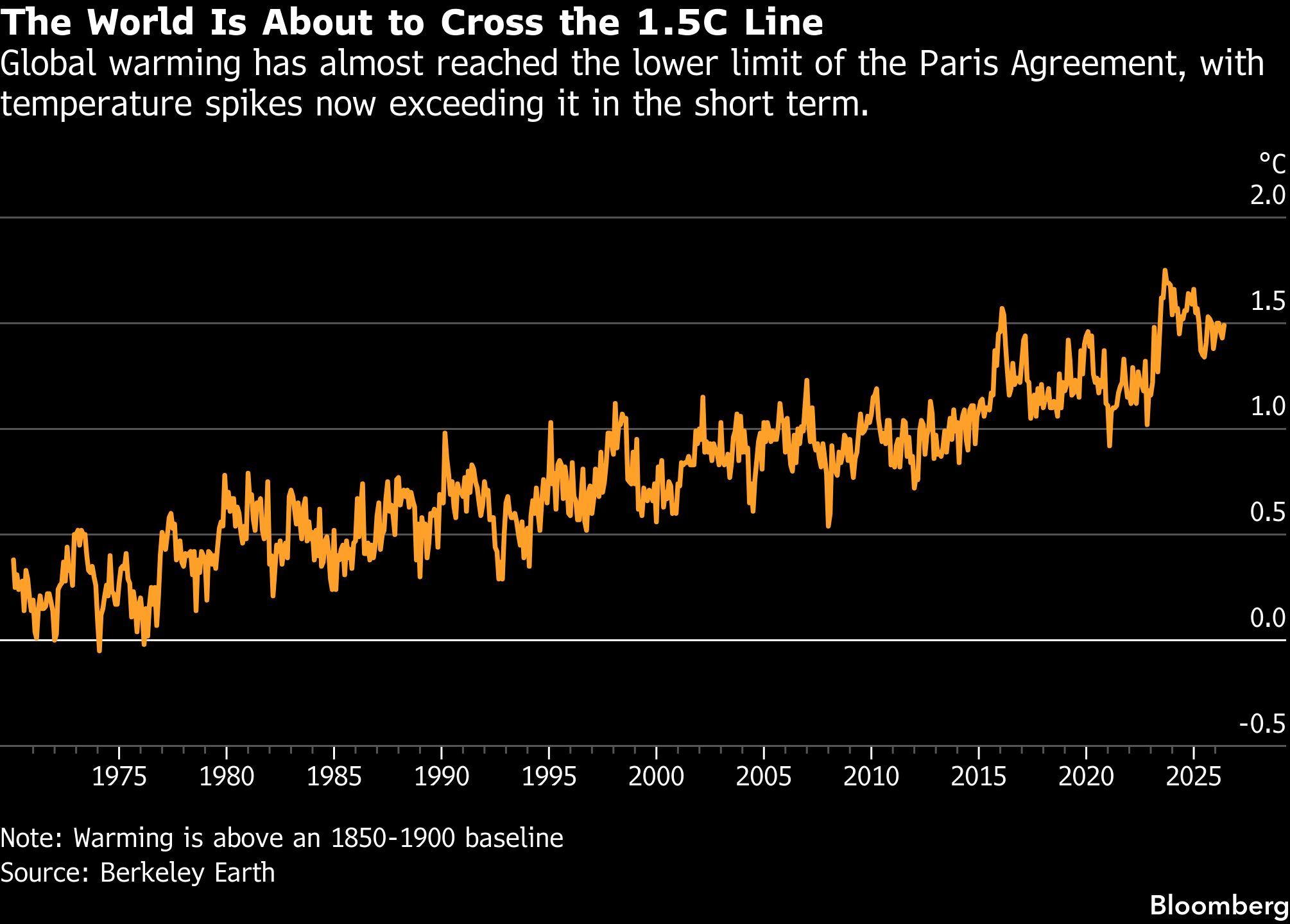
GLOBAL — Nearly a decade after world leaders gathered in the French capital to sign the landmark 2015 Paris Agreement, the era of attempting to indefinitely hold global warming below 1.5°C above pre-industrial levels is drawing to a close.
A groundbreaking assessment published today by the United Nations Environment Programme (UNEP), titled Limiting Overshoot, marks a definitive shift in global climate policy. The report concedes a sobering reality: humanity will almost certainly surpass the critical 1.5°C threshold within the next few years.
Rather than focusing solely on prevention, the international scientific community is now forced to pivot toward an emergency strategy known as "overshoot, peak, and decline." This approach seeks to reverse climate change by the end of the century—pulling global temperatures back down after a temporary, yet potentially catastrophic, breach.
Main Facts
The new UNEP assessment paints a stark picture of the Earth’s immediate climatic trajectory. Currently, long-term global warming stands at approximately 1.4°C, frequently punctuated by extreme temperature spikes.
Under current policy frameworks, scientists project that global temperatures will peak at roughly 1.8°C in a best-case scenario. However, without substantial and immediate policy adjustments worldwide, warming could surge as high as 2.6°C.
To counteract this trajectory, the global community must embrace a dual-track strategy:
- Aggressive Mitigation: Rapidly phasing out fossil fuels to slash greenhouse gas emissions.
- Carbon Dioxide Removal (CDR): Actively pulling CO2 out of the atmosphere through both natural methods, such as massive reforestation campaigns, and advanced technological solutions like direct air capture (DAC).
To ultimately force temperatures back below the 1.5°C threshold, nations must not only achieve net-zero emissions but push past it into a "net-negative" range. Simultaneously, governments must invest heavily in climate adaptation to protect vulnerable economies and populations from escalating environmental disasters.
Chronology: From Paris to the Reality of Overshoot
The journey from the optimistic ambitions of COP21 in Paris to the sobering realizations of today’s UNEP report has been defined by incremental warnings from the scientific community.
- December 2015: The Paris Agreement is adopted by 196 parties at the UN Climate Change Conference (COP21). Countries commit to pursuing efforts to limit the temperature increase to 1.5°C above pre-industrial levels, recognizing that doing so would significantly reduce the risks and impacts of climate change.
- Intervening Years (2016–2025): Successive reports by the Intergovernmental Panel on Climate Change (IPCC) steadily close the window of opportunity. While global emissions nearly plateau in the early 2020s, reduction rates remain woefully inadequate. Extreme weather events intensify globally year after year.
- The Summer of 2026: A convergence of climate disasters—including catastrophic glacial collapses in Asia, historic heat waves across Europe, and unprecedented wildfire seasons in North America and Southeast Asia—underscores the immediate vulnerability of global infrastructure.
- Today: The release of Limiting Overshoot officially transitions global climate policy from prevention to management and reversal, acknowledging that the 1.5°C line will be crossed.
Supporting Data and Real-World Impacts
The consequences of failing to keep warming below 1.5°C are no longer theoretical projections for a distant future; they are unfolding in real-time. Every fraction of a degree of warming amplifies global risks.

Recent events highlight the staggering human and economic toll of unchecked climate volatility:
- South Asia: In Nepal and China, rescue workers continue searching for roughly 4,000 missing individuals following a catastrophic glacial collapse that triggered devastating, widespread flooding. Death tolls have already surpassed 1,000.
- Europe: The continent endured five distinct, punishing heat waves this summer. Rivers like the Danube dropped to historic lows—exposing riverbeds near critical infrastructure like the Paks nuclear power station—while parched crops withered and tens of thousands of excess deaths were linked to the extreme heat.
- North America and Southeast Asia: Choking blankets of wildfire smoke severely impacted air quality for millions of citizens, disrupting economies and daily life.
Looking ahead, the UNEP report warns that future decades could witness the potential submersion of low-lying island nations, the dangerous weakening of critical ocean circulation currents, and surging global health risks.
While cutting emissions can curtail future dangers, the report notes that certain climate impacts—such as irreversible sea-level rise and permanent biodiversity loss—cannot be undone, even if global temperatures are successfully lowered later.
Official Responses and Expert Perspectives
The release of Limiting Overshoot has triggered intense discussions among scientists, policymakers, and international leaders regarding responsibility, strategy, and accountability.
Debra Roberts, an honorary professor at the University of KwaZulu-Natal in South Africa and a co-author of the report, emphasized the narrow window for action.
"We are at a really critical point," Roberts said. "The level of ambition [of countries] will really determine whether overshoot lasts for decades or lasts for millennia."
Richard Betts, a climate scientist at the University of Exeter and the UK Met Office, cautioned against viewing carbon dioxide removal technologies as a magical fix.
"We cannot rely on CDR as a get-out-of-jail-free card, if you like," Betts noted. "We have to reduce emissions with even more urgency than before."
Addressing the question of global accountability, Inger Andersen, executive director of UNEP, pointed directly to major industrial powers.
"Countries with a greater historical responsibility for climate change should do the most work," Andersen stated, noting that the United States remains the largest cumulative emitter in history.
Notably, the UNEP report largely dismisses unproven geoengineering concepts—such as spraying sunlight-reflecting chemicals into the upper atmosphere or cloud-brightening techniques utilizing sprayed seawater.
"The science around this is only just beginning," Andersen remarked. "So this is not a place where we can hang our hat, as solutions."
Implications for Global Policy and the Future
The acknowledgment that the world will overshoot 1.5°C fundamentally reshapes the architecture of international climate negotiations.
1. The Redefinition of Net-Zero
For years, net-zero targets were framed around stopping emissions from rising further. Now, nations must calculate pathways to net-negative emissions. This places immense pressure on governments to fund and scale up carbon removal technologies that are currently in their infancy, while simultaneously accelerating the green energy transition.
2. Mitigation and Adaptation as Twin Pillars
The report stresses that mitigation (stopping emissions) and adaptation (preparing for impacts) are mutually reinforcing. Communities cannot successfully adapt to relentless, escalating disasters if emissions continue to drive environmental breakdown. Resources for adaptation will only remain viable if global heating is actively curbed.
3. The Urgency of 2030
Despite the grim outlook for the 1.5°C threshold, the authors insist that every fraction of a degree matters immensely. To prevent a worst-case warming scenario of 2.6°C—and to shorten the duration of the 1.5°C overshoot—global emissions must nearly halve by 2030 and reach effective zero by mid-century.
The era of merely talking about climate targets has ended. As the world enters the age of overshoot, the decisions made by industrialized nations in the coming years will determine whether planetary recovery is achieved within this century, or if humanity is locked into a legacy of millennial-scale warming.
