

By Tech Desk & Industry Analysis
Published: March 2025
For a quarter of a century, Audacity has stood as the undisputed heavyweight champion of free, open-source audio editing. Launched in the year 2000 by Dominic Mazzoni and Roger Dannenberg at Carnegie Mellon University, the software became a ubiquitous staple for everyone from bedroom podcasters and amateur musicians to high school radio stations and professional sound designers needing a quick fix.
Yet, for all its utility, reliability, and ubiquity, Audacity remained stubbornly anchored in the past. As the digital audio workstation (DAW) landscape evolved around it—introducing fluid, non-destructive workflows, sleek interfaces, and sophisticated clip management—Audacity continued to operate on a clunky, rigid paradigm. Features were often bolted on over the years like additions to an old house, resulting in an interface that was powerful, yes, but notoriously punishing to navigate.
That era officially comes to an end today. Following a protracted development cycle and a minor pre-release controversy over a heavily criticized logo leak late last year, Audacity 4 has officially been released to the public. Billed by its developers as the most significant overhaul in the software’s 25-year history, Audacity 4 sheds its notorious friction, modernizes its visual identity, and introduces the holy grail of modern audio editing: a fully non-destructive workflow.
Main Facts: What’s New in Audacity 4?
The release of Audacity 4 is not merely an incremental update with bug fixes and minor under-the-hood optimizations. It represents a foundational reimagining of how users interact with audio on the platform. The upgrade bridges the gap between a rudimentary audio recorder and a powerful, modern digital audio workstation.
1. The Shift to Non-Destructive Editing
Historically, Audacity operated on a destructive editing model. If you trimmed a clip, applied an effect, or pasted audio over another section, the underlying data was permanently altered or overwritten unless you immediately hit Ctrl+Z.
Audacity 4 changes everything by introducing a true non-destructive editing workflow. Users can now trim clips down, shorten waveforms, and manipulate regions knowing that the original audio data remains intact in the background. If you change your mind five minutes—or five days—later, you can simply drag the edge of a clip back out to recover the hidden audio.
2. Overlapping Clips and Free-Form Timelines
In older versions of Audacity, the timeline was rigid. If you attempted to drag an audio clip past or on top of another existing clip, it would hit a physical barrier and stop dead in its tracks. To work around this, editors had to perform tedious cut-and-paste gymnastics, manually making room on the timeline before moving elements around.
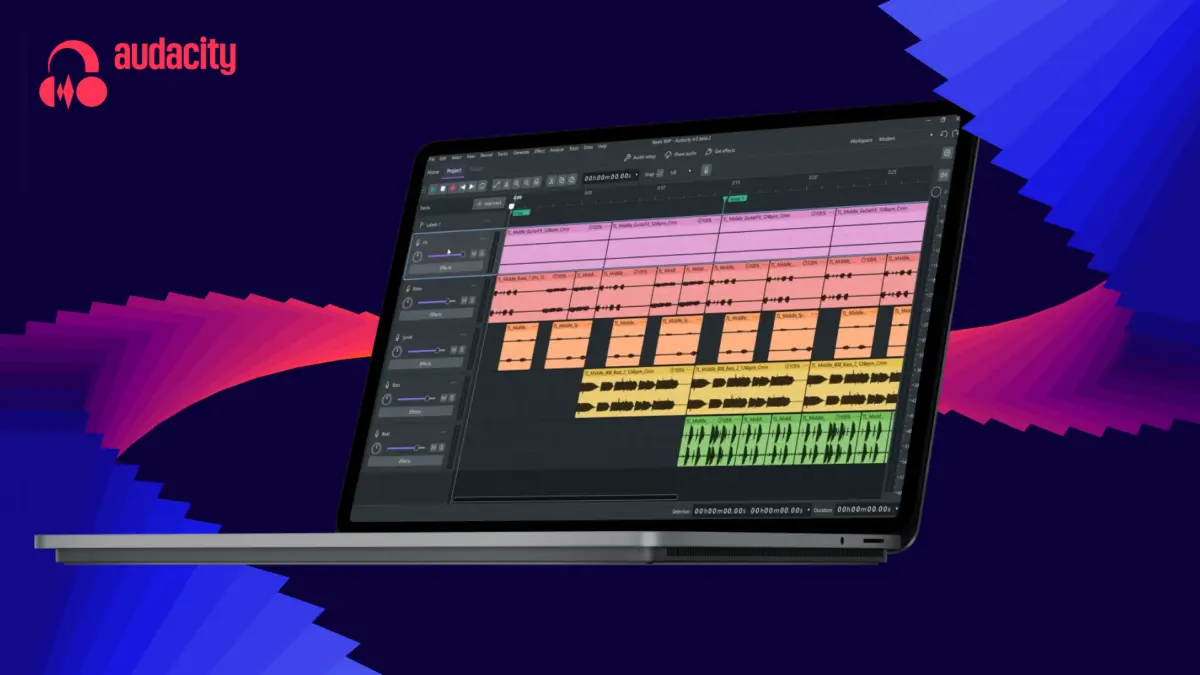
Audacity 4 completely removes these constraints. Clips can now freely overlap. Editors can drop audio into congested areas of the timeline and sort it out later, or drag clips across the workspace with the fluid, unrestricted motion expected from modern DAWs like Ableton Live, Pro Tools, or Reaper.
3. Advanced Splitting, Envelopes, and Effects
Precision is paramount in audio production. Audacity 4 introduces streamlined clip-splitting capabilities, allowing creators to chop up and rearrange audio segments with minimal friction. Furthermore, the development team has completely refreshed clip envelopes (for volume automation) and overhauled the built-in effects suite.
4. A Unified Visual Aesthetic and Project Management
Accompanying the functional updates is a dramatic visual overhaul. Audacity 4 brings the application’s design language in line with Muse Group’s broader ecosystem, which includes notation software MuseScore and cloud-sharing platform Audio.com. The new UI features customizable themes, a cleaner layout, and a dedicated home screen designed to streamline project organization and startup management.
Chronology: A Quarter-Century of Audio and the Road to Version 4
To truly understand the weight of the Audacity 4 release, it is helpful to look back at how the software evolved from a simple academic project into a global phenomenon—and how it reached this critical turning point.

- Fall 2000: Dominic Mazzoni and Roger Dannenberg release Audacity 0.8 to the public. Designed as an open-source, cross-platform audio editor, it quickly gains traction among Linux enthusiasts and budget-conscious creators.
- 2006–2011: Audacity reaches mainstream adoption. As the podcasting boom takes off, millions of independent creators download the software as their primary tool for recording and editing spoken-word audio.
- 2021 (The Muse Acquisition): Muse Group—the company behind Ultimate Guitar and MuseScore—acquires Audacity. The transition is met with immediate friction and community backlash following updates to the privacy policy regarding error reporting and telemetry. The team quickly walks back and clarifies the policy, but trust within the open-source community remains fragile.
- 2023–2024: Muse Group begins laying the groundwork for a generational shift. Cloud integration via Audio.com is introduced, and developers quietly begin prototyping a massive core engine rewrite to address Audacity’s legacy structural limitations.
- October 2024: A minor internet controversy erupts when early concepts of a redesigned Audacity logo leak online. Critics pan the new icon as overly generic and uninspired, prompting swift community discourse across Reddit and tech forums.
- March 2025: Audacity 4 officially launches. The final logo is rolled out (to a much warmer reception than its leaked predecessor), and the long-promised non-destructive architecture goes live worldwide.
Supporting Data: The Scale and Impact of Audacity
Audacity’s influence on the digital media landscape cannot be overstated. Statistics gathered over its 25-year lifespan highlight its monumental footprint:
- Downloads: Audacity has been downloaded hundreds of millions of times across Windows, macOS, and Linux, consistently ranking as one of the most popular open-source utility software packages in history.
- Zero-Cost Barrier: Despite its professional-grade capabilities in specific domains, the software remains 100% free and open-source under the GNU General Public License (GPL).
- Ecosystem Expansion: Since Muse Group’s acquisition, the user base has increasingly tied into cloud workflows, with millions of projects shared annually via Audio.com integration.
- Legacy vs. Modern Performance: Internal benchmarks from the development team indicate that Audacity 4’s new core engine handles complex multi-track sessions with up to 40% fewer UI bottlenecks compared to version 3.x, largely due to the elimination of legacy rendering constraints.
Official Responses and Community Reactions
The development team at Muse Group and the broader open-source community have maintained an ongoing dialogue regarding the direction of the software.
Speaking on the release of Audacity 4, lead maintainers emphasized that preserving the software’s core accessibility was paramount while pushing its technical boundaries. "We knew we were walking a tightrope," noted one lead developer in a community briefing. "Audacity is beloved because anyone can download it, open it up, and record a voice memo in ten seconds without reading a manual. But the ceiling was too low. Creators were outgrowing it and hitting walls that simply shouldn’t exist in modern audio production. Version 4 maintains that instant-on accessibility while opening up professional workflows that users have begged for over a decade."
The community response has been largely enthusiastic, though seasoned veterans have expressed mild adjustments to the learning curve. On platforms like Hacker News and Reddit’s r/podcasting, users who spent decades working around Audacity’s destructive quirks have shared a mixture of relief and disbelief.
"For twenty years, I’ve had to meticulously plan my edits because dragging a clip over another meant losing data or doing three steps of undo," wrote one long-time user on an audio engineering forum. "Testing the Audacity 4 beta feels like taking heavy ankle weights off after running a marathon for a decade."
Regarding the logo controversy from late 2024, design leads acknowledged the community feedback. The final iteration of the icon dials back some of the more jarring corporate-minimalist elements found in the leaked draft, landing on a modern compromise that nods to the classic blue-and-yellow waveform heritage while signaling the software’s contemporary chapter.
Implications: What Audacity 4 Means for the Audio Industry
The release of Audacity 4 carries significant implications for the broader audio software market, educational institutions, and independent creators alike.
1. Disrupting the Entry-Level DAW Market
For years, entry-level creators faced a stark divide: they could either struggle with Audacity’s dated, destructive workflow or invest time and money into steep, commercial learning curves like Adobe Audition, Apple Logic Pro, or paid tiers of Reaper and Pro Tools.
By introducing non-destructive editing and overlapping clips, Audacity 4 effectively bridges this gap. It provides a robust, zero-cost sandbox that teaches concepts native to professional DAWs. This makes it an even more formidable educational tool for high schools, universities, and community media centers.
2. The Maturation of Open-Source Audio
Open-source software often struggles with UI/UX modernization due to fragmented volunteer contributions and a prioritization of backend stability over aesthetic polish. Muse Group’s stewardship of Audacity—while controversial at inception—has demonstrated that commercial backing, when managed respectfully, can inject the resources needed to revitalize aging open-source giants. Audacity 4 proves that free software can look, feel, and perform on par with paid commercial suites.
3. Workflow Shifts for Independent Creators
For podcasters, voiceover artists, and YouTubers, the time saved by non-destructive editing and flexible timeline management will compound exponentially. Tasks that once required meticulous precision or destructive trial-and-error can now be executed on the fly. As creators increasingly migrate toward unified cloud ecosystems (such as the pairing of Audacity with Audio.com), the software is well-positioned to remain a dominant force in digital media creation for the next decade.
Conclusion
Audacity 4 is more than just a software update; it is a redemption arc for a legacy tool that risked becoming a relic of its own success. By shedding its clunky historical baggage while retaining the spirit of radical accessibility that defined its first 25 years, Audacity has secured its place not just in the past of audio editing, but firmly in its future.
