

By Staff Industry Correspondents
Published by ACHR News
Main Facts: The Battleground of Modern HVACR Innovation
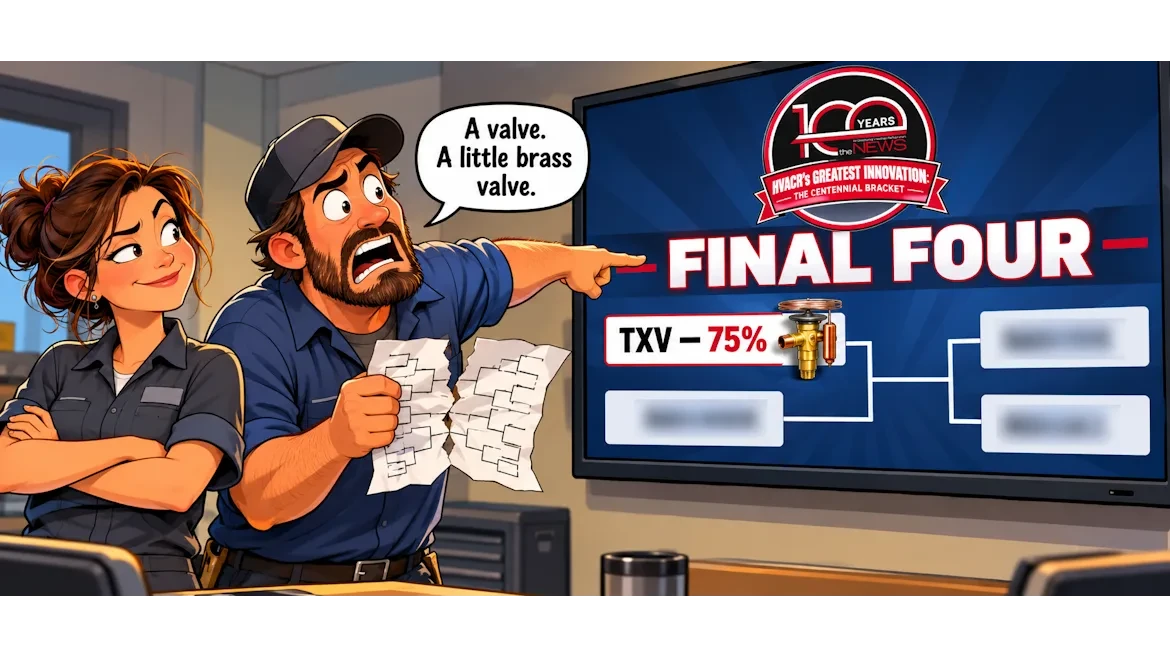
The heating, ventilation, air conditioning, and refrigeration (HVACR) industry has been gripped by a tournament-style fever that mirrors March Madness, but with a decidedly technical twist. Out of a competitive field of industry-defining technologies, components, and regulatory shifts, the bracket has officially been slashed to the "Final Four." Brackets have been thoroughly busted across contractor shops, engineering offices, and wholesale houses nationwide, and somewhere, an exhausted HVAC technician is still demanding a recount over a hard-fought voting margin.
The journey to the final four has been marked by high drama, surprising upsets, and a definitive statement from the field regarding what truly matters on a day-to-day service call. Round 2 delivered massive statistical blowouts and nail-biting, fourth-quarter finishes.
The remaining elite four innovations vying for the ultimate crown are:
- Thermostatic Expansion Valves (TXVs)
- Inverter-Driven Compressors
- Electronically Commutated Motors (ECM)
- Smart Thermostats
As the industry prepares to crown a champion, these four technologies represent the pinnacle of mechanical reliability, energy efficiency, and digital integration. They are the components and systems that define modern comfort, proving that while refrigerant transitions and digital tools dominate headlines, the foundational and adaptive technologies are what truly capture the hearts and votes of the HVAC community.
Chronology: How the Field Narrowed to the Final Four
To understand how these four heavyweights reached the semifinals, one must look back at the chaotic path of the tournament’s early rounds. The competition began with a diverse cross-section of the HVACR ecosystem, pitting legacy mechanical components against cutting-edge electronics, regulatory mandates, and digital service solutions.
Round 1: The Initial Cut
The tournament opened with heavy debates among contractors on job sites and in supply houses. Legacy hardware faced off against software solutions, while efficiency standards squared off against installation mainstays. Early matchups saw traditional staples defending their turf against the relentless push of decarbonization and smart automation. While the opening round claimed several fan-favorite tools and niche components, it set the stage for a dramatic Round 2 where the stakes—and the voting turnout—reached a fever pitch.
Round 2: Steamrollers and Upsets
Round 2 provided the most memorable moments of the tournament so far, highlighted by a massive clash between legacy mechanical reliability and modern regulatory compliance.
The most shocking result of the round occurred when TXVs (Thermostatic Expansion Valves) put up the tournament’s biggest numbers. In a stunning landslide, the humble brass valve absolutely steamrolled low-GWP (Global Warming Potential) refrigerants, capturing a massive 75% of the vote. For years, technicians have endured the headaches of refrigerant transitions, learned to handle new flammable blends, invested in recovery equipment tailored for A2L refrigerants, and sat through countless mildly panicked code discussions regarding building updates. Yet, when push came to shove, all of those macro-industry shifts were shown the door by a little piece of brass that has been regulating superheat for decades.
Meanwhile, Inverter-Driven Compressors flexed their technological muscle, proving they were a true championship contender. In their matchup against ductless mini-splits, inverter compressors secured a decisive victory, taking 66% of the vote to 34% for the mini-splits. The ability to modulate capacity seamlessly rather than operating on a binary on/off cycle resonated deeply with technicians and system designers who prioritize precision comfort and part-load efficiency.
The Fourth-Quarter Thrillers
While the TXV and inverter matches were definitive, the other two semifinal slots came down to dramatic, wire-to-wire fourth-quarter battles.
- ECM Motors vs. Cold-Climate Heat Pumps: In a clash of energy-saving titans, Electronically Commutated Motors held off the surging popularity of cold-climate heat pumps, winning 57% to 43%. Despite the massive regulatory push and federal incentives driving cold-climate heat pumps into northern markets, the ubiquitous ECM motor—found in modern blowers and indoor units everywhere—proved that reliable, variable-speed airflow management remains close to the contractor’s heart.
- Smart Thermostats vs. Digital Diagnostics/Bluetooth Tools: In perhaps the most culturally relevant matchup for modern service techs, smart thermostats survived a fierce challenge from digital manifolds, app-based meters, and Bluetooth diagnostic tools, edging out the competition 56% to 44%. While technicians rely heavily on digital tools in the field, the smart thermostat ultimate emerged as the victor in consumer-facing impact and home automation integration.
Supporting Data: By the Numbers
The tournament data highlights clear trends in what HVAC professionals value most. The following breakdown illustrates the voting percentages from the pivotal Round 2 matchups that shaped the Final Four:
| Matchup | Competitor A | Vote Share (A) | Competitor B | Vote Share (B) | Winner |
|---|---|---|---|---|---|
| Match 1 | TXVs (Thermostatic Expansion Valves) | 75% | Low-GWP Refrigerants | 25% | TXVs |
| Match 2 | Inverter-Driven Compressors | 66% | Ductless Mini-Splits | 34% | Inverter-Driven Compressors |
| Match 3 | ECM Motors | 57% | Cold-Climate Heat Pumps | 43% | ECM Motors |
| Match 4 | Smart Thermostats | 56% | Digital Diagnostics & Bluetooth Tools | 44% | Smart Thermostats |
Key Takeaways from the Data:
- Mechanical Reliability Trumps Regulatory Fatigue: The 75% routing of low-GWP refrigerants by TXVs suggests that while contractors are adapting to the AIM Act and environmental mandates, the ongoing friction of transitions has left many nostalgic for—or deeply reliant upon—proven mechanical fail-safes.
- Modulation is King: The success of both inverter-driven compressors and ECM motors underscores a broader industry shift away from single-stage, brute-force heating and cooling toward continuous, variable-capacity modulation.
- The Connected Home Rules: Smart thermostats beating out internal diagnostic tools highlights the intersection of homeowner experience and technician serviceability, cementing connectivity as a permanent pillar of modern HVAC design.
Official Responses and Industry Commentary
As the bracket narrows to the final two slots, reactions from across the HVACR community have poured in, reflecting humor, professional pride, and philosophical debates over the direction of the trade.
Industry veterans have expressed mixed amusement and validation regarding the dominance of legacy components. "You spend three years retraining your entire service staff on A2L mitigation, leak detection, and manifold changes, and then the industry votes a mechanical brass valve as the heavyweight champion of the world," remarked one commercial contractor from the Midwest. "It just goes to show that no matter how complex the regulatory landscape gets, the fundamentals of superheat, subcooling, and airflow are what keep us up at night."
On the digital side, manufacturers of smart thermostats and variable-speed drives view their presence in the Final Four as a vindication of efficiency trends. Representatives from major equipment manufacturing firms noted that inverter technology and ECM motors represent the intersection of high efficiency and grid stability. As utilities increasingly demand peak-load reduction and demand-response capabilities, inverter-driven systems and smart thermostats serve as the primary conduits for residential and commercial energy management.
Furthermore, engineering societies and trade associations have weighed in on the cultural significance of the tournament. By gamifying technical components, the initiative has successfully engaged thousands of field technicians, engineers, students, and manufacturers in lighthearted debates that underscore the rapid technological evolution of the trade.
Implications: What the Final Four Tells Us About the Future of HVACR
The composition of this year’s Final Four is more than just a bracket game; it serves as a psychological and technical snapshot of an industry at a crossroads. Analyzing the four remaining contenders reveals critical insights into where the HVACR market is heading over the next decade.
1. The Undying Relevance of Core Mechanics
The presence of TXVs in the Final Four proves that despite the digital revolution, mechanical engineering principles remain sacred. While electronic expansion valves (EEVs) have gained ground in high-end VRF systems, the traditional thermostatic expansion valve remains the trusted workhorse of the residential and light commercial sectors. Its victory over low-GWP refrigerants is symbolic: refrigerants may change, regulations may shift, but the physics of vapor-compression refrigeration endure.
2. The Era of Variable Speed is Here to Stay
With both inverter-driven compressors and ECM motors securing their spots in the semifinals, the industry has definitively closed the book on the era of constant-speed, noisy, inefficient brute-force equipment. Variable-speed technology optimizes comfort, reduces humidity, lowers sound levels, and drastically cuts energy consumption. Contractors specifying equipment today must be fluent in inverter diagnostics and ECM troubleshooting, as these components now form the backbone of high-efficiency installations.
3. The Convergence of Comfort and Connectivity
Smart thermostats reaching the Final Four—besting even specialized diagnostic tools—demonstrates that the modern HVAC system is no longer isolated in a basement or utility closet. It is an active node in the smart home ecosystem. Homeowners demand granular control, energy tracking, and remote diagnostics, while contractors leverage connected thermostats for proactive service alerts and remote troubleshooting.
The Final Stretch
As the tournament moves toward its dramatic conclusion, two of these four innovations will be eliminated, leaving a final pair to battle for the ultimate title of Ultimate HVACR Innovation.
The debate is far from over, and the outcome rests in the hands of the professionals who install, service, and engineer these systems every day. Industry members are encouraged to review the matchups, evaluate the technological impact, and cast their votes to determine which innovation takes home the championship trophy.
For readers seeking quick answers on air conditioning, heating, and refrigeration topics while casting their votes, ACHR News encourages exploring Ask ACHR NEWS, the industry’s smart AI search tool designed to provide instant technical insights.
