

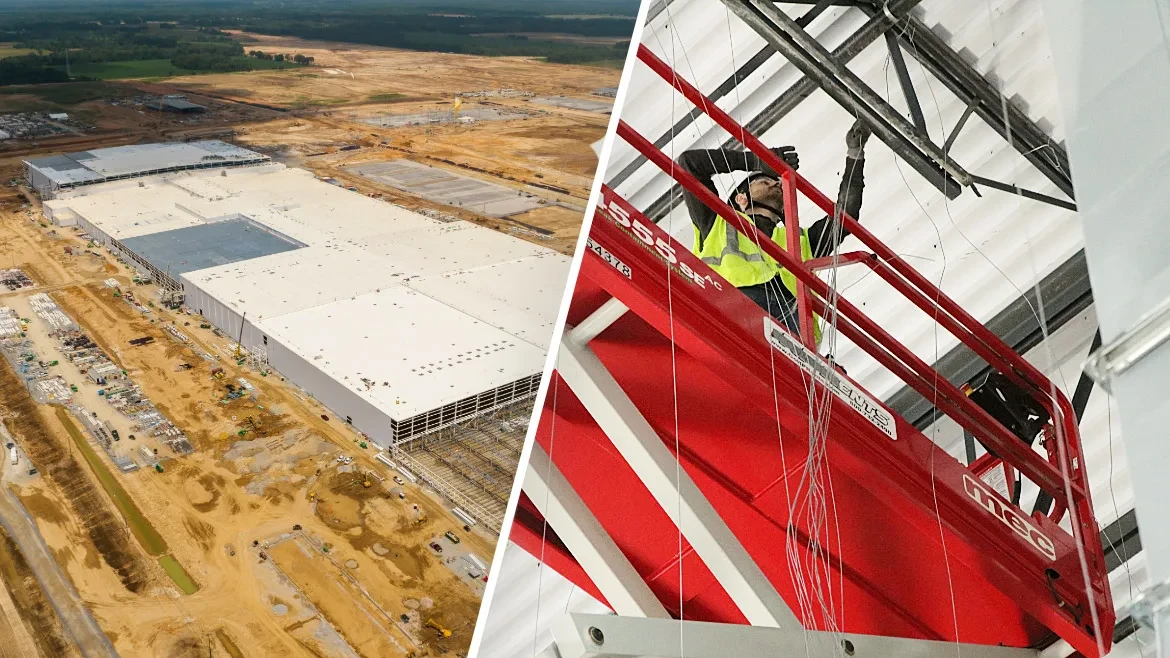
The era of the $1 billion construction project as the ultimate benchmark of scale is officially a relic of the past. Today, hyper-scale data center campuses bearing multi-billion-dollar price tags are rising across rural and suburban landscapes alike. While these technological colosseums promise digital infrastructure for an AI-driven future, they are simultaneously triggering an unprecedented shockwave through the traditional construction industry.
For skilled craft workers, the boom means lucrative paychecks and accelerated career trajectories. For traditional contractors—even those who have never set foot on a server farm jobsite—it means competing for an already depleted labor pool against deep-pocketed tech giants and specialized megaproject developers capable of rewriting regional wage scales overnight.
Main Facts: The Anatomy of the Data Center Labor Crunch
The fundamental tension in modern construction boils down to a simple macroeconomic imbalance: historic demand colliding with a structural labor deficit.
According to estimates from Associated Builders and Contractors (ABC), the construction industry must attract 349,000 net new workers just to maintain equilibrium. Crucially, ABC Chief Economist Anirban Basu notes that the majority of this recruitment need is driven by mass retirements of an aging workforce rather than a sudden explosion in organic service demand.
At the same time, the construction unemployment rate tumbled to a record-low 3.1% in August, with 120,000 jobs added over a 12-month period. However, this growth is starkly bifurcated. Nonresidential specialty trade contractors added 86,000 workers (a 3% increase), while residential construction shed roughly 20,000 jobs. Driving this nonresidential surge are data centers, advanced manufacturing facilities, and major energy infrastructure projects.
The entry of data centers into local markets introduces a disruptive competitor with unmatched financial resources. Staffing firms report that workers transitioning into data center construction—ranging from apprentice electricians to seasoned project managers—frequently command a 25% to 30% wage premium over traditional commercial or residential rates.
Chronology: How Megaprojects Took Over the Market
To understand how the construction sector arrived at this inflection point, it is necessary to trace the convergence of several macroeconomic and technological shifts over the past decade:
- Pre-2020: Data centers were largely regional, modular facilities costing hundreds of millions of dollars, typically integrated smoothly into existing urban and suburban commercial construction pipelines.
- 2020–2022 (The Digital Acceleration): Pandemic-era shifts toward remote work, cloud computing, and e-commerce supercharge digital infrastructure demands. Project budgets swell from hundreds of millions to multiple billions of dollars as hyperscalers scale up.
- 2023–2024 (The Artificial Intelligence Boom): The mainstream emergence of generative AI demands immense computational power, touching off an unprecedented land and construction rush for specialized cooling- and power-intensive data center campuses in markets like Northern Virginia, Ohio, and central Texas.
- 2024–Present (The Labor Market Reckoning): As dozens of multi-billion-dollar campuses break ground simultaneously, regional labor markets dry up. Contractors face severe wage inflation, intense competition for mid-level leadership, and a stark realization that traditional local recruitment is no longer sufficient.
Supporting Data: By the Numbers
Recent empirical data from the Associated General Contractors of America (AGC) and the National Center for Construction Education and Research (NCCER) workforce survey illustrate the profound footprint of data center construction:
- 28% of surveyed contractors performed data center construction work over the past year.
- 58% of those firms reported that data center projects escalated competition for skilled labor.
- 49% observed direct upward pressure on wages.
- 36% noted that data center activity made open positions significantly harder to fill.
- 30% experienced a spike in workforce turnover.
- 55% of firms across the broader industry increased base pay for hourly craft workers more aggressively than they did the previous year.
- 83% of surveyed construction firms reported turnover among new field employees within their first 90 days on the job.
Official Responses and Industry Perspectives
Industry leaders and executives on the front lines are sounding the alarm while aggressively adapting their business models to survive the megaproject squeeze.
The Contractor’s Dilemma
Mindy Bates, Human Resources Director for Valdosta, Georgia-based electrical contractor ACE Electric, has witnessed this transformation firsthand. ACE has experienced double-digit growth in both headcount and revenue for three consecutive years, driven heavily by data center expansion in regions like Columbus, Ohio.
However, growth comes with heavy operational friction. ACE added a net of more than 500 employees over the course of a year, but Bates points out a sobering metric: "You bring in about 700" to net 500 due to early attrition. Furthermore, wage expectations have shifted fundamentally.
"The pay scales that the lower skill people are looking for is the same pay scale of what we used to pay the more experienced ones," Bates explains.
The Orientation Shock
Boyd Worsham, President and CEO of NCCER, brings a 45-year career perspective to the table. Having recently toured massive data center sites nationwide, he highlights a dangerous disconnect in modern workforce integration.
"Those jobs are overwhelming to somebody like me who’s been in the industry for 45 years," Worsham said. "And we take young people who have never walked on a construction job in their life, and we put them on the biggest projects in our country. Of course, they’re going to be overwhelmed."
This baptism-by-fire environment contributes heavily to the industry-wide 90-day turnover rate. Whether due to the sheer physical demands, complex logistical requirements, or unrealistic job expectations, new hires frequently wash out before they can be integrated into long-term career tracks.
The Leadership Bottleneck
While hiring entry-level hands is difficult, contractors universally agree that the true chokepoint lies higher up the organizational chart.
Asia Gower, a senior manager with Holder Construction, emphasizes that the industry’s most critical shortage is not basic labor, but seasoned talent with half a decade or more of field experience.
"The more critical need is in that skilled, maybe five-plus-year [experience bracket], with some leadership experience," Gower noted.
This leadership deficit forces firms to make difficult strategic decisions. ACE Electric has occasionally turned down lucrative contracts simply because it lacked the requisite superintendents, estimators, and project managers to staff them safely and effectively.
"We don’t want to overcommit ourselves," Bates said. "We don’t want to compromise on safety, quality, or put our people at risk."
Implications: Building From Within to Survive the Future
The paradox of the modern construction landscape is that the very projects straining the labor market are simultaneously funding the solutions required to fix it. Because data center developers and hyperscalers operate with substantial capital resources, the financial wherewithal exists to invest in training, recruitment, and educational pipelines.
Shifting Strategies: Growing Your Own Workforce
Contractors are rapidly moving away from reliance on spot-market recruitment. As ACE’s Mindy Bates succinctly puts it:
"You cannot hire your way out of this situation. We got to grow it from within as well."
To achieve this, forward-thinking firms are:
- Establishing Internal Academies: Operating proprietary apprenticeship programs to systematically train electricians, pipefitters, and equipment operators.
- Partnering with Educational Institutions: Expanding high school, vocational, and collegiate outreach programs to capture talent before students enter the traditional job market. Holder Construction, for instance, has aggressively scaled its high school internship initiatives to build a talent bench for five years down the line.
- Enhancing Professional Development: Recent AGC/NCCER data reveals that 35% of firms have initiated or increased spending on training and professional development, while nearly half have deepened engagement with career and technical education (CTE) programs.
The Broader Economic Ripple Effect
Ultimately, the data center boom serves as a harbinger of a broader transformation in the construction sector. The market is no longer defined merely by localized supply and demand curves. Instead, it is increasingly dictated by the gravitational pull of multi-billion-dollar megaprojects that possess the capital to set regional wage floors, absorb talent across state lines, and force traditional contractors to completely modernize their recruitment and retention strategies.
For workers, the megaproject era offers unprecedented earning potential and career mobility. For contractors, it represents a high-stakes balancing act: capturing the immense revenue opportunities of the digital infrastructure boom without compromising safety, quality, or organizational stability in a chronically strained labor market.
