

By Financial News Desk
Main Facts
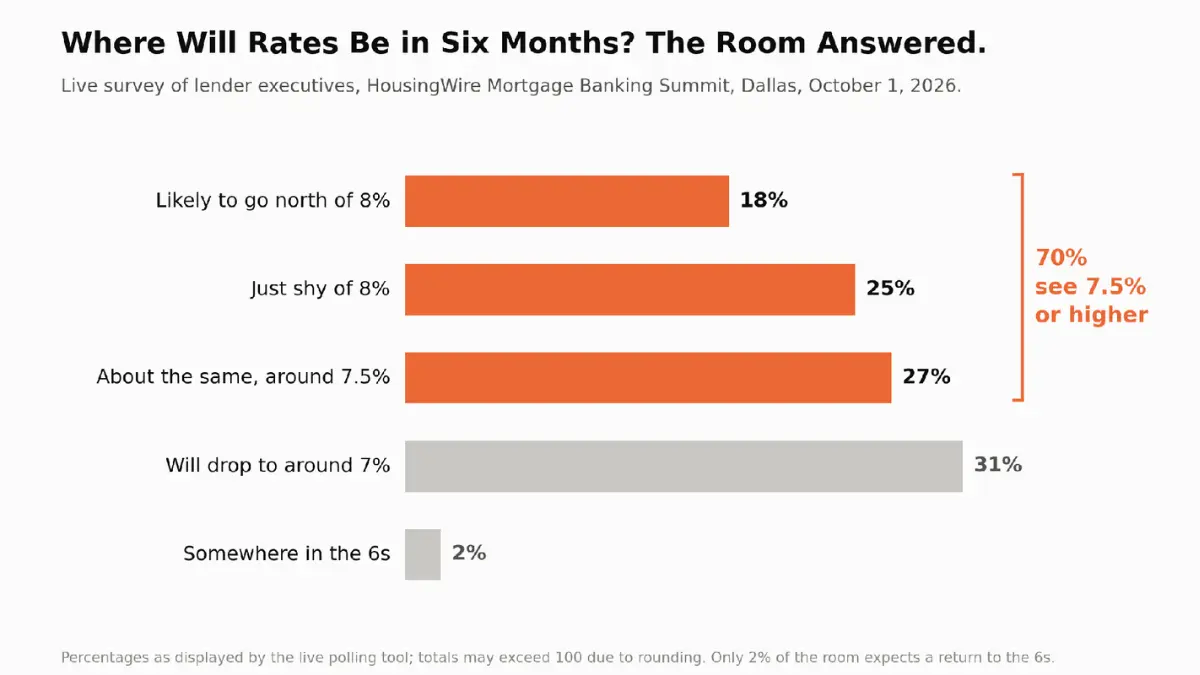
The U.S. mortgage industry is staring down a high-stakes structural shift, defined by persistently elevated interest rates, compressed origination volumes, and a rapidly evolving competitive landscape. According to findings from the recent HousingWire Mortgage Banking Summit live executive survey and industry forecasts, roughly 70% of mortgage executives anticipate that the 30-year fixed mortgage rate will remain at or above 7.5% well into 2027.
With Freddie Mac tracking the weekly average rate climbing to 7.28%—its highest level in nearly three years—and industry projections pointing to a sluggish market capped at roughly 2.1 trillion dollars in annual originations (translating to about 5.5 million loans a year), lenders can no longer afford to wait for Federal Reserve rate cuts to rescue their bottom lines.
The core takeaway for independent mortgage banks (IMBs), traditional depositories, and industry executives is unambiguous: volume will not bail out inefficient cost structures. Per-loan economics must be fundamentally re-engineered today, or market forces will do it for them through consolidation, margin erosion, or talent flight.
Chronology
To understand how the mortgage sector arrived at this critical juncture, it is helpful to trace the trajectory of the recent rate environment and the timeline of industry revelations:
- Late August: The 30-year fixed mortgage rate opened a consecutive series of upward ticks at 6.66%.
- Mid-September: Rates continued their relentless climb, hitting 7.03% just weeks before the annual HousingWire Mortgage Banking Summit.
- October 1 (Morning of the Summit): Freddie Mac printed a weekly average of 7.28%, marking a nearly three-year high and setting a tense backdrop for live executive polling in Dallas.
- October 1 (Live Survey): Executives in the room participated in real-time polling regarding rate expectations for the next six months, competitive threats, and operational cost strategies. The results revealed an industry deeply realistic—and anxious—about a prolonged high-rate horizon extending through 2027 and 2028.
- The 24-Month Horizon (2026–2028): Current forecasts from the Mortgage Bankers Association (MBA) and historical comparisons stretch flat origination expectations across this entire window, cementing the reality that the post-pandemic low-rate era has officially expired.
Supporting Data
The urgency of the current market cycle is underscored by hard economic data, historical comparisons, and real-time polling metrics captured at the Dallas summit:

- Rate Expectations: In the live survey, 27% of executives predicted rates would hold around 7.5% over the next six months; 25% projected rates just shy of 8%; and 18% expected rates north of 8%. Only 31% foresaw a modest dip to 7%, while a mere 2% expected a return to the 6% range.
- Origination Stagnation: The MBA projects total originations of $2.12 trillion in 2026 and $2.10 trillion in 2027. This represents roughly 5.5 million closed loans annually—fewer units than the industry processed in 2009 during the depths of the global financial crisis.
- Historical Parallels and Demographics: The last time the 30-year fixed averaged between 7.5% and 8% was 1997, when the industry produced roughly 7.5 million loans on an $860 billion volume. Adjusting for population growth, the U.S. now has one-third more households than it did in 1997, meaning the transaction rate has plummeted from roughly 74 closings per 1,000 households to just 41.
- The Refinance Drought: Unlike historical cycles where lenders could rely on refinancing waves to bridge purchase market slumps, roughly 70% of today’s outstanding mortgage inventory carries a coupon below 5%. This confines the addressable refinance pool primarily to 2023–2026 vintages—a narrow segment heavily targeted by automated, AI-driven digital platforms and servicers.
- Cost Realities: A persistent $6,350 per-loan cost gap separates top-quintile lenders from bottom-quintile operators. Meanwhile, compensation for loan officers consumes 62% to 65% of direct production costs, leaving operational efficiency and technology-driven fulfillment as the primary battlegrounds for margin preservation.
Official Responses and Industry Sentiment
The disconnect between executive intention and operational execution was a central theme of the summit’s findings. When surveyed about their strategic priorities, leadership teams across the country revealed a stark consensus paired with operational hesitations:
- The Cost-Reduction Mandate: An overwhelming 78% of executives stated that reducing operating costs to offer better pricing is their primary strategy moving forward. When asked how they plan to defend against mounting competition, 45% reiterated cost control, 30% pointed to local Realtor and builder partnerships, and 21% emphasized a broader product mix. Notably, only 4% stated they plan to raise loan officer compensation, while 0% said they would lower it.
- The Blind Spot in Competition: When asked who they view as their biggest competitive threat, 40% of executives pointed to consumer-direct and digital platforms—the loud, heavily advertised market entrants. Paradoxically, only 8% named the broker and wholesale channels.
- Talent Migration as a Silent Disruptor: Industry registration data tells a different story. Over a nine-month tracking period, loan officers shifting their NMLS registrations have made the broker and wholesale channels the only segment with net positive production growth (gaining over $8 billion). Conversely, independent mortgage banks shed nearly $2 billion, and traditional banks lost more than $5 billion as originators migrated toward scalable wholesale platforms.
Industry veterans Jim Deitch (CEO and Founder of Teraverde) and Dr. Rick Roque (Senior VP of Strategic Growth and M&A at NFM Lending and Managing Director of Menlo Company) emphasize that these shifts expose deep vulnerabilities. Lenders are often "watching the front door while inventory leaves through the warehouse," failing to recognize that loan officers are abandoning traditional employment models in favor of platforms that offer superior manufacturing efficiency.
Implications
As the mortgage industry digests these structural realities, lenders are left facing two definitive strategic doors. Standing still is no longer a viable option.
1. The First Door: Radical Operational Re-Engineering
The first path requires aggressive, intentional cost reduction driven by modern technology rather than reactive headcount trimming. Straight-through processing, exception-based staffing, and artificial intelligence are fundamentally altering the middle and back office.
Platforms utilizing outbound voice AI are automating prequalification, client follow-up, and early-stage acquisition, shrinking customer acquisition costs. Concurrently, workflow and closing platforms are streamlining processing, clearing conditions, and reducing the cost per closed loan from historical averages of roughly $11,900 toward an $8,000 target.
Industry analysts estimate that deploying these existing tools can strip 50 to 70 basis points of cost per loan—translating to $1,900 to $2,700 in savings on an average balance—enabling forward-thinking lenders to achieve a 20% to 30% reduction in per-loan operational expenses within a 24-month window.

2. The Second Door: Strategic Combinations and M&A
For organizations whose balance sheets, technology budgets, or management bandwidth cannot sustain the heavy lift of digital transformation, the alternative is strategic consolidation.
A 5.5-million-unit market simply cannot support the bloated cost structures inherited from the zero-rate era. The stark performance gap between top- and bottom-quartile lenders will continue to act as the primary mechanism through which strong institutions absorb struggling ones.
While only 4% of executives surveyed admitted an immediate plan to sell, market realities will not pause for sentiment. Experts note a profound difference between executing a strategic combination from a position of strength in 2026 versus negotiating out of necessity in 2027. Lenders must evaluate whether they control durable, permissioned customer franchises, proprietary distribution, and measurable operating leverage—or if they are simply carrying high overhead waiting for a market rescue that is not coming.
The decisions finalized in the coming quarters will determine which institutions navigate the new rate normal with strategic optionality, and which are forced to surrender their independence to the arithmetic of a contracting market.
