

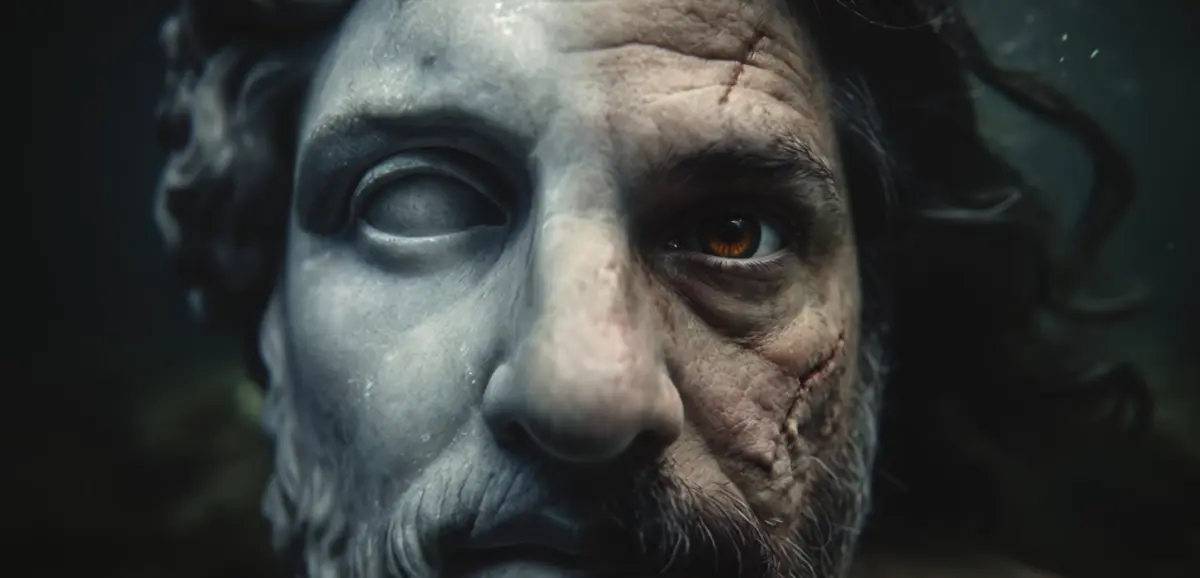
Main Facts: The Clash of Two Odysseys
While Christopher Nolan’s cinematic tour de force based on The Odyssey continues to shatter box office records and spark a global resurgence in classical literature sales, a very different kind of adaptation has quietly limped onto the digital landscape. Odysseus: The Fall, billed as the world’s first fully AI-generated feature film produced to rival a Hollywood blockbuster, has arrived. Crafted by the artificial intelligence startup Fountain 0, the two-and-a-half-hour feature was written, directed, and scored by company co-founder Ash Koosha, who also mapped his own digital likeness onto the legendary Greek king.
Yet, rather than offering a thrilling glimpse into the future of automated filmmaking, the $9.99 web-exclusive release has achieved the opposite effect. Plagued by bizarre visual inconsistencies, an incoherent narrative structure, and a total absence of cinematic weight, the film has quickly become a cautionary tale. Far from standing alongside Nolan’s masterclass in human craftsmanship, Odysseus: The Fall plays out like a sprawling digital accident—one so visually jarring and dramatically inert that it threatens to alienate audiences from the very concept of generative AI in cinema.
Chronology: From Tribeca Dreams to Digital Freefall
To understand the trajectory of Odysseus: The Fall, one must examine the rapid and ambitious timeline of its creators.
- Early 2026: Fountain 0 gains preliminary attention within independent film circles when their experimental short-form AI project, Dreams of Violets, secures a screening at the prestigious Tribeca Festival. Encouraged by this niche success, the studio pivots immediately to a much grander, highly commercial venture.
- July 2026: Fountain 0 issues a high-profile press release via Business Wire, boldly announcing the production of Odysseus: The Fall. The studio markets it as a groundbreaking milestone: the first entirely AI-generated movie engineered to match the scale, ambition, and storytelling cadence of a major Hollywood blockbuster.
- August 3, 2026: Propelled by the massive cultural momentum of Christopher Nolan’s Odyssey—which is simultaneously driving a mainstream boom in classic literature book sales—Fountain 0 launches Odysseus: The Fall directly to consumers via web browser streaming at a rental price of $9.99.
- Post-Launch: Within days of release, critics and casual viewers alike begin dissecting the film. Instead of celebrating a technological breakthrough, audiences take to social media to catalog the endless stream of AI generation artifacts, transforming the viewing experience into an unintended comedy of errors.
Supporting Data: A Catalog of Algorithmic Absurdities
Clocking in at a grueling 150 minutes, Odysseus: The Fall exposes the severe technical limitations of current generative video models. Because state-of-the-art AI systems struggle to maintain temporal and spatial continuity across extended timelines, the film is fractured into a dizzying patchwork of brief, disconnected visual sequences stitched together with little regard for logic or narrative flow.
Viewers attempting to stream the film are met with a barrage of technical and artistic failures:
- Spatial and Scale Inconsistencies: The scale of the world shifts from one cut to the next. The Cyclops holding Odysseus captive fluctuates wildly in height between shots. In maritime sequences, ocean waves move counter to the prevailing wind, while a massive fleet of racing ships features a vessel inexplicably gliding sideways across the water.
- Object Morphing: Props and assets lack permanence. In a striking example, a warrior’s sword melts and transforms mid-scene into a dagger. More bizarrely, eagle-eyed viewers have spotted unintended anomalies baked into the background, such as an alien carcass roasting over an ancient Greek spit.
- Lip-Syncing and Audio Failures: Dialogue synchronization is virtually nonexistent. Mouths frequently move out of time with the spoken words—or move wordlessly while automated voice-overs play independently. Furthermore, the AI-generated voice models repeatedly mispronounce foundational names within the Greek pantheon, including Odysseus and Zeus.
- Pacing and Logic Gaps: Current AI models are largely restricted to generating clips lasting only a few seconds. Consequently, scenes lack developmental breathing room. Characters pause for unnatural, multi-second intervals for no discernible reason, and inappropriate bursts of laughter interrupt dramatic tension. Important plot points—such as the suitors plaguing Penelope—are crammed into the final moments of the runtime, rendering the plot virtually incomprehensible to anyone unfamiliar with Homer’s original text.
Official Responses and Creator Intentions
Fountain 0 and co-founder Ash Koosha have defended the project through the lens of artistic passion and technological pioneering. In official corporate communications, Koosha maintained that the adaptation was born out of a genuine, long-held admiration for Homer’s epic, claiming he had felt deeply connected to the source material since first reading it years prior.
However, industry analysts and cultural commentators have been quick to point out the opportunistic timing of the release. By positioning the film directly alongside Nolan’s blockbuster adaptation, Fountain 0 openly invited comparisons to one of the most commercially successful and critically revered cinematic projects of recent years.
Critics argue that Koosha’s framing of the project as a passionate homage rings hollow when weighed against the execution. Rather than showcasing the potential of human-AI collaboration, the studio’s approach has been widely interpreted as an attempt to capitalize on the cultural hype surrounding classical mythology—effectively transforming generative AI technology into a high-tech iteration of a direct-to-video cash grab.
Implications: The Future of AI in Filmmaking and the Value of Human Artistry
The release of Odysseus: The Fall arrives at a critical cultural juncture regarding the integration of artificial intelligence in the creative industries. As studios grapple with the ethical, legal, and artistic implications of automated content generation, this project serves as a stark warning about the limits of bypassing human craftsmanship.
The Death of Cinematic Physics and Weight
One of the most profound takeaways from Odysseus: The Fall is the total absence of physical reality. In traditional filmmaking, even fantasy and science fiction are anchored by real-world physics, gravity, and spatial awareness. The camera work, lighting, and blocking are intentional choices made by directors of photography, grips, and editors.
In contrast, the AI-generated visuals of Odysseus lack any sense of weight or consequence. The juxtaposition is jarring: smooth, hyper-realistic human character models generated by algorithms sit awkwardly next to monstrous creatures that resemble low-budget, shabby stop-motion puppets from the 1930s. The result is neither avant-garde nor nostalgic; it is profoundly dull and visually exhausting.
The Irreplaceable Value of the Script Supervisor
The film’s myriad errors highlight a deeper truth about the complex ecosystem of Hollywood filmmaking. Roles that may seem administrative or mundane to outsiders—such as script supervisors, continuity coordinators, and editors—are the invisible glue that holds narrative cinema together. By attempting to compress the collaborative labor of hundreds of skilled craftspeople into a solitary automated workflow, Odysseus: The Fall demonstrates the chaotic consequences of removing human oversight from the creative process.
A Renewed Appreciation for Human Craft
Ultimately, the most ironic legacy of Odysseus: The Fall may be its unintentional service to traditional artists. By laying bare the limitations, soullessness, and aesthetic fatigue of fully automated storytelling, the film has galvanized audiences’ appreciation for authentic human labor.
Christopher Nolan’s success with The Odyssey proves that audiences do not just flock to theaters for spectacle; they respond to the palpable enthusiasm, rigorous dedication, and artistic vision of a director who deeply cares about the medium. Conversely, Odysseus: The Fall exhibits a clear contempt for cinematic traditions, offering little more than algorithmic "slop." As viewers continue to navigate the dawn of generative AI in entertainment, projects like Odysseus: The Fall ensure that the distinct, flawed, and brilliant touch of human artistry will remain more valued—and more essential—than ever before.
