

By Anthony Capkun
Published August 7, 2026
Main Facts
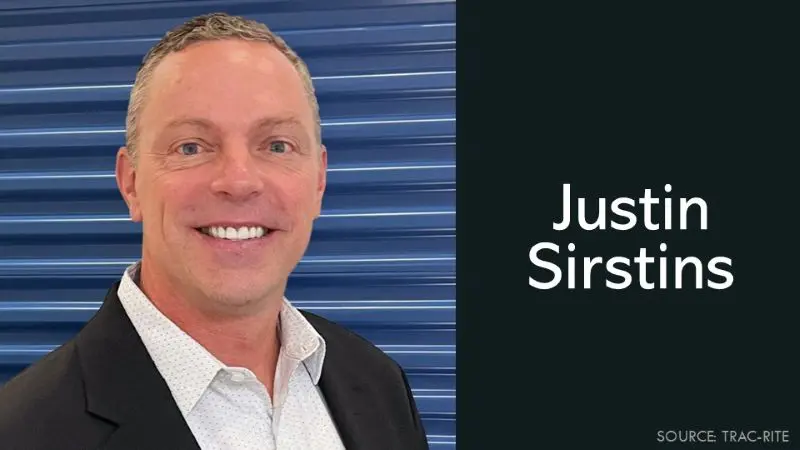
In a strategic move designed to bolster its national sales infrastructure and deepen regional client engagement, Trac-Rite—a premier manufacturer of roll-up doors, hallway systems, and specialized self-storage building components—has announced the appointment of Justin Sirstins to the newly created role of Western Regional Sales Manager.
Effective immediately, Sirstins will oversee and direct sales operations, business development, and client relations across a vast and economically dynamic territory encompassing Washington, Oregon, California, Nevada, Utah, and Arizona. In this capacity, he will serve as the primary point of contact for a diverse ecosystem of industry stakeholders, including self-storage facility owners, commercial real estate developers, authorized dealers, and general contractors.
The creation of this regional sales management position underscores Trac-Rite’s broader corporate strategy to transition from a centralized sales model to a highly localized, consultative approach. By placing seasoned industry veterans directly within key geographic markets, the company aims to streamline project delivery, offer tailored technical guidance, and respond more agilely to the burgeoning demand within the Western United States commercial construction and self-storage sectors.
Chronology: The Evolution of Trac-Rite’s Market Strategy
The establishment of the Western Regional Sales Manager position does not happen in a vacuum; rather, it represents the culmination of a multi-year operational evolution for Trac-Rite. Understanding the timeline of the company’s expansion provides crucial context for Sirstins’ appointment.
Phase 1: Foundation and Centralized Operations
For decades, Trac-Rite built its reputation on manufacturing high-durability roll-up doors and modular hallway systems engineered specifically for the self-storage industry. During its foundational growth phase, the company operated primarily through a centralized sales and distribution model headquartered out of its main manufacturing plants. While this approach successfully established the brand’s national footprint, executive leadership recognized that the hyper-localized nature of modern commercial real estate development required a more nimble, boots-on-the-ground presence—particularly in high-growth regions like the American West.
Phase 2: Identifying Regional Bottlenecks and Opportunities
Between 2020 and 2025, the Western U.S. experienced unprecedented migration patterns, driving a massive wave of residential construction followed predictably by an acute demand for commercial infrastructure, notably self-storage facilities. During this period, Trac-Rite’s leadership team observed that customers in states such as California, Washington, and Arizona faced unique regulatory environments, distinct seismic and climatic engineering requirements, and accelerating project timelines. Centralized account management, while functional, occasionally lacked the nuanced regional awareness needed to optimize large-scale developments efficiently.
Phase 3: Restructuring and Role Creation (Late 2025 – Mid 2026)
In response to market feedback and surging sales volumes, Trac-Rite’s executive board and sales leadership initiated a comprehensive restructuring of the commercial division in late 2025. The strategic blueprint called for the creation of targeted regional management positions designed to decentralize authority and empower local leaders. The Western region—spanning the entire Pacific Coast and the Mountain West—was designated as a top-priority territory for this new operational paradigm, setting the stage for the formal creation of the Western Regional Sales Manager role in mid-2026.
Phase 4: The Appointment of Justin Sirstins (August 2026)
Following an extensive executive search that evaluated candidates with deep sector expertise, Trac-Rite selected Justin Sirstins for the role in August 2026. Bringing a specialized blend of relationship-building experience and a half-decade of direct immersion in the self-storage industry, Sirstins was tapped to operationalize the company’s vision of enhanced regional integration across the six-state Western territory.
Supporting Data: The Self-Storage Sector and Western Regional Dynamics
To fully appreciate the strategic weight of Sirstins’ appointment, one must examine the macroeconomic and industry-specific data driving the Western commercial construction landscape.
The Self-Storage Construction Boom in the West
According to recent commercial real estate analyses, the self-storage asset class has demonstrated remarkable resilience and growth, driven by shifting demographic trends, urbanization, and the rise of remote and hybrid work models that require suburban and urban storage solutions.
- Geographic Concentration: The Pacific and Mountain census divisions account for roughly 28% of all new self-storage development projects initiated nationwide over the past 24 months.
- State-Specific Growth Vectors:
- California and Washington continue to lead in multi-story conversion projects and high-density urban facilities, where space optimization and sophisticated hallway systems are paramount.
- Arizona, Nevada, and Utah represent massive greenfield expansion corridors, characterized by sprawling suburban developments requiring robust, weather-resistant exterior roll-up doors capable of withstanding extreme desert thermal cycles.
- Oregon maintains steady demand driven by sustainable construction mandates and stringent building codes, requiring manufacturers to provide certified, energy-efficient, and durable structural components.
The Value of Specialized Manufacturing Components
In modern self-storage development, structural components are no longer viewed as mere commodities; they are critical elements of asset valuation and operational longevity.
- Roll-Up Doors: Represent the primary touchpoint for end-users, making reliability, ease of operation, and low maintenance essential for facility profitability.
- Hallway Systems: Modular layouts dictate the net rentable square footage of a facility. Optimized hallway designs can increase a property’s revenue-generating potential by 3% to 7%.
- General Contractor Integration: Industry data indicates that construction delays in self-storage development cost an average of $15,000 to $40,000 per month in carrying costs per mid-sized facility. Having a dedicated regional manager who can coordinate directly with general contractors significantly mitigates supply chain friction and installation bottlenecks.
Official Responses and Executive Insights
The corporate leadership at Trac-Rite has been vocal about the strategic importance of this appointment, framing it as a direct investment in customer-centric growth.
In his official announcement statement, Kellen Anderson, Vice President of Sales at Trac-Rite, emphasized the necessity of scaling the sales organization to match the company’s broader trajectory:
"As Trac-Rite continues to grow, we’re investing in our sales organization to better serve customers in every region. Justin’s experience in the self-storage industry, combined with his passion for building lasting customer relationships, makes him an excellent fit for our team."
Anderson’s remarks highlight a core corporate philosophy: that manufacturing excellence must be paired with peerless field-level service. By delegating regional oversight to seasoned professionals like Sirstins, Trac-Rite aims to bridge the gap between factory production floors and job sites.
Justin Sirstins, stepping into the newly minted role, echoed this sentiment, emphasizing his dedication to collaborative project execution across the Southwest and Pacific Northwest:
"I look forward to working with customers across the Southwest and helping them achieve success on every project."
With over 15 years of cumulative experience dedicated to nurturing client relationships—including five years specifically embedded within the operational and developmental nuances of the self-storage sector—Sirstins brings a consultative methodology to the role. Rather than functioning purely as an order-taker, his mandate is to act as a trusted advisor to developers and contractors navigating complex structural specifications.
Implications: What This Means for the Industry
The creation of the Western Regional Sales Manager position and the onboarding of Justin Sirstins carry several profound implications for Trac-Rite, its competitors, and its client base across the Western United States.
1. Elevated Standard of Customer Service and Technical Support
For self-storage owners, developers, and general contractors operating in Washington, Oregon, California, Nevada, Utah, and Arizona, the primary implication is a dramatic reduction in communication latency. Having a dedicated regional manager means clients no longer need to route inquiries through a generalized national queue. Sirstins will provide on-the-ground consultations, assist with product selection tailored to regional building codes (such as seismic requirements in California or wind-load standards in the desert Southwest), and troubleshoot installation challenges in real time.
2. Competitive Positioning in a Lucrative Market
The Western U.S. market is fiercely competitive, with numerous component manufacturers vying for dominance in high-growth metropolitan statistical areas (MSAs) like Phoenix, Las Vegas, Salt Lake City, Seattle, and the major metropolitan hubs of California. By placing a high-caliber professional like Sirstins at the helm of its Western sales apparatus, Trac-Rite signals to the market that it is doubling down on regional market share. This move allows the company to compete more effectively against regional players by combining the robust manufacturing power of a national brand with the personalized touch of a local partner.
3. Streamlined Supply Chain and Project Delivery
Construction delays are the bane of commercial real estate developers. By embedding a regional expert who understands local supply chain dynamics and project scheduling realities, Trac-Rite can better synchronize factory production schedules with job-site readiness. This tighter coordination minimizes holding costs for developers and ensures that projects utilizing Trac-Rite’s roll-up doors and hallway systems reach completion on schedule and within budget.
4. A Blueprint for Future Expansion
Industry analysts will undoubtedly monitor the success of Trac-Rite’s restructured Western sales division as a potential blueprint for future organizational developments. If the localized management model yields the projected increases in client retention, project acquisition efficiency, and market penetration, it is highly likely that Trac-Rite will replicate this strategic framework in other high-demand domestic markets, such as the Southeast or the Texas-led Gulf Coast corridor.
Conclusion
As the commercial construction and self-storage sectors continue to adapt to economic shifts and surging regional demand, manufacturers must evolve beyond traditional supply models. Trac-Rite’s appointment of Justin Sirstins as Western Regional Sales Manager marks a pivotal step in aligning corporate capability with regional market realities. Backed by over a decade and a half of relationship-building expertise and specialized industry knowledge, Sirstins is uniquely positioned to steer Trac-Rite’s Western operations into a new era of collaborative growth, project success, and reinforced client loyalty.
