

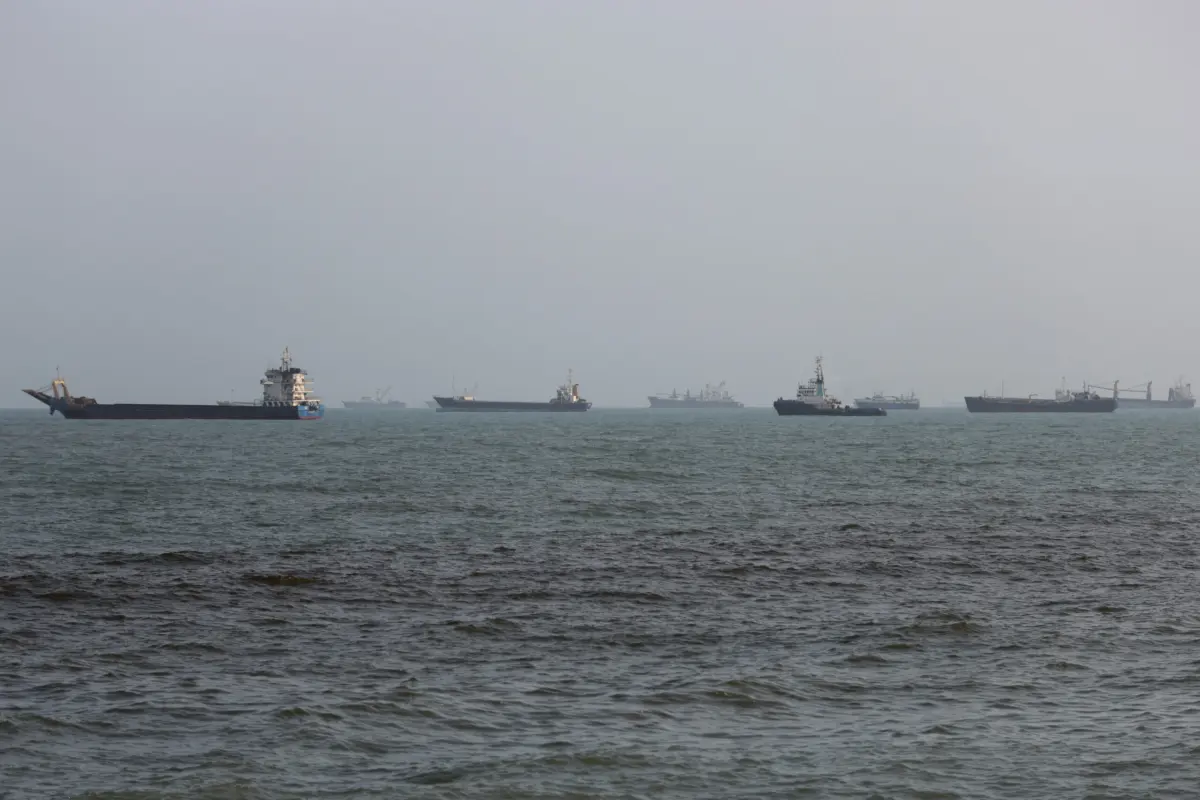
DUBAI/LONDON — In a dramatic escalation of maritime tensions in the Middle East, two ultra-large crude carriers (ULCCs) were struck in rapid succession by unidentified projectiles while navigating the strategic Strait of Hormuz. The attacks, which occurred as the vessels were exiting the Persian Gulf, have immediately rattled global energy markets, reignited deep-seated security concerns across vital shipping lanes, and sent shockwaves through international shipping and geopolitical corridors.
According to prominent maritime security consultancy Marisks, the targeted vessels—the Saudi-flagged Sidr and the South Korean-operated Senegal Prosperity—sustained structural impacts while traversing one of the world’s most critical energy chokepoints. The incidents have prompted emergency evaluations by vessel operators, heightened threat levels for commercial shipping traversing the region, and forced military and intelligence analysts to scramble for clues regarding the origins and mechanics of the assaults.
Main Facts
The twin attacks took place in international waters within or adjacent to the Strait of Hormuz, a narrow maritime passageway that accommodates roughly a fifth of the world’s petroleum consumption.
- The Vessels: The first vessel identified by security analysts is the Sidr, a massive Very Large Crude Carrier (VLCC) owned and operated by Bahri, the national shipping carrier of Saudi Arabia. The second vessel is the Senegal Prosperity, operated by South Korea’s Sinokor Merchant Marine.
- The Nature of the Strikes: Marisks reported that the Sidr was struck by an unknown projectile while sailing northeast of Khasab, Oman. Shortly thereafter, the Senegal Prosperity was hit by a salvo of three distinct projectiles while traveling east of Oman. Both vessels were moving away from the Persian Gulf, laden with or positioned for crucial crude transport duties.
- Corroborating Reports: The United Kingdom Maritime Trade Operations (UKMTO), which acts as a vital communication link between military forces and commercial shipping in the region, issued an earlier advisory confirming that an unidentified tanker had reported being struck by three unknown projectiles during an outbound transit of the Strait. While the UKMTO withheld the name of the vessel in its initial flash warning, the timeline and details closely align with the coordinates and characteristics of the Senegal Prosperity.
- Current Status: Initial assessments indicate that despite the structural impacts, both vessels avoided catastrophic hull failures, and preliminary reports suggest no immediate major oil spills or crew casualties. However, full damage control assessments remain ongoing as the vessels seek safe harbor or drift under close monitoring.
Chronology of Events
The unfolding crisis developed rapidly over the course of a single morning watch, tracking the vulnerable vessels as they attempted to navigate the heavily monitored yet increasingly perilous waters of the Persian Gulf exit route.
- Early Morning Outbound Transit: The Sidr and the Senegal Prosperity separate from their respective loading terminals within the Persian Gulf, clearing customs and entering the Traffic Separation Scheme (TSS) designed to manage the dense flow of crude carriers, container ships, and LNG tankers through the Strait of Hormuz.
- The First Strike (Northeast of Khasab): As the Sidr—run by Saudi Arabia’s Bahri—reaches a position northeast of the Omani enclave of Khasab, maritime security monitors register an anomalous impact. An unidentified projectile strikes the vessel. The ship’s bridge crew initiates standard emergency protocols, sounding alarms, checking for hull breaches, and notifying regional monitoring authorities.
- The Second Incident (East of Oman): Within a tight window following the first attack, maritime intelligence feeds pick up distress signals and automated tracking anomalies further east. The Senegal Prosperity, operated by Sinokor, is struck not once, but three times by fast-moving projectiles. The multi-hit nature of this attack suggests a targeted, deliberate volley rather than stray ordnance.
- UKMTO Advisory Issued: The UK Maritime Trade Operations publishes an urgent warning to all regional shipping traffic. The alert notes that an outbound tanker has sustained hits from three unknown projectiles while completing its transit of the Strait, advising all vessels in the vicinity to exercise extreme caution, heighten watchfulness, and report any suspicious activity immediately.
- Marisks Identification and Market Reaction: Maritime security consultant Marisks publicly correlates the disparate alerts, identifying the vessels specifically as the Sidr and the Senegal Prosperity. As the news disseminates across global financial terminals, crude oil futures surge in electronic trading, reflecting immediate anxiety over supply chain disruptions in the Gulf.
Supporting Data & Geopolitical Context
To understand the gravity of the strikes on the Sidr and the Senegal Prosperity, one must examine the irreplaceable economic and strategic weight of the Strait of Hormuz.
The Strait of Hormuz: Global Energy Chokepoint
- Volume of Trade: The Strait of Hormuz connects the Persian Gulf with the Gulf of Oman and the Arabian Sea. At its narrowest point, the channel is just 21 miles (33 kilometers) wide, with the inbound and outbound shipping lanes each only two miles wide, separated by a two-mile buffer zone.
- Dependency: According to the U.S. Energy Information Administration (EIA), approximately 20 million barrels of petroleum liquids pass through the Strait daily, accounting for roughly 20% of global petroleum consumption. Furthermore, a significant share of the world’s liquefied natural gas (LNG)—predominantly exported from Qatar—traverses this exact corridor.
- Vessel Vulnerability: VLCCs and ULCCs are massive structures, often stretching over 300 meters in length. Despite their immense carrying capacity, their low maneuverability and high profiles make them prominent targets in confined maritime corridors, complicating defensive maneuvering when sudden threats emerge.
Historical Precedents
The region is no stranger to maritime friction. The "Tanker War" phase of the 1980s Iran-Iraq War saw widespread attacks on commercial shipping, and the region experienced a fresh wave of sabotage and seizures in 2019 involving limpet mines and drone activity directed at oil tankers near the UAE coast. Security analysts point out that any escalation in this corridor instantly revives memories of those vulnerabilities, driving up war-risk insurance premiums for shipowners operating fleets in the Persian Gulf, Gulf of Oman, and Red Sea basins.
Official Responses and Industry Reaction
As news of the attacks reverberated globally, official channels and corporate headquarters moved with varying degrees of speed to address the emerging security crisis.
- Corporate Silence: Representatives for Bahri, the operator of the Sidr, and Sinokor Merchant Marine, operator of the Senegal Prosperity, did not immediately respond to repeated requests for comment from international media outlets. Industry insiders suggest that corporate communications teams are currently prioritizing crew welfare, damage assessments, and coordination with maritime insurance underwriters and military liaisons before issuing formal statements.
- Maritime Security Guidance: Following the Marisks disclosures and the UKMTO advisory, international maritime security agencies have advised all commercial vessels transiting the Strait of Hormuz and the Gulf of Oman to elevate their security threat levels to maximum readiness. Crews have been instructed to rig anti-boarding measures, maintain continuous radar and visual watches, and, where operationally feasible, consider delaying transits until the security environment clarifies.
- Naval and Defense Posture: Regional naval forces, including the United States Navy’s Fifth Fleet headquartered in Bahrain and European naval coalition assets operating under Operation AGENOR, are reviewing intelligence data, tracking radar signatures, and offering assistance to the affected vessels. However, pinpointing the origin of low-radar-cross-section projectiles—whether launched from land, surface craft, or airborne platforms—remains a complex forensic challenge for military investigators.
Implications for Global Energy and Shipping
The targeting of two major supertankers in quick succession carries profound implications that extend far beyond the immediate geographical confines of the Strait of Hormuz.
1. Insurance and Freight Rates
The immediate economic fallout will likely manifest in spiking marine insurance costs. War-risk premiums, which fluctuate based on regional threat assessments, have historically reacted sharply to kinetic incidents in Middle Eastern waters. A sustained threat environment will force shipowners to demand higher charter rates, ultimately inflating the landed cost of crude oil and refined petroleum products for end-consumers worldwide.
2. Supply Chain Re-Routing and Redundancies
While the Strait of Hormuz is virtually irreplaceable due to the sheer volume of hydrocarbons it handles, major producers like Saudi Arabia and the United Arab Emirates maintain bypass pipelines—such as the East-West Pipeline (Petroline) in Saudi Arabia and the Habshan-Fujairah oil pipeline in the UAE—that can divert a portion of crude exports directly to Red Sea or Gulf of Oman terminals. However, these pipelines possess finite capacity and cannot entirely absorb the massive volumes typically carried by tankers through the Strait.
3. Geopolitical Stability and Security Stances
For consuming nations in Asia, Europe, and the Americas, the incident serves as a stark reminder of the fragility of maritime supply chains. Policymakers are expected to face renewed pressure to bolster diplomatic engagement in the region, enhance intelligence-sharing frameworks among maritime allies, and reinforce naval escort or deterrence mechanisms to protect freedom of navigation.
As investigations into the identity of the projectiles and the perpetrators behind the attacks continue, the global maritime and energy communities remain on high alert, watching anxiously to see whether these strikes represent an isolated incident or the dangerous dawn of a new campaign against international commerce in the Persian Gulf.
