

By Anthony Capkun
Published August 12, 2026
Main Facts
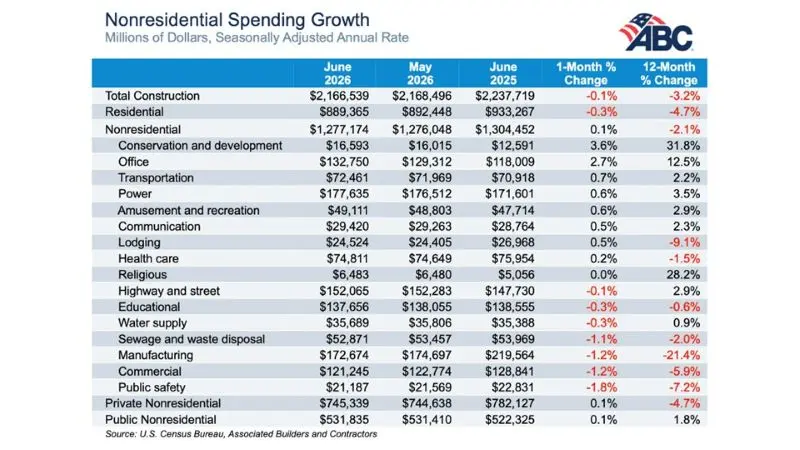
National nonresidential construction spending experienced a modest uptick in June 2026, rising 0.1% according to a comprehensive economic analysis by Associated Builders and Contractors (ABC) of data released by the U.S. Census Bureau. On a seasonally adjusted annual rate (SAAR), total nonresidential construction spending reached a towering $1.277 trillion.
Beneath this headline stability, however, lies a deeply fractured market characterized by stark dichotomies. While overall monthly spending saw marginal gains—with positive momentum recorded across exactly half (8 of 16) of the tracked nonresidential subcategories—the broader annual trajectory tells a sobering story of contraction. Both public and private nonresidential spending inched upward by 0.1% on a monthly basis, yet private nonresidential spending has plummeted by nearly 5% compared to the same period in 2025.
The primary driver preventing a broader market collapse is the relentless, multi-billion-dollar data center construction boom. Fueled by insatiable demand for artificial intelligence infrastructure and cloud computing capacity, data center projects are soaring. Conversely, traditional commercial projects, heavy manufacturing facilities, and other foundational private sectors are experiencing sharp, sustained pullbacks. This divergence has created a two-tier construction economy: contractors positioned within the digital infrastructure niche are enjoying robust project pipelines and extended backlogs, while those reliant on traditional industrial and manufacturing sectors face steep year-over-year declines.
Chronology and Market Timeline
To understand the current state of U.S. nonresidential construction in the summer of 2026, it is necessary to examine the timeline of economic shifts that have shaped the industry over the past several quarters:
- April 2025 (The Private Spending Peak): Private nonresidential construction spending hit a cyclical zenith, establishing a high-water mark that the market has struggled to recapture. Since this peak, tightening credit conditions, elevated borrowing costs, and shifting corporate investment priorities have exerted downward pressure on private-sector projects.
- Mid-2025 to Early 2026: The broader manufacturing construction sector, which had experienced an unprecedented multi-year surge driven by federal legislation like the CHIPS Act and the Inflation Reduction Act, began to cool. Projects that broke ground in 2023 and 2024 began reaching completion, and new starts slowed significantly amid economic uncertainties.
- June 2025: Baseline data from one year prior highlights the steepness of the current downturn. For instance, private nonresidential spending was significantly higher at this point than in the summer of 2026, and manufacturing construction was operating at heights that have since experienced double-digit corrections.
- June 2026 (The Current Reporting Period): The U.S. Census Bureau released its monthly construction spending metrics, showing a nominal 0.1% monthly increase to a $1.277 trillion SAAR. ABC released its corresponding analysis, spotlighting the widening chasm between booming data center activity and shrinking manufacturing and commercial segments.
Supporting Data and Economic Metrics
The nuances of the June 2026 report are best understood through the granular data compiled by ABC and the U.S. Census Bureau.
Macroeconomic Totals
- Total Nonresidential Spending: $1.277 trillion (SAAR).
- Monthly Growth (June 2026): Up 0.1% nationally.
- Subcategory Performance: Positive monthly growth was achieved in exactly 8 of the 16 monitored nonresidential subcategories.
- Public vs. Private Growth: Both public and private nonresidential construction spending ticked up by identical margins of 0.1% for the month.
The Private Sector Slump
- Year-Over-Year Change (Private Nonresidential): Down nearly 5% compared to June 2025.
- Decline from Peak: Private nonresidential construction spending has contracted to a seasonally adjusted annual rate of $745.3 billion since its April 2025 peak—representing a total decline exceeding 7%.
- Excluding Data Centers: When stripping out the red-hot data center sector, the numbers look even more concerning. Private nonresidential construction spending excluding data centers fell by 0.6% in June 2026 alone, and is down a striking 7.9% on a year-over-year basis.
Sector-Specific Extremes
- Manufacturing Construction: Recorded the single sharpest year-over-year decline among all nonresidential categories, with spending tumbling 21.4% from June 2025 levels. This correction reflects the normalization of industrial plant investments after years of hyper-accelerated growth.
- Data Center Construction: Stood in stark contrast to the broader industrial slowdown. Data center spending surged 7% in a single month (June 2026) and skyrocketed by 46% compared to the same month in the previous year.
Contractor Backlog Dynamics
ABC’s proprietary Construction Backlog Indicator (CBI) underscores how this data center anomaly directly impacts contractors on the ground:
- Data Center Specialists: The 13% of ABC member contractors currently under contract to work on data center projects report a significantly higher average backlog of 11.0 months.
- Non-Specialist Contractors: The remaining 87% of ABC members who are not engaged in data center construction report an average backlog of just 8.5 months.
Official Responses and Expert Analysis
Industry leaders and economists have offered critical perspectives on what these figures mean for the broader economy and the construction trade in the months ahead.
Anirban Basu, Chief Economist for Associated Builders and Contractors, emphasized the paradoxical nature of the current market during his analysis of the June data.
"Despite an ongoing data center construction boom, private nonresidential construction spending has declined to a seasonally adjusted annual rate of $745.3 billion since the April 2025 peak, which translates into a decline exceeding 7%," Basu noted.
Basu further pointed out that market observers must look beyond headline figures to understand the underlying weakness in non-digital sectors.
"Tellingly, private nonresidential construction spending excluding data centers fell 0.6% in June 2026 and is down 7.9% year over year."
Regarding the forces driving the digital infrastructure market, Basu highlighted the immense resilience of tech-driven builds. Data center construction was up 7% in June and up an astonishing 46% from a year ago, ensuring that specialized contractors remain insulated from broader commercial headwinds.
"According to ABC’s latest Construction Backlog Indicator, the 13% of ABC members under contract to work on data centers have significantly higher backlog [11.0 months] than the 87% that are not [8.5 months]," Basu explained, illustrating the tangible business advantage held by firms aligned with the artificial intelligence and cloud computing expansion.
Implications for the Construction Industry and Broader Economy
The June 2026 construction spending report carries profound implications for stakeholders across the architecture, engineering, construction (AEC), and financial sectors.
1. The Bifurcated Contractor Market
The most immediate implication of the current data is the polarization of contractor fortunes. Firms heavily invested in mechanical, electrical, and plumbing (MEP) systems, high-capacity cooling, and secure power distribution—the lifeblood of modern hyperscale data centers—are operating at or near full capacity. Their healthy 11.0-month backlogs provide revenue visibility well into 2027.
Conversely, general contractors and specialty trade sub-segments tied to heavy manufacturing, office spaces, and retail construction face increasing margin pressures. With manufacturing construction down more than 21% year-over-year, firms that retooled their operations to capture the industrial boom of 2023–2024 are now forced to pivot back toward institutional projects, public infrastructure, or commercial retrofits.
2. The Weight of High Interest Rates and Financing Realities
The steady slide in private nonresidential spending from its April 2025 peak underscores the lingering impact of restrictive monetary policy. While the Federal Reserve has navigated a complex economic landscape, elevated financing costs continue to make speculative commercial development challenging. Developers are exercising extreme caution, delaying starts on office parks, hospitality venues, and distribution centers until clearer signals of demand and lower capital costs emerge.
3. Public Sector Stability as a Buffer
While private nonresidential spending battles downward trends outside of the tech sector, public construction spending continues to provide a vital economic floor. Public investments in infrastructure—such as transportation, water systems, educational facilities, and public safety buildings—have remained relatively steady, recording a 0.1% monthly gain in June. This public sector consistency is currently preventing a steeper macroeconomic contraction within the construction trades.
4. Future Outlook: AI, Energy Demands, and Technological Evolution
Looking ahead, the data center boom shows no immediate signs of abatement. The explosive adoption of generative artificial intelligence, machine learning applications, and enterprise cloud migrations guarantees that tech giants and colocation providers will continue pouring capital into physical infrastructure. However, this trend brings its own set of secondary challenges, including strains on local electrical grids, water usage for cooling, and zoning approvals.
For the broader nonresidential construction sector to return to generalized growth, a broader recovery in private investment—potentially catalyzed by shifts in monetary policy or a stabilization of manufacturing supply chains—will be required. Until then, the U.S. construction economy will remain a tale of two markets: a hyper-accelerated digital frontier running alongside a cooling, highly selective traditional landscape.
