

By Anthony Capkun
Published August 20, 2026
Main Facts
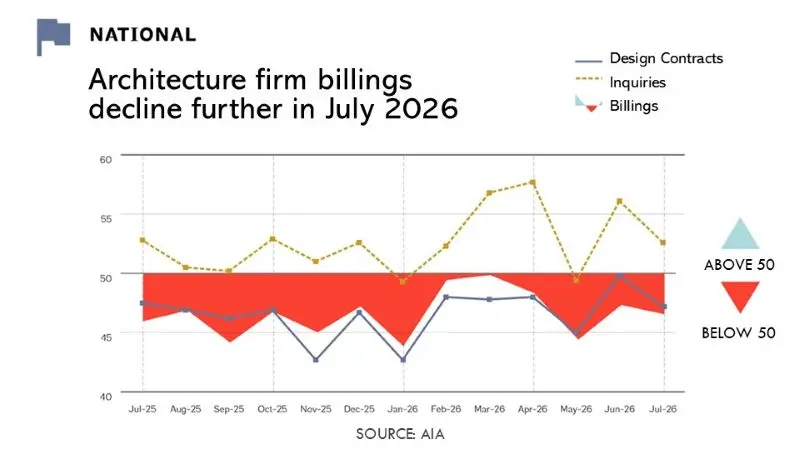
The architectural and nonresidential construction sectors continue to navigate a protracted and challenging economic cycle. According to the latest data released by the American Institute of Architects (AIA) and Deltek, the Architecture Billings Index (ABI) registered a score of 46.6 for July 2026. This figure represents a slight decrease from June’s mark of 47.3, reinforcing a prolonged downward trend that has now persisted for nearly three and a half years.
The ABI serves as a vital monthly economic indicator for the broader construction and real estate development industries. Because architectural billings generally precede nonresidential construction activity by nine to 12 months, the index is closely monitored by developers, economists, and material suppliers as a reliable barometer of future market health.
The index operates on a baseline of 50:
- Scores above 50 indicate an aggregate increase in billings from the previous month, signifying expansion.
- Scores below 50 indicate a decline in billings, signaling market contraction.
With July’s score remaining firmly below the 50-point threshold, the data underscores a sustained period of suppressed activity across the design and construction landscape. While new project inquiries continue to trickle in from prospective clients—keeping that specific sub-index in positive territory—the actual conversion of those inquiries into signed contracts and billable hours remains sluggish. Furthermore, regional challenges are ubiquitous, with every geographic territory in the United States reporting soft business conditions, and specific sectors, such as commercial and industrial design, enduring multi-year droughts.
Chronology
To fully understand the current trajectory of the architectural services market, it is necessary to examine the timeline of events leading up to the July 2026 report. The industry’s ongoing struggles are not a sudden shock, but rather the cumulative effect of a multi-year economic adjustment characterized by elevated borrowing costs, tightening credit conditions, and shifting commercial real estate demands.
The Pandemic Aftermath and Post-Lockdown Surge (2021–2022)
Following the initial disruptions of the COVID-19 pandemic in 2020, the architecture and construction sectors experienced a robust, pent-up demand surge throughout late 2021 and much of 2022. During this period, the ABI routinely posted scores well above 50 as firms scrambled to staff up and handle an influx of new project commissions across residential, commercial, and institutional sectors.
The Turning Point and Onset of Contraction (Late 2022–2023)
As central banks around the globe—most notably the U.S. Federal Reserve—began aggressively raising interest rates to combat inflation, the macroeconomic environment shifted dramatically. By late 2022 and into early 2023, the cost of capital spiked, causing commercial developers to put projects on hold or cancel them outright. The ABI slipped below the 50 growth threshold during this window, marking the official beginning of the current contractionary cycle.
The Prolonged Slump and False Dawns (2024–2025)
Throughout 2024 and 2025, the industry experienced what many sector analysts described as a "holding pattern." While occasional months showed flashes of recovery—particularly within specialized niches like multifamily residential and institutional facilities—broad-based momentum failed to materialize. High construction material costs, persistent labor shortages, and cautious corporate spending kept architectural firms in a defensive posture.
The First Half of 2026
Entering 2026, hopes for an imminent monetary policy pivot that might revive project financing faced delays.
- January–May 2026: Architecture employment figures began to steadily contract, losing a combined total of 900 jobs by mid-year.
- June 2026: The ABI registered at 47.3. While this represented a marginal improvement over prior months, newly signed design contracts hovered just below the growth threshold, teasing a potential rebound that ultimately failed to materialize.
- July 2026: The ABI dipped back down to 46.6. Concurrently, broader economic indicators showed nonfarm payroll employment decreasing by 23,000 jobs, while architectural services employment shed another 100 positions in June (the most current labor data available), marking the fourth consecutive month of industry-specific job losses.
Supporting Data
A granular analysis of the July 2026 AIA/Deltek ABI report reveals distinct trends across different project specializations, regional markets, and economic indicators. While the headline figure provides a general overview, the underlying sub-scores highlight where the contraction is most acute.
Project Inquiries vs. Design Contracts
A notable dichotomy persists between early-stage client interest and finalized business commitments:
- Project Inquiries: The index for new project inquiries remained above the 50 threshold in July, indicating that clients are still actively brainstorming, planning, and reaching out to architecture firms for potential future work. However, the pace of these inquiries slowed compared to June.
- Design Contracts: The value of newly signed design contracts declined further in July. After coming tantalizingly close to breaking into positive growth territory the previous month, firms reported that clients remain hesitant to execute binding design agreements, often due to ongoing financing uncertainties.
Regional Breakdown
Business conditions remained weak across all four major regions of the United States in July:
- The Northeast: Reported the softest conditions in the country for the second consecutive month, struggling with localized permitting hurdles, high operating costs, and sluggish commercial development.
- The Midwest, South, and West: While these regions also remained in contraction territory, the pace of the ongoing decline slowed slightly compared to previous months, offering a modest glimmer of stabilization.
Sector-Specific Specializations
Billings declined across firms of all specializations, though the depth of the downturn varies drastically by market sector:
- Commercial and Industrial Facilities: Firms specializing in commercial spaces (such as retail centers and office buildings) and industrial facilities (such as manufacturing plants and warehouses) have been hit the hardest. This segment has not reported a sustained increase in billings for four consecutive years, heavily impacted by the structural shift toward remote work and overbuilt warehouse inventories from earlier years.
- Multifamily Residential and Institutional: These sectors offered pockets of resilience earlier in the year, with modest growth spurts driven by housing demand and public-sector investments. However, by July 2026, conditions in these specializations had softened as well, dragging overall firm billings down.
Broader Economic and Labor Market Indicators
The health of the architectural sector is inextricably linked to the broader macroeconomic climate:
- Nonfarm Payrolls: The U.S. economy shed 23,000 jobs in July, marking the second time this year that nonfarm payroll employment has decreased.
- Construction Employment: Remained generally flat during the month, acting as a lagging indicator that has not yet mirrored the deeper contractions seen in design-stage billings.
- Architecture Services Employment: According to the latest available data for June, architectural services employment dropped by 100 positions. This brought the total job losses in the architectural sector to 900 since January 2026, representing the fourth consecutive month of industry job contraction.
Official Responses
Representatives from the American Institute of Architects, alongside industry analysts and economic researchers, have offered critical perspectives on what the July 2026 data means for the professional design community.
In official statements accompanying the release of the July ABI report, AIA leadership emphasized that while client interest has not dried up entirely—as evidenced by steady project inquiries—the bridge from conceptual interest to active design contracts remains obstructed.
"Clients are still bringing business to firms, as inquiries into new projects rose again in July, albeit at a slower pace than in June," AIA noted in its official summary. "However, the hesitation to execute newly signed design contracts indicates that external financial pressures are keeping owners from greenlighting their capital improvement plans."
Economic analysts tracking the sector point out that architectural firms have had to adapt to an "extended lower-normal" operating environment. For many small- and medium-sized firms, managing overhead while waiting for clients to secure favorable financing has become a delicate balancing act. Industry groups continue to advocate for predictable monetary policies and targeted investments in public infrastructure to help stabilize institutional and municipal pipelines, which have historically cushioned firms during private-sector downturns.
Implications
The prolonged three-and-a-half-year slump highlighted by the July 2026 Architecture Billings Index carries significant, far-reaching implications for the entire built environment ecosystem. Because architectural billings forecast construction activity nearly a year in advance, the persistent sub-50 scores point toward a subdued construction market well into 2027.
1. Impact on Nonresidential Construction Pipelines
With design billings contracting for an extended period, the pipeline of projects moving from the drawing board to breaking ground will likely narrow over the next 9 to 12 months. General contractors, construction managers, and specialty trade subcontractors should anticipate a leaner bidding environment. While existing backlogs have sustained many construction firms up to this point, those reserves are steadily being worked through, raising the prospect of increased competition and compressed profit margins for builders in 2027.
2. Supply Chain and Material Manufacturer Adjustments
Manufacturers of structural steel, concrete, glass, metal construction products, and interior finishes rely heavily on the nonresidential construction pipeline. A prolonged architectural slowdown means that demand for building materials will likely remain tempered. Producers may need to adjust production capacities, manage inventory levels conservatively, and focus on renovation and adaptive reuse projects rather than massive new-build developments.
3. Employment and Talent Retention in Design Professions
The loss of 900 architectural jobs since January 2026—coupled with four consecutive months of industry payroll declines—signals mounting pressure on firm workforces. While many firms went to great lengths to hoard talent following the labor shortages of the post-pandemic era, the protracted nature of this downturn is forcing difficult operational choices. Persistent layoffs or hiring freezes risk displacing experienced talent, potentially leading to a skills gap when the market eventually rebounds.
4. Strategic Shifts Toward Adaptation and Sustainability
To survive the current climate, architecture firms are increasingly pivoting their business models. Rather than relying on massive new commercial or industrial builds—sectors that have languished for four years—firms are diversifying into adaptive reuse, historic preservation, energy-efficiency retrofits, and sustainable infrastructure upgrades. These project types often align with evolving regulatory mandates and corporate environmental, social, and governance (ESG) goals, providing a vital revenue stream while traditional new-construction markets find their footing.
Ultimately, while the July 2026 ABI score of 46.6 confirms that the architecture industry is not yet out of the woods, the persistence of new project inquiries suggests that substantial pent-up demand remains ready to be unleashed. Once macroeconomic conditions—particularly financing costs—stabilize more definitively, the stage will be set for a robust recovery across the design and construction sectors.
