


RICHMOND, Va. — For decades, the Commonwealth of Virginia has worn its crown as the undisputed data center capital of the United States with unwavering pride. Paved by favorable tax structures, robust fiber-optic infrastructure, and a streamlined approach to industrial growth, Northern Virginia—particularly Loudoun County, famously known as "Data Center Alley"—became the beating heart of the global internet. More than half of the world’s daily internet traffic flows through these server farms.
However, the political and social climate surrounding this digital gold rush is undergoing a seismic shift. Amid mounting public pushback over soaring electricity bills, deafening industrial noise, intensive water consumption for cooling, and sweeping land-use transformations, Virginia is putting up a yellow light.
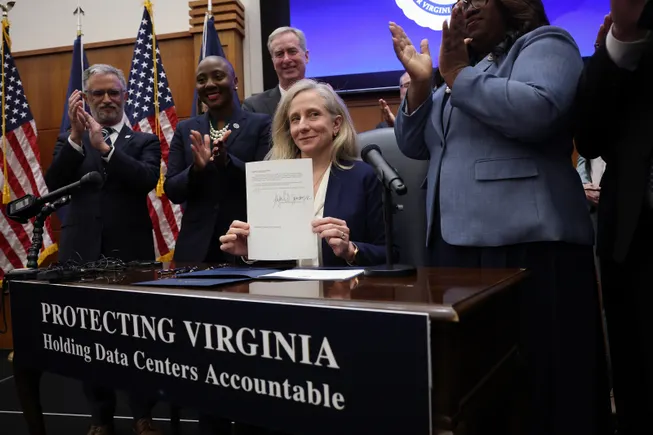
Governor Abigail Spanberger formally altered the state’s welcoming stance on September 18 by signing a sweeping executive order. Designed to introduce rigorous accountability measures and AI-driven infrastructure guardrails, the directive aims to pump the brakes on unchecked growth. Under the new rules, massive data center projects—specifically those with an anticipated peak power demand of 25 megawatts or greater—will be stripped of eligibility for state site development assistance and expedited permitting programs. Furthermore, the order takes direct aim at transparency, banning state agencies from using nondisclosure agreements (NDAs) to cloak proposed developments and public-private incentive packages in secrecy.
While the immediate impact on active construction sites is minimal, legal and industry experts warn that the executive order is merely the opening salvo. As state agencies draft comprehensive regulatory frameworks over the coming months and Governor Spanberger eyes legislative action in the 2027 General Assembly session, the construction, engineering, and real estate landscapes in Virginia are bracing for profound transformation.
The Main Facts
The executive order signed by Governor Spanberger fundamentally reshapes how Virginia interacts with the booming data center industry.
- The Power Threshold: Data center projects anticipating a peak energy demand of 25 megawatts (MW) or higher are now excluded from state site development assistance and expedited permitting. To put this in perspective, 25 MW is enough electricity to power thousands of homes, though modern hyperscale data centers frequently demand hundreds of megawatts.
- Ban on Secrecy: State and local agencies are now strictly prohibited from entering into non-disclosure agreements (NDAs) that keep details of proposed data center projects—and any associated public tax incentives or subsidies—hidden from taxpayers.
- Multi-Agency Rulemaking: The order mandates a comprehensive review period over the next several months. State agencies must formulate rigorous new guidelines addressing chronic public concerns, including noise pollution, carbon and backup-generator emissions, water consumption, and electrical grid strain.
- Legislative Follow-Through: The executive directives are designed to lay the groundwork for statutory changes. Governor Spanberger’s administration has signaled its intention to push for formal legislative reforms during Virginia’s 2027 General Assembly session.
- Regional Trend: Virginia is not acting in a vacuum. Neighboring Maryland Governor Wes Moore recently signed a parallel executive order establishing strict guardrails for data center developments, signaling a broader regional realization that the infrastructure boom requires tighter oversight.
Chronology of Events and Regulatory Shifts
To understand how Virginia arrived at this regulatory turning point, it is necessary to examine the rapid escalation of digital infrastructure and the corresponding friction with local communities.
- Early 2000s–2010s: The Unchecked Boom: Capitalizing on targeted tax exemptions enacted by the General Assembly, Virginia aggressively recruits data center operators. Localities like Loudoun, Prince William, and Henrico counties eagerly welcome the massive tax windfalls, positioning data centers as an economic engine that diversifies local revenue away from residential property taxes.
- 2020–2024: The Hyperscale and AI Explosion: The global shift to cloud computing, followed rapidly by the generative artificial intelligence boom, triggers an unprecedented wave of data center proposals. Facilities grow from modest regional server rooms into sprawling multi-building campuses demanding unprecedented amounts of power and water.
- 2023–2025: Rising Public Opposition: As data centers creep closer to residential neighborhoods, historic battlefields, and rural conservation areas, local pushback reaches a boiling point. Citizens organize powerful grassroots opposition groups, citing ruined viewsheds, 24/7 low-frequency hums from industrial cooling fans, and fears of rolling blackouts as grid operators struggle to keep pace.
- September 18, 2026: Governor Spanberger’s Executive Order: Facing intense scrutiny and shifting political dynamics, Governor Spanberger signs the executive order establishing data center accountability initiatives, removing fast-track state perks for large facilities, and eliminating project secrecy.
- Late 2026 (Ongoing): The Agency Review Period: Over a 120- to 240-day window, various state departments—including environmental quality, economic development, and energy—compile data and formulate recommendations regarding emissions, water usage, and zoning footprints.
- September 2026 and Beyond (Looking Ahead): Legal analysts anticipate that the true teeth of this policy shift will crystallize during the 2027 Virginia General Assembly session, where lawmakers will debate codifying these executive actions into permanent state law.
Supporting Data: The Scale of the Industry and Public Friction
The friction between economic development and environmental preservation is rooted in hard numbers. According to industry trackers, Virginia hosts over 350 operational data centers, with the highest concentration in Northern Virginia.
However, this dominance comes with severe logistical footprints:
- Grid Demands: Modern AI-driven data centers require massive continuous blocks of power. Utilities like Dominion Energy have repeatedly warned that electricity demand in the commonwealth is growing at a pace not seen in decades, forcing utilities to weigh new transmission lines and generation sources—including natural gas and small modular nuclear reactors.
- Water Usage: A typical hyperscale data center can consume millions of gallons of water per day for evaporative cooling systems, placing a heavy burden on local municipal water and wastewater treatment plants during dry summer months.
- Land Use: Large campuses often require hundreds of acres of cleared land, sparking intense battles over agricultural preservation and suburban sprawl.
Public sentiment polling indicates a dramatic erosion of local goodwill. While local governments historically viewed data centers as a fiscal panacea—generating millions in local machinery and tools tax revenue—residents increasingly view the sprawling gray boxes as industrial neighbors that degrade quality of life without providing commensurate local jobs once construction is completed.
Official Responses and Industry Perspectives
Reactions to the executive order have been mixed, ranging from cautious optimism among community advocates to a wait-and-see attitude from the construction and legal sectors.
Ked Whitmore, chair of the land use and zoning practice at Washington, D.C.-based law firm Venable, notes that while the executive order introduces immediate procedural hurdles, it does not instantly halt hammers from swinging on active projects.
"From a construction standpoint, I don’t know that it’s a ton of changes," Whitmore explains. "Most of the changes that are going to impact construction are probably going to be the result of whatever the rulemaking process ends up saying at the end of the 120, 180, or 240 days."
According to Whitmore, the immediate impacts are heavily administrative and front-loaded in the development pipeline. "I think most of the immediate impacts are going to be related to things like incentive agreements, NDAs, that sort of thing, not related necessarily to construction. I think most of the immediate changes are for things that are far earlier in the process."
At the same time, Whitmore emphasizes that design teams must prepare for significant pivots as environmental and municipal requirements tighten.
"There’s going to be a significant review around a lot of things that impact design, around noise, around emissions, around water and cooling, and around where these things can be built overall," Whitmore says. "That stuff is going to have a huge impact on how the buildings are designed, particularly how the generators and other ancillary structures are designed."
Governor Spanberger’s administration maintains that the executive order is not an anti-business maneuver, but rather a necessary recalibration to ensure sustainable, long-term growth that respects Virginia’s natural resources and taxpayer interests. By removing expedited state assistance for projects over 25 MW, the state is signaling that the era of rolling out an unconditional welcome mat to any and all server farms has officially closed.
Implications for Contractors, Developers, and the Future Pipeline
For general contractors, project managers, and real estate developers navigating the Virginia market, the executive order and subsequent legislative pipeline demand a strategic pivot in risk management and project scheduling.
1. Navigating Permitting and Site Readiness
Developers can no longer rely on expedited state-level site development assistance for larger campuses. Projects exceeding the 25 MW threshold will find themselves subject to more traditional, localized, and potentially lengthier review processes. Whitmore advises developers to audit their portfolios immediately.
"Developers need to understand where each of their sites are in the permitting process, so that they can evaluate where and how these changes are going to line up with future milestones," Whitmore notes. Because these changes will take months to fully materialize through agency reports, developers must remain highly adaptable. "It’s going to require developers to be very cognizant of what milestones they need to achieve and how those might be impacted by the legislative changes that are sure to come next year."
2. Architectural and Engineering Adjustments
Because the upcoming agency guidelines will place a heavy focus on emissions, noise abatement, and water conservation, design-build teams must factor in advanced mitigation technologies from day one. Acoustic shielding for backup diesel generators, closed-loop or waterless cooling innovations, and cleaner energy integration will transition from optional "green" selling points to mandatory compliance metrics.
3. The Threat of Over-Regulation vs. Common-Sense Guardrails
A central concern among industry stakeholders is whether the regulatory pendulum will swing too far. While public advocacy groups celebrate the crackdown on secrecy and unchecked sprawl, real estate interests worry about creating an untenable business climate.
When asked if the executive order would choke off Virginia’s data center construction pipeline entirely, Whitmore urges calm and discourages alarmism.
"There is still a lot to be understood about what the impacts are going to be, and those impacts are going to be more clear when we get the agency reports back in a couple of months," he says. "Then I think significant changes are going to take place during the general assembly session in 2027. I think that’s really where you’re going to see the changes crystallize, and those impacts will start to become clear at that point."
Whitmore remains optimistic that the process can yield balanced outcomes if policymakers engage constructively with industry constraints.
"It’s too much to say that it’s going to limit or prevent data center construction from taking place," Whitmore concludes. "We don’t know what a lot of these impacts are going to be. It may be that hopefully the state comes up with some really common sense, good guidelines and procedures that take into account the constraints the industry has and will allow for this development to continue, but with guardrails that the state thinks are appropriate."
At the same time, he issues a cautionary note: "It’s also possible that the agencies and the general assembly could make changes to the law that are untenable, that make data center development much more difficult. I don’t know the answer to that, but I think characterizing this as ‘they are stopping data center development’—I don’t think that’s accurate, at least not at this point."
Conclusion
Virginia remains the epicenter of the nation’s digital architecture, but the rules of engagement have permanently changed. As state agencies draft their directives and the 2027 General Assembly looms, the commonwealth is attempting a delicate balancing act: preserving its economic crown jewel while demanding accountability, transparency, and environmental stewardship from the multi-billion-dollar digital infrastructure machine. For contractors and developers, success in this new era will depend on agility, proactive community engagement, and meticulous attention to an evolving regulatory landscape.
