

By: Global Automotive & Environmental Desk
Published: August 2026
Main Facts
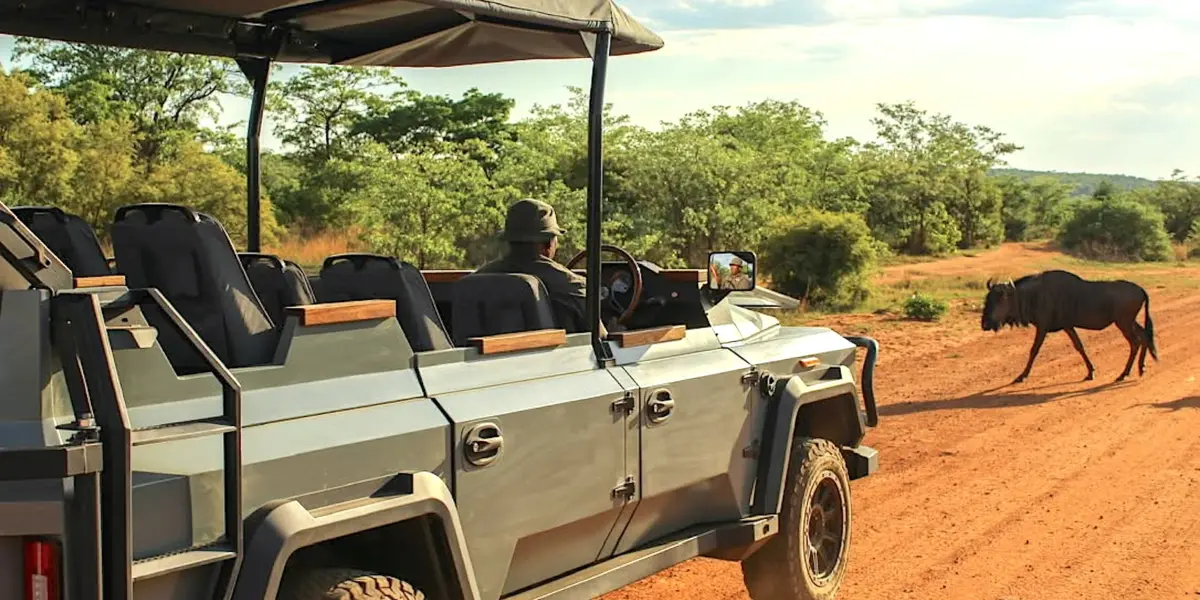
The traditional African safari is undergoing a radical, emission-free evolution. South African startup Thula Solutions has officially rolled out its flagship vehicle: the Thula ESV 4×4 (Electric Safari Vehicle). Unlike standard combustion-engine safari trucks or poorly executed diesel-to-electric conversions, the ESV 4×4 has been engineered completely from the ground up as a purpose-built electric off-roader.
Designed specifically for game reserves, scientific research expeditions, and park management operations, the vehicle tackles the fundamental drawbacks of legacy safari transport—namely, choking diesel exhaust, loud engine noise, and disruptive vibrations. Powered by a 65-kWh battery pack paired with a 225-kW (approx. 302 horsepower) electric motor, the vehicle is built to navigate punishing terrain while providing a completely silent, zero-emission platform.

While its 200-kilometer (~125-mile) range might sound modest compared to standard consumer electric vehicles, the ESV’s unique duty cycle—which involves slow game-viewing crawls rather than high-speed highway commuting—allows it to operate for up to three full days on a single charge. Following years of rigorous prototyping and testing, Thula Solutions has officially transitioned into series production, exporting vehicles across African borders and establishing itself as a pioneering international electric commercial truck brand.
Chronology: From Concept to International Deployment
The journey toward the Thula ESV 4×4 reflects the broader, accelerating push across African nations to modernize transit, curb fossil fuel dependency, and protect delicate ecosystems.
- The Early Development Phase (2021–2023): Recognizing that existing safari vehicles were simply loud, heavy, and polluting workhorses adapted from agricultural or military platforms, engineers at Thula Solutions began conceptualizing a dedicated electric architecture. The goal was to eliminate compromises inherent in retrofitting internal combustion engine (ICE) chassis.
- The Breakthrough Testing Era (2023): Thula released a viral demonstration video on its YouTube channel, showcasing prototype ESV models climbing steep inclines, traversing rocky riverbeds, and handling deep mud traps with effortless, silent torque. This phase proved that an electric drivetrain could not only match the capabilities of a diesel 4×4 in extreme off-road conditions, but surpass them due to instant throttle response.
- Commercialization and Series Production (2024–2025): Transitioning from experimental prototypes to scalable manufacturing, Thula refined its suspension, battery thermal management, and drivetrain durability. The company optimized the vehicle to withstand extreme sub-Saharan heat, dust, and continuous low-speed off-road abuse.
- International Expansion (2026): Thula Solutions achieved a major milestone by shipping its first series-production ESV units across international borders into neighboring African safari destinations. The brand officially solidified its status as an emerging global player in specialized electric utility transport, capturing the attention of conservationists, eco-tourists, and park operators worldwide.
Supporting Data & Technical Specifications
To understand why the Thula ESV 4×4 is turning heads in the automotive and conservation sectors, one must look closely at its specifications, which are tailor-made for the bush rather than the boulevard.

Performance and Drivetrain Metrics
- Motor Power: 225 kW (~302 horsepower), delivering instantaneous torque across all four wheels.
- Battery Capacity: 65-kWh custom battery pack, engineered for thermal resilience in high-temperature environments.
- Range: Approximately 200 kilometers (~125 miles) per charge.
- Operational Endurance: Up to three full days of typical game-drive duty cycles (low-speed tracking, frequent stopping, and idling) before requiring a recharge.
- Suspension: Long-travel, four-wheel independent suspension paired with a heavy-duty, purpose-built off-road chassis designed to absorb severe terrain shocks.
Comparing Duty Cycles: Passenger EVs vs. Safari EVs
| Metric | Standard Passenger EV | Thula ESV 4×4 |
|---|---|---|
| Primary Use Case | Highway commuting, errands, road trips | Low-speed wildlife tracking, rough-terrain crawling |
| Average Daily Mileage | 40–80 km (higher speeds) | 30–60 km (sustained low speeds) |
| Charge Frequency | Daily or bi-daily | Every 2 to 3 days under typical game-drive loads |
| Primary Constraint | High-speed aerodynamic drag & battery weight | Thermal management under heavy loads & extreme heat |
The data highlights a crucial engineering philosophy: chasing a massive 500-kilometer passenger car range in a heavy safari vehicle would add unnecessary battery weight, driving up costs and degrading off-road agility. Instead, Thula optimized the vehicle’s capacity for its specific operational reality, maximizing efficiency where it counts.
Official Responses and Industry Reactions
The reception from conservationists, tour operators, and wildlife photographers has been overwhelmingly positive, though the vehicle has also sparked nuanced debates across automotive forums.
The Conservation and Photography Perspective
Wildlife researchers and professional photographers have long struggled with the sensory pollution of traditional safari vehicles. Diesel engines produce low-frequency vibrations that travel through the chassis, rattling camera equipment and alerting wildlife long before the vehicle comes into view. Furthermore, exhaust fumes obscure pristine air, ruining both the sensory experience for tourists and high-definition photography opportunities.

Thula Solutions emphasizes this breakthrough on its official platform, noting that the ESV 4×4 delivers "stunning photography opportunities without the distraction of engine vibrations."
Tour guides have also praised the vehicle for enabling a more natural communication environment. In a diesel truck, guides often have to shout over the engine roar to point out a leopard in the brush or explain animal behavior to passengers. The silent electric powertrain allows for conversational tones, creating a more intimate and immersive wilderness experience.
Automotive and Environmental Commentary
Industry analysts point out that South Africa and other sub-Saharan African nations are increasingly targeting cleaner, fossil-free public and commercial transit alternatives. By removing tailpipe emissions from national parks and private game reserves, operators can protect local air quality and reduce their reliance on diesel supply chains that must be trucked over vast, remote distances.

However, online automotive communities have not missed the irony—or the slight edge—of the vehicle’s dual utility. Commentators on platforms like Electrek have playfully debated whether the massive reduction in tailpipe emissions outweighs the unmistakable "better to sneak up on and eventually shoot animals with" stealth factor. While hunters and conservationists alike appreciate the near-silent approach, the overwhelming consensus is that the vehicle’s primary value lies in ecotourism, scientific monitoring, and low-impact park management.
Implications for the Future of Ecotourism and Off-Road EVs
The commercial launch of the Thula ESV 4×4 carries profound implications for multiple industries, ranging from regional manufacturing to global conservation standards.
1. Setting a New Standard for Ecotourism
Eco-tourism relies heavily on the premise of sustainability. For decades, however, eco-lodges marketed pristine wilderness experiences while relying on fleets of noisy, polluting diesel 4x4s for game drives. The introduction of purpose-built electric safari vehicles closes this hypocrisy gap. As tourists become increasingly eco-conscious, game reserves that adopt silent, zero-emission fleets will likely gain a significant competitive marketing advantage.

2. Proof of Concept for Niche Commercial EVs
The automotive industry often focuses heavily on mass-market passenger cars, delivery vans, and heavy long-haul semi-trucks. Thula Solutions demonstrates the viability of highly specialized, low-volume commercial EVs. By focusing on a niche market with extreme environmental demands (dust, heat, rough terrain, heavy payload), Thula is proving that electric powertrains can outperform combustion engines where reliability and torque matter most.
3. Energy Independence in Remote Reserves
Many game reserves operate in remote regions far from robust electrical grids, often relying on expensive and dirty diesel generators. Pairing vehicles like the Thula ESV with localized solar microgrids and battery storage systems creates a closed-loop sustainability model. Reserves can generate their own clean energy via solar arrays, store it in stationary batteries, and use it to charge their safari fleets—completely severing their dependence on imported fossil fuels.
Conclusion
Thula Solutions has done more than just build another electric truck; they have reimagined how humans interact with the wild. By eliminating the roar of the diesel engine, the acrid smell of exhaust, and the chassis-rattling vibrations of legacy 4x4s, the ESV 4×4 restores peace to the natural habitats it traverses.

As these silent guardians of the bush expand their footprint across international borders, they mark a definitive turning point for African conservation and commercial EV engineering. Whether you are a wildlife photographer hunting for the perfect crisp frame, a researcher tracking animal behavior, or a traveler seeking a deeper connection with nature, the future of the safari is undeniably electric—and wonderfully, peacefully quiet.
