

August 27, 2026
By Camila Ghisleni (Translated by Diogo Simões)
Main Facts: The Concept and Its Modern Resurgence
Nearly a century after Swiss-French architect Le Corbusier first formalized the concept, the promenade architecturale—or architectural promenade—remains one of the most powerful guiding philosophies in global design. Far more than a mere method of circulation, the promenade is a deliberate choreography of movement, time, and space. It transforms a building from a static object into a dynamic, unfolding narrative experienced sequentially by the human body.

In modernist masterpieces such as the 1929 Villa Savoye, the promenade was the ultimate realization of functionality, aesthetics, and contextual integration. Visitors were guided along a carefully calculated upward trajectory—via ramps and staircases—that deliberately altered their viewpoints, framed the surrounding landscape, and culminated in the contemplation of a roof garden.
Today, this foundational modernist theory is experiencing a sweeping renaissance. Across diverse typologies—ranging from private residential sanctuaries and sweeping cultural museums to expansive public libraries and urban parks—contemporary architects are reinterpreting the promenade. By manipulating how occupants move through space, modern designers generate a synesthetic spatial experience where the cumulative impact of the journey far surpasses the sum of its individual architectural parts.

Chronology: From Avant-Garde Theory to Contemporary Practice
To understand the ubiquity of the architectural promenade in modern design, it is essential to trace its evolution from a radical early-20th-century blueprint into a versatile tool of the 21st century.
- The Early 20th Century (The Birth of Modernism): Pioneers of the Modern Movement, led by Le Corbusier, began shifting architectural focus away from static facades and closed-off rooms. Influenced by the advent of the automobile and rapid industrialization, architects sought to design spaces that accounted for temporal progression and human motion.
- 1929 (The Milestone of Villa Savoye): Le Corbusier completes Villa Savoye in Poissy, France. The building serves as the definitive textbook example of the promenade architecturale. The continuous interior ramp allows occupants to experience the architectural volume at a slow, measured pace, seamlessly connecting the ground plane to the elevated living spaces and, ultimately, the open sky.
- The Late 20th Century (Deconstructivism and Complexity): Post-modern and deconstructivist architects began twisting, fracturing, and expanding the promenade. Rather than the clean, linear ascents of early modernism, figures like OMA and Zaha Hadid introduced complex, labyrinthine loops and dramatic diagonal vectors that challenged traditional perceptions of gravity and orientation.
- The 21st Century (The Contemporary Renaissance): In modern projects worldwide—such as Studio MK27’s residential works, OMA’s Casa da Música, and FR-EE’s Museo Soumaya—the promenade is leveraged to address dense urban environments, biophilic design principles, and multi-generational public engagement. The concept has evolved from a theoretical luxury into an indispensable spatial strategy.
Supporting Data: Typologies and Spatial Dynamics
The versatility of the promenade architecturale lies in its adaptability across vastly different architectural scales and programs. Data from contemporary spatial analysis reveals how the concept manifests across four primary typologies:

1. Residential Architecture: The Private Journey
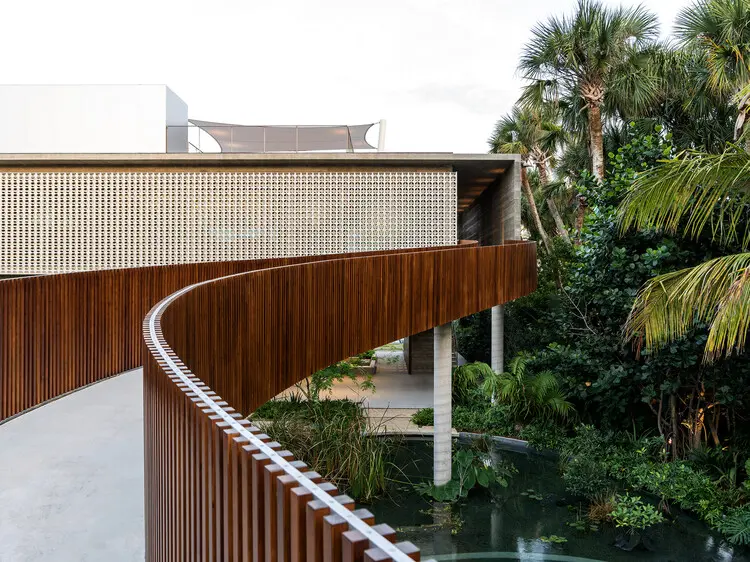
In high-end residential design—such as Studio MK27’s Canal House or Jacobsen Arquitetura’s EA Residence—the promenade serves to dissolve the boundary between interior living and exterior nature. Circulation paths are rarely treated as dead-end corridors; instead, they function as transitions. A typical contemporary home route might guide a resident from a compressed, shadowed entryway into a wide-open, double-height living pavilion, before gently lifting them via floating stairs toward private quarters or a vegetated rooftop. This gradual transition deepens the occupant’s emotional connection to the home and its immediate environment.
2. Cultural Institutions: Curated Discovery in Museums and Libraries
Cultural spaces rely heavily on the architectural promenade to manage heavy visitor flows while maintaining emotional engagement. In museums like the Museo Soumaya in Mexico City, designed by FR-EE / Fernando Romero Enterprise, the visitor is drawn up a vast, continuous spiral ramp. This eliminates the disorientation often found in traditional grid-based galleries, turning the act of viewing art into an uninterrupted spatial journey. Similarly, libraries use multi-tiered mezzanines and cascading staircases to encourage serendipitous discovery, inviting patrons to wander rather than simply navigate from point A to point B.

3. Public Architecture and Urban Parks: Civic Flow
At the macro scale, the promenade bridges the gap between private architecture and the public realm. Urban parks and civic centers utilize pedestrian pathways, elevated boardwalks, and ramps to dictate pacing, offer sudden architectural framing of city skylines, and create communal gathering zones. The movement of the crowd becomes part of the building’s living facade.
Official Perspectives: The Philosophy of Movement
Architectural theorists and practicing architects alike continue to debate and refine the mechanics of spatial sequencing.

"Le Corbusier advocated for the profound relationship between time and architecture," notes architectural historian and writer Camila Ghisleni. "The promenade begins at the building’s threshold and unfolds as a living path to be explored by the physical body, gradually exposing the diverse layers of the design. It offers a dynamic experience where the whole sequence supersedes the isolated parts."
Contemporary practitioners echo this sentiment, emphasizing that the modern user demands more than visual appeal—they seek sensory immersion. By intentionally orchestrating light, shadow, compression, expansion, and texture along a path, architects can dictate mood and focus.

Renowned firms utilizing these principles emphasize that a successful promenade does not force the user, but rather seduces them forward. Every turn, threshold, and window placement acts as a visual prompt, encouraging the occupant to look up, look out, or move deeper into the structure.
Implications: The Future of Spatial Design
As we look toward the future of architecture, the enduring relevance of the promenade architecturale offers critical insights into how we design for human well-being, psychological comfort, and environmental integration.

Human-Centric Design in a Digital Age
In an era increasingly dominated by virtual spaces and instantaneous digital consumption, physical architecture must offer a grounding counter-narrative. The architectural promenade forces slowness, physical presence, and spatial mindfulness. By engaging the body in a deliberate sequence of movement, buildings help counteract the sensory fatigue of modern digital life.
Biophilic Integration and Sustainability
Furthermore, as sustainable design prioritizes natural ventilation, daylighting, and biophilic connections, the promenade serves as an ideal vehicle. When a circulation path is designed to snake alongside internal courtyards, green walls, or solar-oriented facades, it naturally exposes occupants to changing qualities of light and air throughout the day. This strengthens the psychological bond between humans and the natural environment.

Conclusion
A hundred years after its inception, the promenade architecturale is far more than a historical footnote of the Heroic Period of Modern Architecture. It remains a living, evolving philosophy. Whether navigating a minimalist Brazilian beach house, ascending a futuristic cultural center in Europe, or wandering through an urban park, the modern user continues to read architecture with their feet. Through the mindful choreography of space and time, the architectural promenade ensures that buildings are not just places we inhabit, but journeys we experience.
