

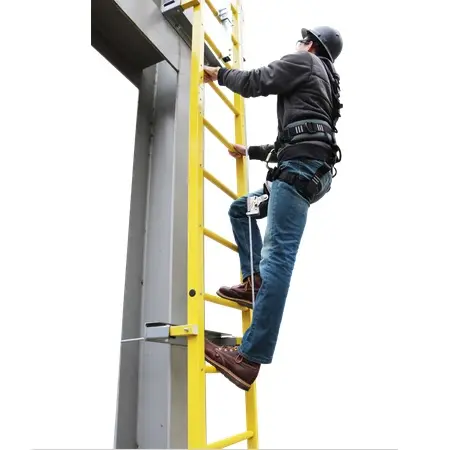
For decades, climbing a fixed vertical ladder to access a commercial roof hatch or elevated platform was considered a routine, albeit inherently risky, part of a roofer’s daily work. To mitigate this risk, building owners and contractors traditionally relied on metal ladder cages or well enclosures as the standard line of defense against catastrophic falls.
However, the regulatory landscape governing vertical ascent underwent a fundamental shift with the United States Occupational Safety and Health Administration’s (OSHA) overhaul of its walking-working surfaces standards. Under these revised rules, the traditional ladder cage is no longer recognized as an acceptable sole means of fall protection for high-climbing workers.
For commercial roofing contractors and building owners, navigating these updated regulations requires a thorough understanding of compliance timelines, technical equipment specifications, and liability implications. As the industry marches toward a critical compliance deadline, proactive audits of both internal roof hatches and external roof access systems are becoming essential for legal compliance and worker safety.
Main Facts: The Paradigm Shift in Vertical Fall Protection
Historically, the safety of a fixed ladder was visually defined by the presence of a metal cage wrapping around the rungs. When a ladder extended high above the ground, these cages were intended to prevent a falling worker from plunging backward to the surface below.
This standard changed when OSHA amended its Walking-Working Surfaces rule (specifically 29 CFR 1910.28(b)(9)). The agency determined that ladder cages do not prevent falls; instead, they can actually exacerbate injuries by causing a falling worker to strike the metal hoops on their way down.
+-----------------------------------------------------------------------------+
|                          OSHA 29 CFR 1910.28(b)(9)                          |
|                                                                             |
|  For fixed ladders extending > 24 feet above a lower level:                 |
|                                                                             |
|  * Cages and wells are no longer recognized as primary fall protection.     |
|  * Compliance requires a Ladder Safety System (LSS) or Personal Fall        |
|    Arrest System (PFAS).                                                    |
+-----------------------------------------------------------------------------+
The core mandates of the amended standard include:
- The 24-Foot Threshold: Any fixed ladder that extends more than 24 feet above a lower level must be equipped with active fall protection.
- The Rejection of Cages: For ladders meeting or exceeding this height, cages and wells are no longer considered acceptable fall protection.
- Mandatory System Integration: Compliance must be achieved through either a Ladder Safety System (LSS) or a Personal Fall Arrest System (PFAS).
- Universal Application: The standard applies to both internal access systems (such as roof hatches) and external systems (such as exterior roof access ladders).
Chronology: The Multi-Decade Compliance Timeline
To prevent immediate disruption across millions of commercial facilities, OSHA established a phased, multi-decade implementation schedule. This timeline transition began in late 2018 and extends to a final enforcement deadline in 2036.
       Nov 19, 2018                    Nov 19, 2018                   Nov 18, 2036
------------x--------------------------------x------------------------------x------------
      Legacy Systems                  New Installations               Universal Deadline
  Cages/wells grandfathered         LSS or PFAS mandatory             All fixed ladders >24'
  unless repaired/replaced.        from day of installation.          must have LSS or PFAS.
Phase 1: November 19, 2018 (The Legacy Grandfathering Clause)
Under 1910.28(b)(9)(i)(A), fixed ladders installed prior to November 19, 2018, that extend more than 24 feet were initially allowed to remain in service with their existing cages, wells, or legacy safety systems. This grandfather clause was designed to prevent immediate, costly retrofits for existing building owners.
Phase 2: November 19, 2018 (The New Installation & Replacement Trigger)
Under 1910.28(b)(9)(i)(B), any new fixed ladder installed after November 19, 2018, must be equipped with a ladder safety system or a personal fall arrest system from day one.
Crucially, this phase introduced a "replacement trigger": if any portion of an existing legacy ladder, cage, or well is damaged and requires replacement or repair, the entire ladder system must be upgraded to meet the new LSS or PFAS requirements.
Phase 3: November 18, 2036 (The Universal Deadline)
As codified in 1910.28(b)(9)(i)(D), the grandfathering period will officially expire on November 18, 2036. On and after this date, all fixed ladders exceeding 24 feet in height, regardless of their original installation date, must be retrofitted with a compliant ladder safety system or personal fall arrest system. Cages and wells will no longer be legally recognized as fall protection under federal law.
Supporting Data and Technical Specifications
To achieve compliance, building owners and contractors must understand what constitutes an acceptable safety system under OSHA standards. The regulations distinguish between two primary configurations, each requiring specific hardware and engineering standards.
1. Ladder Safety Systems (LSS)
According to OSHA guidelines, a Ladder Safety System is an engineered, integrated assembly designed to eliminate or significantly reduce the risk of a worker falling off a ladder.
+----------------------------------------------------------------------------+
|                       Components of a Ladder Safety System                 |
+----------------------------------------------------------------------------+
|  [Carrier/Rail] ---> [Safety Sleeve (Traveler)] ---> [Lanyard] ---> [Harness] |
+----------------------------------------------------------------------------+
An LSS typically consists of:
- The Carrier: A rigid rail or a tensioned flexible cable (such as a stainless steel vertical cable system) that runs vertically along the center or side of the ladder.
- The Safety Sleeve (or Traveler): A mechanical locking device that glides smoothly along the carrier as the worker climbs but locks instantly in the event of a slip or fall.
- The Connector & Lanyard: A short, high-strength connection element linking the safety sleeve to the worker’s harness.
- The Body Harness: A full-body safety harness rated for fall arrest.
2. Personal Fall Arrest Systems (PFAS)
While similar to an LSS, a PFAS on a fixed ladder typically utilizes a flexible lifeline or self-retracting lifeline (SRL) anchored above the ladder. The system is designed to arrest a fall after it has begun, limiting the impact force on the worker’s body.
The Harness Conundrum: 29 CFR 1910.140(d)(1)(iv)
One of the most frequently overlooked technical details in vertical fall protection is the specific design of the safety harness. Under OSHA 1910.140(d)(1)(iv), fall arrest systems must be designed to:
"…sustain the employee within the system/strap configuration without making contact with the employee’s neck and chin area."
                 DORSAL D-RING                    CHEST/WAIST D-RING
             (Standard Roof Harness)             (Ladder Safety Harness)

                    /                                   /
                   /                                   /
                  |  O  | <--- Danger: Neck/Chin       |  O  |
                  |     |      Contact on Vertical     |  X  | <--- Safe: Frontal
                  |  |  |      Ascent Fall             |  |  |      D-Ring Connection
                  |  |  |                              |  |  |
In a standard roofing environment, workers typically wear harnesses with a single dorsal (back-mounted) D-ring. However, if a worker falls backward off a vertical ladder while attached to a dorsal D-ring, the harness straps can shift upward under tension. This upward movement can cause the straps to compress the wearer’s throat, neck, or chin, risking asphyxiation or severe cervical trauma.
To comply with the standard during vertical climbs, workers must use specialized harnesses equipped with a sternal (chest-mounted) or waist-mounted D-ring. This configuration keeps the worker in an upright position during a fall and prevents the harness straps from riding up into the neck and face area.
Official Responses and Industry Perspectives
The transition away from ladder cages has drawn significant commentary from safety professionals, industry associations, and equipment manufacturers.
OSHA’s Safety Rationale
In publishing the revised standards, OSHA cited extensive safety data showing that traditional cages failed to stop falls. In many documented cases, workers who slipped inside a cage fell the entire length of the ladder, suffering severe lacerations, fractures, and head trauma from colliding with the cage’s metal hoops.
By contrast, an engineered cable- or rail-based ladder safety system stops a fall within inches, significantly reducing both the fall distance and the impact forces on the worker’s body.
The Contractor Perspective
The National Roofing Contractors Association (NRCA) has actively educated its members on these changes, emphasizing that contractors must protect not only their own field personnel but also their clients.
Many contractors now use the 2018-2036 transition period to educate building owners. By identifying non-compliant ladders during routine roof inspections, contractors can position themselves as safety advisors rather than simple service providers.
The Supplier and Engineering Response
Equipment manufacturers have responded by developing highly modular, retrofittable ladder safety kits. Modern cable-based systems can be installed on existing aluminum, steel, or fiberglass ladders without requiring complete demolition of the ladder structure.
"The transition from passive cages to active cable and rail systems represents a major leap forward in worker safety," says an industry specialist at Roofmaster. "With over 70 years of experience and five locations nationwide, we are seeing a significant increase in contractors seeking engineered vertical lifelines to bring older commercial properties into alignment with modern standards."
Implications for Building Owners and Contractors
The business and legal implications of OSHA 1910.28(b)(9) are substantial, carrying liabilities that stretch far beyond simple regulatory compliance.
+-----------------------------------------------------------------------------+
|                        Liability & Compliance Matrix                        |
+-----------------------------------------------------------------------------+
|  Scenario: Existing ladder (>24') with cage only (Pre-2018 installation).   |
|                                                                             |
|  * Legal Status: Grandfathered until Nov 18, 2036.                          |
|  * Risk Exposure: HIGH. If a contractor falls, the building owner may face  |
|    civil lawsuits for maintaining a known hazardous condition.              |
|  * Trigger Event: Any repair to the ladder instantly voids the grandfather  |
|    status, requiring immediate LSS/PFAS installation.                       |
+-----------------------------------------------------------------------------+
1. Liability and Risk Management for Building Owners
While legacy ladders with cages are technically grandfathered until 2036, relying on this exemption carries significant civil liability risk. If a third-party contractor or maintenance worker falls from an older, caged ladder that lacks an active safety system, the building owner may face civil litigation for failing to provide a safe working environment, regardless of the OSHA timeline.
Furthermore, any modification, repair, or relocation of an existing ladder instantly voids its grandfathered status, legally requiring an immediate upgrade to an LSS or PFAS.
2. The Advisory Role of Roofing Contractors
Roofing contractors are uniquely positioned to help property owners navigate these regulations. During initial roof surveys or preventative maintenance visits, contractors should perform a Fixed Access Ladder Audit.
              Fixed Access Ladder Audit Checklist

  [ ] Height Check: Does the ladder exceed 24 feet?
  [ ] Installation Date: Was it installed after Nov 19, 2018?
  [ ] Physical Condition: Are there signs of rust, wear, or damage?
  [ ] Fall Protection: Is an active LSS or PFAS currently installed?
  [ ] Harness Compatibility: Do workers have chest/waist D-ring harnesses?
If a contractor discovers a ladder exceeding 24 feet that relies solely on a cage, they should formally document this finding and present the owner with an upgrade proposal. This approach helps protect the contractor’s employees, reduces the building owner’s liability, and generates additional service revenue.
3. Capital Expenditure and Proactive Planning
Waiting until the 2036 deadline to retrofit fixed ladders can lead to hurried installations and inflated capital costs. Forward-thinking facility managers are integrating ladder safety retrofits into their annual capital improvement budgets.
Upgrading ladders during scheduled reroofing projects is highly cost-effective, as the necessary staging, scaffolding, and safety personnel are already on-site.
Conclusion
OSHA’s phase-out of ladder cages represents a significant modernization of vertical fall protection. By requiring active ladder safety systems and specialized front-connecting harnesses, the regulations target the root causes of vertical fall injuries.
While the final compliance deadline of November 18, 2036, may seem distant, the triggers for compliance—including new installations, repairs, and general civil liability—make this an immediate concern for the commercial roofing industry.
Contractors and building owners should partner with experienced safety equipment suppliers to evaluate their existing systems, select compliant hardware, and ensure that every climb is backed by modern safety engineering.
