

By John Davis
The commercial roofing industry has undergone a massive technological and material evolution over the past three decades. Today, single-ply membrane roofing systems—primarily Thermoplastic Polyolefin (TPO) and Polyvinyl Chloride (PVC)—reign supreme as the dominant choice for low-slope commercial structures. However, the success of these installations relies on more than just high-quality membranes and skilled labor. It depends heavily on the precision of specialized hot-air welding equipment and, crucially, the generators that power them on the job site.
While contractors frequently focus on the maintenance of their high-value hot-air welders, such as industry-standard Leister units, they often overlook the heartbeat of the entire operation: the portable generator. In an era where supply chain constraints make equipment downtime exceptionally costly, understanding the nuances of generator maintenance is no longer just a chore for the shop mechanic—it is a critical business strategy.
Main Facts: The Intersection of Single-Ply Dominance and Power Reliability
Single-ply membrane applications constitute the largest segment of the commercial roofing market, valued at billions of dollars annually. Despite severe material supply shortages, shipping bottlenecks, and chemical precursor scarcity over the last few years, the demand for TPO and PVC systems has remained resilient due to their energy efficiency, ease of installation, and reflective properties.
+-----------------------------------------------------------------------+
|                       THE CRITICAL POWER CHAIN                        |
|                                                                       |
|  [ Portable Generator ] ------> [ Hot-Air Welder ] ------> [ Seam ]   |
|     Provides stable,             Requires precise,           Ensures  |
|     clean voltage.               consistent heat             water-   |
|                                  & speed settings.           tightness|
+-----------------------------------------------------------------------+
To join these thermoplastic sheets, contractors utilize advanced automatic and hand-held hot-air welders. These machines use microprocessors to monitor and adjust temperature and speed in real-time, ensuring a flawless, watertight seam. However, this sophisticated digital circuitry requires exceptionally stable, clean electrical power.
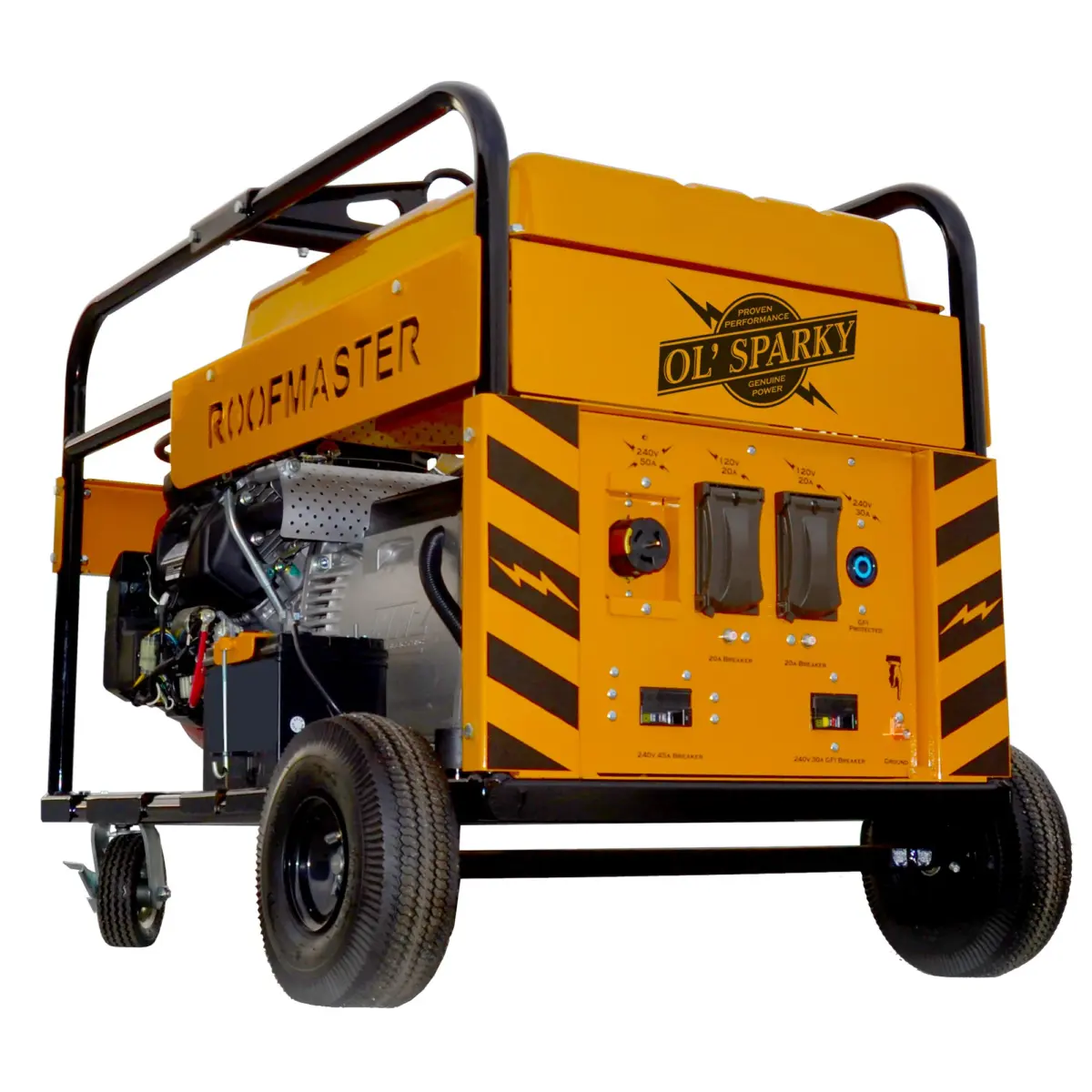
On a commercial job site, this power is almost exclusively provided by portable generators. If a generator is poorly maintained, it can produce voltage fluctuations, harmonic distortion, or sudden power drops. This does not just stall production; it can instantly destroy the sensitive electronic control boards of a $10,000 automatic welder. To mitigate these risks, Roofmaster® Products Company operates specialized service centers with certified mechanics across key regional hubs, including Los Angeles, California, and Dallas-Fort Worth, Texas, to support contractors in keeping their power fleets operational.
Chronology: The Evolution of Single-Ply Roofing and Job Site Power
Understanding the current state of commercial roofing requires looking back at how material advancements forced a parallel evolution in job site power requirements.
The Rise of Single-Ply Membranes (1970s–1990s)
During the late 20th century, the commercial roofing market began shifting away from traditional multi-ply Built-Up Roofing (BUR) and asphalt-based modified bitumen systems. The introduction of single-ply membranes like EPDM (rubber) offered faster installation times and reduced labor costs. By the 1990s, thermoplastic membranes (TPO and PVC) gained significant market share because their seams could be hot-air welded rather than glued, creating a monolithic, highly durable barrier.
The Digitalization of Welding Equipment (2000s–2010s)
Early hot-air welding tools were relatively simple, analog devices with basic heating elements and motors. They were forgiving of fluctuating electrical currents. However, as wind-uplift codes tightened and building owners demanded longer warranties, equipment manufacturers introduced highly precise, digitally controlled automatic welders.
Machines like the Leister Varimat became standard. These units rely on onboard microchips to maintain exact temperatures (often exceeding 1,000°F) and consistent drive speeds, regardless of ambient conditions. This technological leap transformed welders into sensitive electronic devices, highly vulnerable to dirty power.
The Supply Chain Crisis and Equipment Preservation (2020–2022)
The COVID-19 pandemic and subsequent global supply chain disruptions severely impacted the roofing industry. Shortages of raw chemical components led to allocations and long lead times for TPO and PVC membranes. Concurrently, electronic chip shortages made new hot-air welders and high-end generators difficult to source.
Contractors could no longer afford to simply replace damaged equipment; they had to extend the service life of their existing fleets through rigorous preventative maintenance.
The Modern Era (2023–Present)
As the market stabilizes, single-ply roofing remains the undisputed leader in commercial applications. However, labor shortages and high interest rates mean contractors must operate with maximum efficiency. A single day of downtime due to a blown generator or a fried welding control board can erase the profit margin of an entire project. Consequently, professional generator maintenance has transitioned from an afterthought to a core operational priority.
Supporting Data: The Mechanics of Power and Market Realities
To appreciate the importance of generator maintenance, one must look at the technical and economic metrics that define modern commercial roofing.
Market Share and Economic Impact
According to industry data from the National Roofing Contractors Association (NRCA) and Single-Ply Roofing Industry (SPRI) reports:
- Single-ply membranes account for over 60% of all commercial low-slope roofing installations in the United States.
- TPO represents approximately 40% to 45% of that total, followed closely by PVC and EPDM.
- A typical commercial roofing crew of six to eight workers represents an average labor cost of $300 to $500 per hour, including insurance and overhead. If a generator failure halts work, a contractor can lose thousands of dollars in unproductive labor in a single afternoon.
The Technical Challenge: Total Harmonic Distortion (THD)
Standard utility grid power is exceptionally clean, with a Total Harmonic Distortion (THD) of less than 3%. In contrast, cheap or poorly maintained commercial generators can produce a THD of 15% to 30% under heavy loads.
Generator Power Quality vs. Equipment Health:
+------------------------+------------------------+------------------------+
| Power Source Type      | Average THD %          | Impact on Welder       |
+------------------------+------------------------+------------------------+
| Utility Grid           | < 3%                   | Safe / Optimal         |
| High-End Inverter Gen  | < 5%                   | Safe / Optimal         |
| Unmaintained Standard  | 15% - 30%              | High Risk of Failure   |
+------------------------+------------------------+------------------------+
When THD exceeds 10%, the microprocessors in modern hot-air welders can experience "logic lockup," where the machine shuts down or misreads temperature sensors. More critically, high THD and voltage spikes cause excessive heat buildup in the welder’s electric motors and control transformers, leading to premature component failure.
Expert Guidelines: Generator Maintenance Dos and Don’ts
Proper maintenance ensures that a generator delivers clean, stable voltage to sensitive roofing equipment. Below are the essential guidelines compiled by field service technicians.
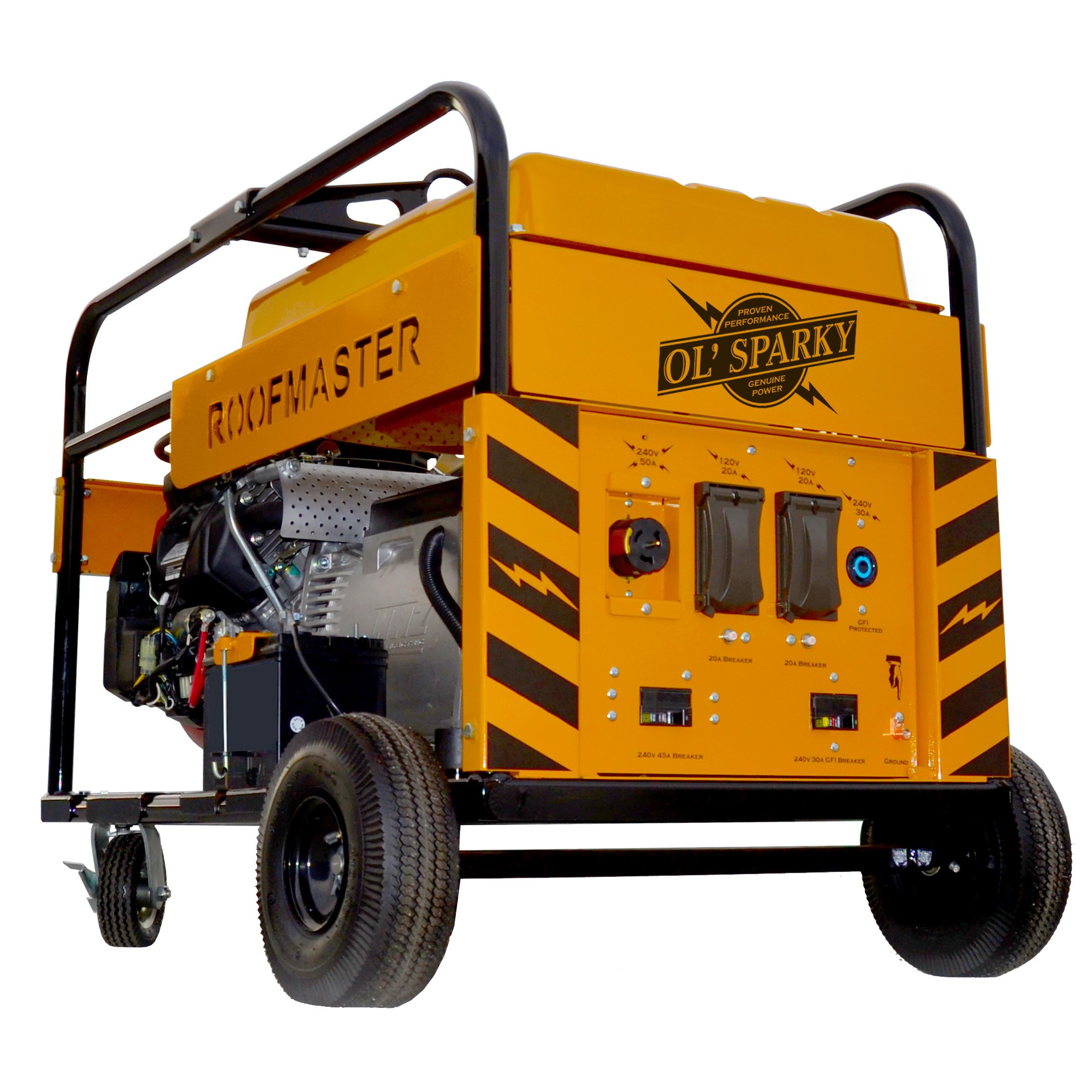
The Dos of Generator Maintenance
Do: Check and Change the Oil Regularly
Small air-cooled generators used on roofs typically do not have oil filters; they rely on splash lubrication. Therefore, keeping the oil clean is paramount.
- Frequency: Check the oil level daily before starting the unit. Change the oil every 50 to 100 hours of operation, or at least once a month during peak roofing season.
- Specification: Use high-quality, full-synthetic oil of the viscosity recommended by the manufacturer (typically 10W-30 or 5W-30 for cold-weather starting). Synthetic oils withstand the high operating temperatures of rooftop environments far better than conventional mineral oils.
Do: Use Fresh Fuel and Stabilizers
Gasoline begins to degrade in as little as 30 days. Degraded fuel forms gum and varnish deposits in the carburetor, leading to a lean fuel-to-air ratio. This causes the engine to "surge" or hunt for idle, which directly translates to fluctuating voltage output.
- Action: Use fresh, high-octane (87 or higher) unleaded gasoline. If the generator will sit idle for more than two weeks, always add a high-quality fuel stabilizer. Where available, use ethanol-free fuel to prevent moisture absorption and fuel system corrosion.
Do: Inspect and Clean the Air Filter Daily
Rooftop environments are incredibly dusty. Tear-off operations release massive amounts of asphalt dust, fiberglass, and old insulation into the air.
- Action: Clean the foam pre-filter daily with warm, soapy water, and replace the paper cartridge element weekly or whenever it becomes visibly clogged. A choked engine runs rich, loses power, and can cause the voltage regulator to drop output voltage.
Do: Maintain Proper Grounding
A generator that is not properly grounded can pose a severe safety hazard and lead to erratic operation of electronic welding equipment.
- Action: Always follow OSHA guidelines and the manufacturer’s instructions for grounding the generator on-site, especially when operating on elevated steel-deck structures.
The Don’ts of Generator Maintenance
Don’t: Idle the Generator Down While Welders Are Connected
Many modern generators feature an "auto-idle" or "eco-mode" switch that drops the engine speed when there is no electrical draw.
- The Risk: When a hot-air welder demands power, the generator must rapidly ramp up to full speed. During those few seconds of acceleration, the voltage can sag dramatically, followed by an overcompensating voltage spike.
- Rule: Always turn off the auto-idle feature when powering welding equipment. The generator must run at constant full governed speed (usually 3,600 RPM) to maintain stable voltage and frequency (60Hz).
Don’t: Overload the Generator
A Leister Varimat V2 automatic welder typically requires 4,600 watts of continuous power at 230 volts. If a crew plugs in additional hand welders, screw guns, or battery chargers into the same generator, they risk overloading the unit.
- The Risk: Overloading causes the engine speed to drop, which lowers both voltage and frequency. This can burn out the heating elements in the hand welders and damage the control boards of the automatic welders.
- Rule: Dedicate a specific, appropriately sized generator (minimum 6,500 to 8,000 surge watts) solely to the automatic welder.
Don’t: Neglect the Spark Plug and Spark Arrester
A fouled spark plug causes engine misfires, leading to instantaneous drops in electrical frequency. Additionally, a clogged spark arrester screen in the muffler restricts exhaust flow, reducing engine power.
- Action: Inspect, clean, and re-gap the spark plug every 100 hours. Clean the spark arrester screen with a wire brush at the same interval.
Official Responses and Industry Insights
In the competitive landscape of commercial roofing, manufacturers and service providers emphasize that preventative maintenance is the most effective hedge against inflation and labor losses.
"We see it in our repair shops every single week," says a senior service coordinator at Roofmaster’s Dallas-Fort Worth facility. "A contractor brings in a Leister welder with a fried mainboard, complaining that the machine is defective. When we run diagnostics, we find the board was subjected to severe voltage fluctuations. Nine times out of ten, the culprit was a generator with a dirty carburetor, a clogged air filter, or a failing automatic voltage regulator (AVR). The contractor ends up paying thousands of dollars for a welder repair that could have been avoided with a fifteen-dollar oil change and a fresh air filter on their generator."
Roofmaster® Products Company has addressed this industry-wide pain point by investing heavily in its service infrastructure. By maintaining certified mechanics at dedicated service hubs in Los Angeles and Dallas-Fort Worth, the company provides contractors with rapid diagnostic and repair services for both their hot-air welders and their job site power equipment.
"Our goal is to keep crews on the roof and productive," explains John Davis, industry expert and author. "Having certified mechanics in key logistics hubs like LA and DFW allows us to offer fast turnaround times. But more importantly, we want to educate our customers on preventative care. A well-maintained generator doesn’t just last longer; it protects the highly sensitive, expensive welding tools that are the lifeblood of modern single-ply installations."
Strategic Implications for Commercial Contractors
The relationship between generator maintenance and project profitability carries profound implications for the commercial roofing sector.
                  FINANCIAL & OPERATIONAL RISK PROFILE
+------------------------------------+------------------------------------+
| Unmaintained Generator Risks       | Maintained Generator Benefits      |
+------------------------------------+------------------------------------+
| • Voltage drops ruin welder boards | • Consistent heat for perfect seams|
| • Downtime costs $300-$500/hour    | • Maximizes equipment lifespan     |
| • Weak seams lead to warranty leaks| • Prevents labor cost bleed        |
+------------------------------------+------------------------------------+
Financial Risk Management
In a tight-margin economy, equipment reliability is a key differentiator. If a contractor’s automatic welder fails due to poor power quality, the direct costs include repair bills and shipping. The indirect costs, however, are far more damaging: missed project deadlines, liquidated damages, and lost labor hours. By establishing a strict, documented generator maintenance protocol, contractors can transform their field operations from reactive to proactive.
Warranty and Liability Preservation
A critical, often overlooked aspect of single-ply roofing is seam integrity. If a generator’s voltage fluctuates, the hot-air welder’s temperature will fluctuate as well. This can result in "cold welds"—seams that appear bonded but fail under wind load or thermal movement.
Cold welds lead to water infiltration, mold, and premature roof failure. If a forensic analysis reveals that a roof failed due to improper seam welding caused by inconsistent power supply, the contractor could face massive liability claims and the voiding of manufacturer warranties.
Equipment Lifespan Extension
With high interest rates making capital expenditure financing more expensive, extending the lifecycle of existing assets is vital. A high-quality commercial generator, when meticulously maintained, can easily provide over 3,000 hours of reliable service. Conversely, a neglected unit may fail permanently in less than 500 hours, forcing premature replacement.
Ultimately, the power supply is the foundation upon which the entire single-ply roofing process is built. By treating the generator with the same respect and maintenance discipline as the high-tech welding equipment it powers, commercial roofing contractors can secure their operations against unexpected downtime, protect their capital investments, and ensure the long-term integrity of their installations.
