

By Thomas Ricker
Published September 2026
Main Facts: Redefining High-End Projection Technology
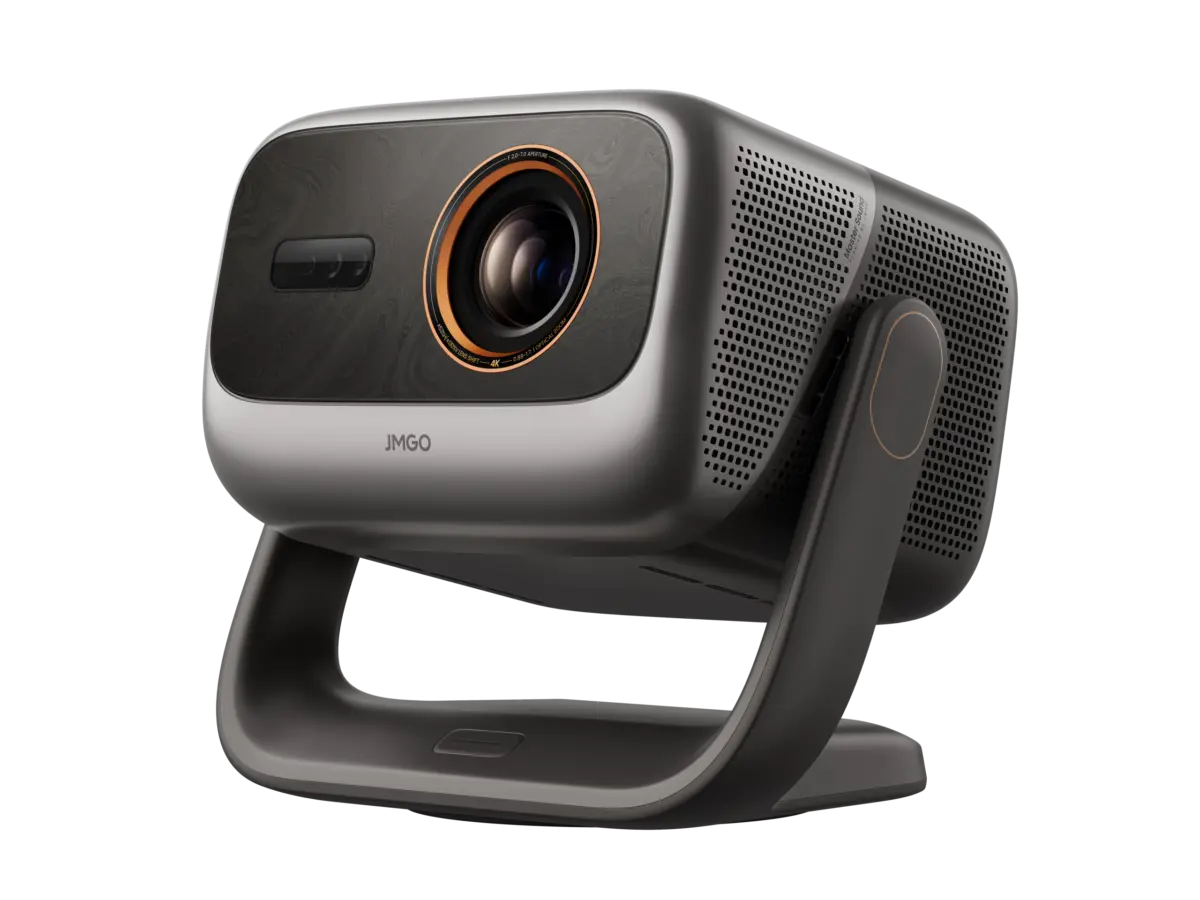
JMGO has officially launched its highly anticipated all-in-one Google TV projector, the Iris Ultra Max, for markets outside of China. Billed as a tour de force in home projection technology, the new flagship model attempts to solve some of the most persistent hurdles in projection history—namely, managing ambient light, achieving deep black levels, and maintaining color fidelity at ultra-high brightness levels.
Priced at an eventual retail MSRP of $3,499—though discounted to $2,999 for early adopters participating in the preorder window starting today ahead of an October 19th ship date—the Iris Ultra Max targets home theater enthusiasts and next-generation console gamers alike.
At the core of the device’s engineering is a proprietary dual-iris system. By deploying two separate physical apertures at different points along the internal optical path, JMGO claims the projector can aggressively control light scatter and suppress unwanted reflections. This mechanism yields an impressive 10,000:1 native contrast ratio, a figure that dwarfs traditional single-iris designs.
Powered by a robust triple-laser light engine, the Iris Ultra Max pumps out an eye-watering 6,500 ISO lumens. Paired with native 4K resolution running at a buttery-smooth 120Hz refresh rate, and complete with support for Dolby Vision HDR, Variable Refresh Rate (VRR), and Auto Low Latency Mode (ALLM), the hardware spec sheet positions this all-in-one unit as a serious challenger to traditional multi-component home theater installations.
Chronology: The Evolution of the All-in-One Projector Market
To understand the significance of the Iris Ultra Max release, it is helpful to look back at the rapid trajectory of the all-in-one projector category over recent years.
- Late 2024 to Early 2025: The market witnessed a massive surge in demand for smart, integrated projection systems. Brands began packing comprehensive operating systems like Google TV and advanced automated setup tools into compact form factors, allowing consumers to bypass complex AV receiver setups.
- IFA (Late 2025): Achieving 6,000 lumens in an all-in-one projector footprint was viewed as a breakthrough, establishing a new boundary for portable or semi-permanent high-end home cinema gear.
- Early 2026: Companies like JMGO experimented heavily with automated physical alignment tools, introducing motorized gimbals to simplify physical placement without sacrificing digital Keystone correction quality. However, criticisms regarding color distortion at maximum brightness—as seen in reviews of previous hardware iterations like the N3 Ultimate—remained a thorn in the industry’s side.
- September 2026 (Current Release): At IFA 2026, specifications that were once considered bleeding-edge have quickly become table stakes. The debut of the Iris Ultra Max marks a turning point where 4K 120Hz gaming, ultra-bright triple-laser engines, and dual-iris dynamic optical control converge into a single commercially available chassis. Preorders open immediately, setting the stage for global deliveries on October 19th.
Supporting Data: Technical Specifications and Performance Metrics
When evaluating high-end display hardware, raw numbers tell only part of the story, but the engineering specs behind the JMGO Iris Ultra Max certainly demand attention.

| Feature / Specification | JMGO Iris Ultra Max Details |
|---|---|
| Resolution & Refresh Rate | Native 4K at 120Hz |
| Brightness Output | 6,500 ISO lumens (Triple-laser light engine) |
| Native Contrast Ratio | 10,000:1 (via dual-iris physical aperture system) |
| HDR & Gaming Support | Dolby Vision, VRR (Variable Refresh Rate), ALLM (Auto Low Latency Mode) |
| Placement Flexibility | Motorized pan-and-tilt gimbal, 0.88–1.7:1 optical zoom |
| Lens Shift Capabilities | Vertical ±130%, Horizontal ±53% |
| Operating System | Google TV (All-in-one integration) |
| Pricing & Availability | $3,499 standard retail; $2,999 preorder; shipping October 19th |
The Mechanics of the Dual-Iris System
Projectors have historically struggled with contrast because light behaves unpredictably inside an enclosed optical chamber. Stray photons bounce off internal lenses and chassis walls, lifting black levels and turning deep cinematic shadows into a murky grey haze.
By placing two distinct mechanical irises at strategic nodes within the optical pathway, JMGO’s engineers can physically clamp down on stray light before it exits the projection lens. This hardware-level intervention works independently of software-based contrast enhancement (which often crushes shadow details or alters gamma curves), theoretically preserving the native fidelity of dark scenes while maximizing the peak highlights enabled by the 6,500-lumen triple-laser system.
Precision Placement via Motorized Gimbal and Optical Zoom
Physical installation has long been the primary friction point for home theater owners. Ceiling mounts require precise measurements, and tabletop setups often force users to rely on digital keystone correction, which inherently degrades resolution and wastes pixels.
The Iris Ultra Max addresses this with a built-in motorized pan-and-tilt gimbal—reminiscent of intuitive, motion-based pointing controls. Combined with an impressive 0.88–1.7:1 optical zoom lens and generous lens shift parameters (Vertical ±130%, Horizontal ±53%), users can position the projector off-center while maintaining full optical image quality. This mechanical flexibility ensures that every single one of the 4K pixels makes it onto the screen without digital cropping or scaling penalties.
Official Responses and Industry Context
While JMGO’s marketing materials highlight groundbreaking performance, consumer technology journalism urges a degree of cautious optimism. Industry experts point out that high-output laser engines often walk a tightrope between blistering brightness and color accuracy.
In reviewing JMGO’s previous flagship, the N3 Ultimate, critics noted that pushing the hardware to its absolute peak brightness resulted in noticeable color distortion, rendering the highest lumen settings practically unwatchable for critical viewing. Although the Iris Ultra Max boasts an even higher ceiling of 6,500 ISO lumens, early hands-on reports emphasize that independent, rigorous third-party testing will be necessary to determine whether JMGO has successfully resolved these color-purity trade-offs.
Furthermore, the inclusion of Google TV positions the Iris Ultra Max not just as a silent box of lenses and lasers, but as a complete media hub. By streamlining access to mainstream streaming applications natively, JMGO is courting mainstream consumers who might otherwise be intimidated by traditional multi-device home theater ecosystems.

Implications: What the Iris Ultra Max Means for the Home Entertainment Market
The commercial release of the JMGO Iris Ultra Max signals several broader shifts in the consumer electronics and home entertainment landscape:
1. The Blurring Lines Between Gaming Monitors and Cinematic Projectors
With native support for 4K at 120Hz, paired with gaming-centric features like VRR and ALLM, high-end projection is shedding its historical reputation as a medium strictly for cinematic movies and casual television viewing. As modern consoles (PlayStation 5 Pro, Xbox Series X successors, and high-end PC rigs) push frame rates higher, large-screen enthusiasts no longer have to choose between the responsiveness of a gaming monitor and the immersive scale of a 150-inch projection wall.
2. The Standardization of "Table Stakes" Specs at IFA
What was considered revolutionary engineering at trade shows just twelve months ago is now a baseline requirement for flagship status. The rapid commoditization of triple-laser engines and high lumen counts means that manufacturers must compete on nuanced optical engineering—such as JMGO’s dual-iris contrast management—rather than raw wattage alone.
3. Pricing Pressures on Traditional Home Theater Brands
At a standard retail price of $3,499 (and an introductory $2,999), all-in-one smart projectors are aggressively undercutting traditional, modular projector setups that require separate screens, external streaming sticks, dedicated soundbars, and complex calibration equipment. If units like the Iris Ultra Max can deliver on their promises of color fidelity and contrast without requiring a pitch-black dedicated media room, traditional home theater brands may face mounting pressure to rethink their product pricing strategies.
As preorders roll out today and initial shipments land on October 19th, the home theater community will be watching closely to see if JMGO’s dual-iris innovation can truly deliver a cinematic experience that transcends the traditional limitations of projection technology.
