

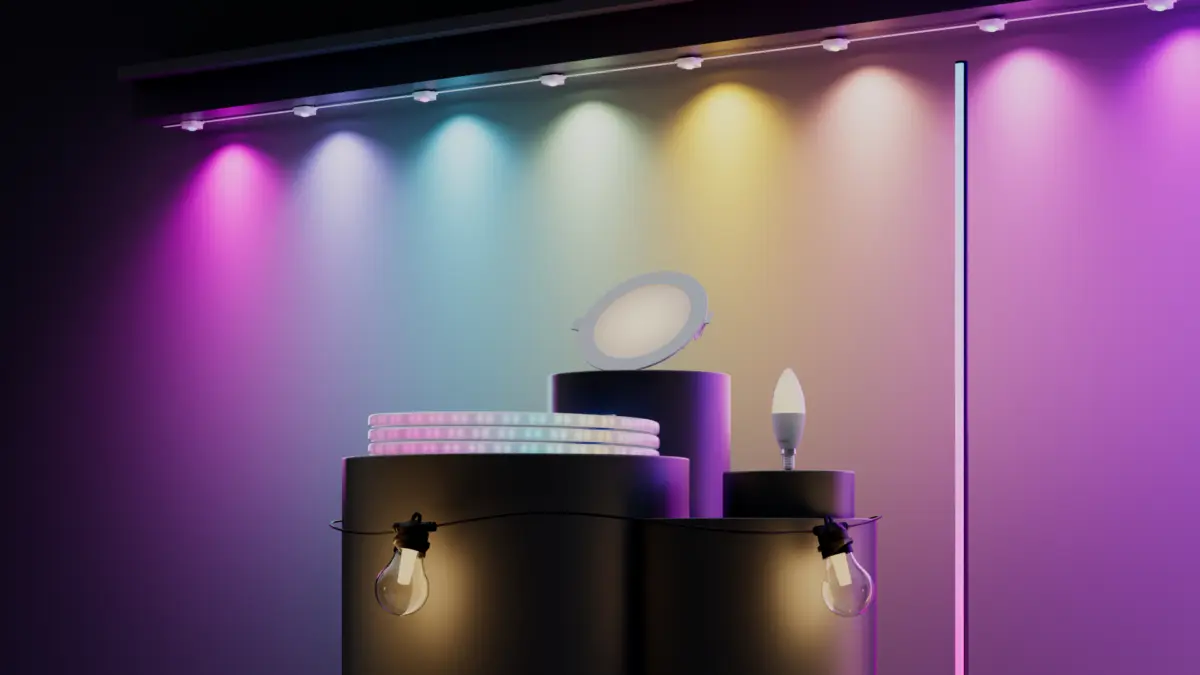
BERLIN — For years, smart home enthusiasts have known Aqara as a stalwart defender of the household perimeter. Renowned for its reliable multi-purpose security sensors, window magnets, and sophisticated presence detectors, the company carved out a comfortable, highly respected niche in home safety and automation. But at IFA 2026, the smart security specialist executed a sharp, highly ambitious pivot, throwing its hat directly into the vibrant, fiercely competitive ring of smart lighting.
Announcing a comprehensive, sprawling suite of illumination products that take direct aim at category leader Govee, Aqara is signaling that it is no longer content merely monitoring your home. Now, it wants to paint it with light.
This unexpected yet calculated expansion spans almost every category of residential lighting imaginable—from indoor ambient solutions to heavy-duty, weather-resistant outdoor displays. Yet, rather than building a standalone ecosystem of colorful bulbs, Aqara is leaning heavily on its core competency, promising a deep integration of its new lighting arrays with its legacy ecosystem of security sensors, switches, and AI-driven spatial intelligence.
Main Facts: Aqara’s Grand Lighting Invasion
The core of Aqara’s IFA 2026 announcement is its staggering breadth. While most consumer tech brands spend years slowly introducing a single light bulb or a solitary LED strip before testing the waters, Aqara has dropped an entire ecosystem all at once.

The initial lineup includes:
- Indoor Living Essentials: Standing floor lamps and sophisticated table lamps featuring granular multi-zone color controls (such as an 18-zone standing lamp capable of complex, cascading color gradients).
- Architectural Illumination: Low-profile smart downlights tailored for lower ceilings, alongside high-density smart LED strips packing an impressive 108 LEDs per meter.
- Outdoor & Architectural Lighting: Weatherproof permanent outdoor eave lights designed for year-round architectural accenting, paired with dynamic outdoor string lights boasting a wide color temperature range capable of mimicking nuanced natural light.
- Unified Connectivity: Universal support for Zigbee, Thread, and Matter protocols, ensuring cross-compatibility with Apple Home, Google Home, and Amazon Alexa.
- AI & Community Platforms: The introduction of "Gen-Scene" for zone-wide AI-generated lighting themes, alongside "Aqara Builder," a crowdsourced community platform for sharing custom smart home automations.
Chronology: From Perimeter Defense to Ambient Illumination
Aqara’s evolution into smart lighting did not happen overnight, though the speed of its execution has caught many industry analysts off guard.
- The Foundation (Pre-2025): Aqara established itself as a premier smart home brand by focusing on granular automation infrastructure. Its Zigbee-based door sensors, motion detectors, and millimeter-wave presence sensors became the gold standard for enthusiasts seeking reliable, local-first automation via platforms like Apple HomeKit and Home Assistant.
- The Matter Transition (2024–2025): As the smart home industry coalesced around the Matter standard, Aqara systematically updated its hubs and switches to bridge disparate ecosystems, laying the technical groundwork for a broader hardware portfolio.
- The IFA 2026 Reveal (September 2026): Breaking away from its traditional security-first messaging, Aqara used the global stage at IFA 2026 in Berlin to unveil its massive smart lighting catalog. By positioning its new lamps, strips, and permanent outdoor fixtures side-by-side with its existing sensor architecture, the company laid out a clear roadmap for the future: security and lighting operating as a single, cohesive organism.
Supporting Data: Specifications and Competitive Positioning
When evaluating Aqara’s new hardware against established market players, the engineering specifications reveal a direct challenge to brands like Govee and Philips Hue.
| Product Category | Aqara IFA 2026 Offering | Key Technical Specs | Competitive Target |
|---|---|---|---|
| Indoor Ambient | Floor Lamp T1 & Table Lamp | Multi-zone addressable zones (e.g., 18 zones on floor lamp) | Govee RGBIC Floor Lamps |
| Linear Lighting | Smart LED Strip T2 | 108 LEDs per meter, high density | Premium architectural light strips |
| Recessed Lighting | Smart Downlight T2 | RGB + CCT (Tunable White) support | Smart recessed ceiling modules |
| Outdoor Permanent | Permanent Outdoor Lights H1 | Weatherproof, eave-mounted, multi-color | Govee Permanent Outdoor Lights |
| Ecosystem Protocols | Zigbee, Thread, Matter | Native local control + multi-ecosystem bridges | Universal smart home standards |
The decision to pack 108 LEDs per meter into its flagship light strip is a notable engineering choice. In practical testing across the smart lighting sector, higher LED density dramatically reduces the visible "dotting" effect, providing a smooth, neon-like diffusion that consumers increasingly demand for premium home theater setups and architectural accenting.

Furthermore, the inclusion of native Zigbee, Thread, and Matter support addresses one of the primary historical pain points of ambient lighting: walled gardens. While competitors often lock advanced multi-zone effects behind proprietary, cloud-dependent mobile apps, Aqara’s hardware-level protocol support ensures that users can execute automations locally, maintaining speed and privacy.
Official Responses and Strategic Vision
Speaking at the IFA 2026 exhibition, representatives for Aqara emphasized that this expansion is not a departure from the company’s identity, but rather its logical culmination.
"For years, our users have used Aqara sensors to dictate when lights turn on or off," noted a senior product strategist during the hardware unveiling. "What we realized is that true smart lighting shouldn’t just be a colorful novelty you control with your voice. It should react dynamically to your life, your movements, and your safety requirements without you having to lift a finger."
This philosophy underpins Aqara’s introduction of "AI-driven spatial intelligence." While competing brands utilize generative AI primarily to whip up pretty color palettes based on mood boards or vacation photos—a feature Aqara is also matching with its new "Gen-Scene" tool—Aqara is integrating AI deeper into spatial awareness.

By leveraging data from its high-precision millimeter-wave presence sensors, Aqara’s lighting systems can theoretically map human traffic patterns through a home over time, adjusting color temperatures to support circadian rhythms or shifting illumination paths dynamically as a person walks through a dark hallway at night.
Additionally, Aqara addressed the developer and enthusiast community with the announcement of Aqara Builder. Recognizing that the most creative smart home configurations often come from end-users rather than corporate boardrooms, the platform is designed as a centralized hub where consumers can share custom routines, automation walkthroughs, and aesthetic layouts—mirroring the collaborative spirit found in open-source automation communities like Home Assistant.
Implications: What This Means for the Smart Home Market
Aqara’s aggressive move into smart lighting carries significant implications for the broader consumer electronics landscape.
1. Direct Pressure on Govee and Philips Hue
For years, Govee has dominated the affordable, high-density, color-rich segment of smart lighting, while Philips Hue has maintained a stronghold on premium, reliable white and color ambiance ecosystems. By introducing products that directly mirror Govee’s permanent outdoor setups and multi-zone floor lamps—while simultaneously undercutting the integration friction traditionally found in mixed-brand smart homes—Aqara is offering a compelling alternative. Consumers no longer have to choose between robust home security sensors and vibrant decorative lighting; they can buy into a single ecosystem that handles both.

2. The Maturation of Matter and Thread
Aqara’s hardware rollout serves as a real-world stress test for the Matter and Thread standards. Historically, advanced lighting effects (such as multi-zone color chasing or complex scene generation) struggled to translate cleanly across universal protocols like Matter, often forcing users back into proprietary manufacturer apps. If Aqara successfully exposes its advanced multi-zone lighting controls and AI-generated Gen-Scenes across Thread and Matter, it could establish a new benchmark for interoperability in the smart home industry.
3. Redefining "Security" as "Ambience and Safety"
Perhaps the most profound implication is psychological. The boundary between a security system and home decor is officially dissolving. When a door opening sensor doesn’t just sound an alarm or push a silent notification to your smartphone, but instead gently shifts the entryway lighting to a warm amber hue to welcome you home—or flashes red in tandem with an intrusion alert—lighting becomes an active participant in home safety.
As Aqara prepares to roll out pricing and formal release dates for its expansive 2026 lighting catalog, one thing is certain: the smart home lighting wars just got a lot more colorful, and the security sector has officially expanded its horizons.
