

By Automotive and Tech Desk
Published September 2026
Main Facts
The debate surrounding the future of urban mobility and autonomous transit reached a fever pitch following Tesla’s high-profile re-unveiling of the Cybercab in Austin, Texas. Designed as a dedicated, steering-wheel-free robotaxi, the vehicle was showcased to a select group of influencers and media members via invitation-only test rides. However, the glossy marketing event contrasted sharply with public sentiment on the ground.
A multi-week sidebar survey conducted by Electrek, capturing nearly 2,700 reader responses, revealed an overwhelming tide of skepticism. Nearly two-thirds of participants rejected the notion that the Cybercab will revolutionize transportation, selecting instead a stark assessment: that the vehicle cannot be transformative if consumers cannot own it, and if Tesla has yet to definitively prove its artificial intelligence stack is capable of safely navigating complex real-world environments without human oversight.
This consumer hesitation arrives amid a turbulent regulatory and legal backdrop for Tesla’s driver-assistance technology. The National Highway Traffic and Safety Administration (NHTSA) recently opened a formal investigation into the Cybercab’s Federal Motor Vehicle Safety Standards (FMVSS) compliance. Concurrently, scrutiny has intensified over Autopilot and Full Self-Driving (FSD) software following a series of fatal crashes, ongoing lawsuits, and shifting timelines that have plagued Tesla’s autonomous ambitions for years.
Chronology of Events
To understand how the current climate of skepticism materialized, it is necessary to trace the timeline of Tesla’s recent developments, regulatory friction, and community discourse leading up to the Austin showcase:
- Early September 2026: Tesla data confirms active driver-assistance systems were engaged during separate, tragic incidents—including a crash in Moraine that killed a motorcyclist, and another in Batavia that claimed the life of a mother of five.
- September 1–2, 2026: Tesla resolves a high-profile wrongful death lawsuit stemming from an Autopilot collision with a stationary fire truck, effectively sidestepping a jury trial and mitigating further public discovery of internal software logs.
- September 3, 2026: Tesla officially opens search parameters for Cybercab fleet sales. On the same day, community discussions on platforms like Electrek ignite as readers dissect the feasibility of the automaker’s long-term commercial strategy.
- September 3–4, 2026: Tesla re-unveils the Cybercab in Austin, Texas, offering invitation-only demo rides to select digital influencers, yielding mixed performance reviews regarding the smoothness and reliability of the autonomous system.
- September 4, 2026: The NHTSA formally initiates an investigation into the Cybercab’s vehicle certification and safety architecture, questioning its exemption from standard human-operated controls.
- Mid-September 2026: Electrek concludes its multi-week reader survey, tallying nearly 2,700 responses that underscore a profound disconnect between corporate hype and consumer confidence.
Supporting Data and Survey Metrics
The quantitative data gathered from the Electrek readership highlights a remarkable departure from historical enthusiasm. Historically, online EV communities have leaned heavily into optimistic projections regarding Tesla’s technological roadmaps. However, the Cybercab poll results indicate a fundamental shift toward pragmatism and distrust.
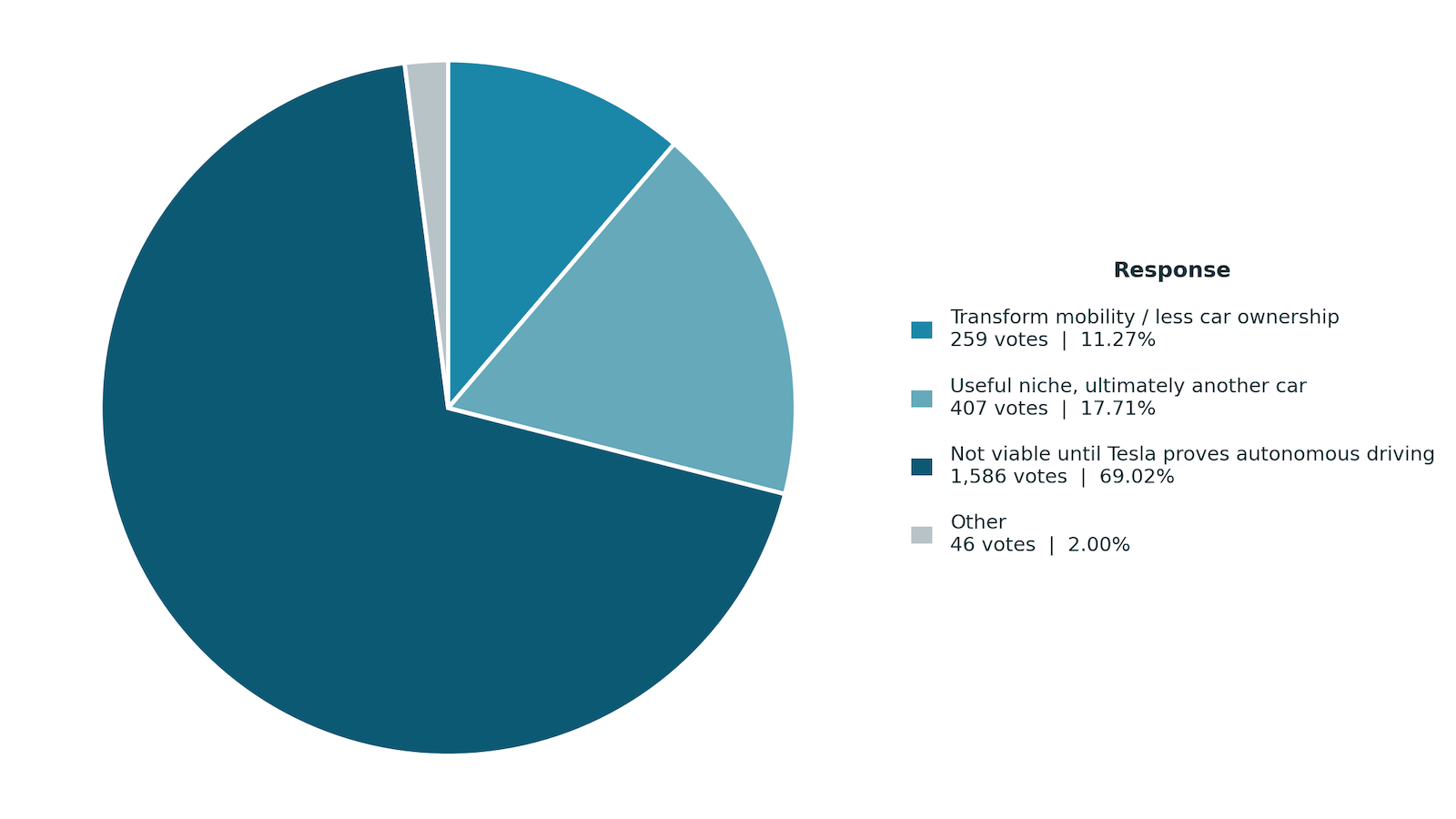
- Total Respondents: Approximately 2,700 verified readers participated in the survey over a multi-week deployment.
- The Dominant Sentiment: Nearly 66% of respondents coalesced around the viewpoint that the Cybercab represents little more than "just another car"—or worse, an inaccessible product that fails to deliver on foundational promises.
- The Core Grievance: The prevailing narrative among survey participants centered on accessibility and shifting business models. Where Tesla once promised that everyday consumers could monetize their personal vehicles as autonomous robotaxis while sleeping or working, the Cybercab is structured primarily as a corporate-owned fleet vehicle.
Commenters on the platform voiced these concerns directly. User OliveAirBalloon remarked, "The car company that isn’t a car company wants to sell you a car you don’t need because of all these cabs they’re making… And oh, by the way, you will be able to put your own car out there to be used as a cab and compete with the company cabs. Yep. Any day now."
Another long-time commenter, RARARARARARA, echoed the sentiment: "Wait, I thought your Tesla was going to make you money, while you were sleeping or working? Sounds like Elon is keeping that pie for himself, if he succeeds."
Even among those predicting a degree of commercial viability, expectations remained muted. Reader HALFWITWIZARD suggested that while Tesla might capture a fraction of the rideshare market, profit margins would likely be thin before investors pivoted to the company’s next promised revolution. Meanwhile, user David M offered a geographic caveat, noting that autonomous taxi services might find pockets of utility in hyper-dense urban cores like Manhattan, San Francisco, or Washington D.C., but would struggle to achieve the infrastructure saturation required in sprawling suburban or rural environments.

Official Responses and Regulatory Pressure
Tesla’s push toward an autonomous future faces mounting hurdles not just from public perception, but from federal regulators tasked with highway safety enforcement.
The NHTSA’s investigation into the Cybercab targets a central engineering paradox: the vehicle’s intentional omission of traditional driving controls, such as a steering wheel and pedals. For decades, federal motor vehicle safety standards have mandated physical controls designed for a human operator. Securing regulatory approval for a vehicle that entirely discards these failsafes requires unprecedented waivers or certification adjustments—a process that federal regulators are subjecting to intense scrutiny.
Furthermore, the recent legal settlements and active investigations involving Autopilot and FSD have put federal oversight bodies on high alert. With safety data indicating recurring challenges in complex edge-case scenarios—highlighted by recent fatal collisions involving motorcyclists and pedestrians—regulators are demanding transparent validation metrics before permitting widespread deployment of unmonitored autonomous fleets on public roads. Tesla executives have maintained that their vision-based neural network architecture will ultimately surpass human drivers in safety, yet they face an increasingly skeptical regulatory panel demanding empirical proof.

Implications for the Industry and Market
The lukewarm reception of the Cybercab—as reflected by both regulatory bottlenecks and grassroots skepticism—carries profound implications for the broader automotive and tech sectors.
1. The Death of the "Passive Income" EV Narrative
For years, the promise of vehicle appreciation through autonomous capabilities served as a powerful sales driver for Tesla. Buyers were encouraged to view their purchases as appreciating assets that would eventually earn revenue as robotaxis. By pivoting toward a dedicated, corporate-operated Cybercab fleet, Tesla risks alienating early adopters who purchased vehicles specifically under the premise of participating in a decentralized peer-to-peer rideshare network.
2. Infrastructure Realities vs. Silicon Valley Optimism
As urban planning experts frequently note, the viability of point-to-point autonomous transit relies heavily on population density. While services like Waymo have carved out operational niches in specific metropolitan zones, scaling a dedicated taxi fleet nationwide remains an economic and logistical labyrinth. The consensus emerging from consumer feedback suggests that robotaxis will likely remain localized novelties rather than universal replacements for personal vehicle ownership, particularly in auto-dependent regions.

3. Erosion of True-Believer Momentum
Perhaps the most notable takeaway from the recent wave of commentary is the conspicuous absence of the "true-believer" demographic that historically dominated online discussions regarding Tesla’s forward-looking products. Whether this silence stems from fatigue over chronic timeline slippage, disappointment regarding shifted product strategies, or a broader disillusionment with autonomous promises, it signals a maturing market. Consumers are increasingly evaluating tech announcements through the lens of tangible delivery rather than speculative potential.
As Tesla prepares to navigate its upcoming regulatory battles with the NHTSA and attempts to build out its operational framework for fleet sales, the road ahead is fraught with challenges. The Cybercab may yet prove to be a milestone in automotive engineering, but winning over the hearts, minds, and trust of a skeptical public will require far more than promotional gloss and invitation-only test drives.
