

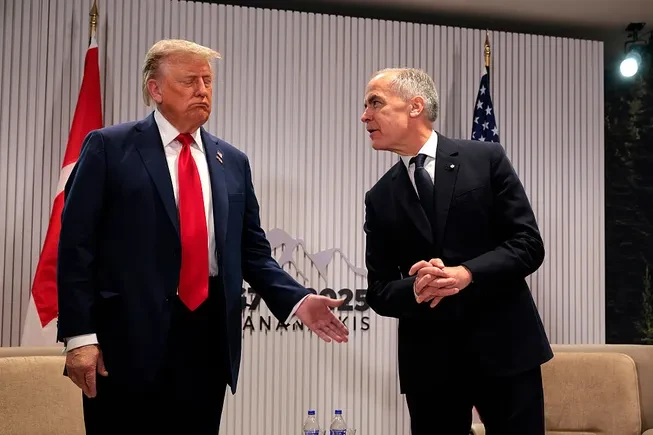
WASHINGTON — The economic standoff between North America’s closest neighbors reached a new threshold on Tuesday as the United States significantly escalated its trade war with Canada. President Donald Trump enacted a series of aggressive economic measures through five separate presidential proclamations, moving beyond retaliatory tariffs to outright import bans on select Canadian automotive, dairy-related, and alcoholic goods.
Simultaneously, the administration extended its punishing 50% Section 338 retaliatory tariffs to a broader array of Canadian imports, including specialty cheeses, boats, furniture, and various industrial inputs. The sweeping actions arrived on the exact day that Canadian Prime Minister Mark Carney’s government implemented its own sweeping retaliatory tariffs of up to 50% on approximately $20 billion worth of American goods—a direct response to levies previously enacted by Washington.
The intensifying tit-for-tat trade war threatens to disrupt deeply integrated cross-border supply chains, rattle financial markets, and increase operational costs for manufacturers, retailers, and public sector agencies in both nations. As political leaders on both sides trade blame for the breakdown of bilateral negotiations, global trade analysts are warning of long-term structural damage to the North American economy.
Main Facts: The Scope of the New U.S. Measures
The latest escalation from the White House is characterized by a two-pronged strategy: targeted import prohibitions and an expanded scope of punitive tariffs.
Effective September 29, the United States will completely ban the importation of specific Canadian goods. According to White House documentation, the banned categories include:
- Motorcycles and Cycles: Two-wheeled vehicles fitted with internal-combustion piston engines featuring a cylinder capacity exceeding 800 cubic centimeters.
- Alcoholic Beverages: Beer, wines, cider, other fermented beverages, high-proof beverage alcohol, and many major spirits categories.
- Dairy and Associated Products: Whey products, molasses, and non-alcoholic beer.
To bridge the gap between the immediate present and the implementation date of the bans, these specific goods will be subjected to a temporary 50% Section 338 tariff starting immediately.
Beyond outright bans, the Trump administration widened the net of its 50% tariff regime starting September 15. The newly expanded list of tariffed goods includes:
- Specialty cheeses and modified fats and oils.
- Bovine hides, upholstery leather, and certain raw or dressed furskins.
- Recreational motorboats, golf carts, and associated accessories.
- Specialty paper, select steel and aluminum items, metal fittings, and welding inputs.
- Consumer and commercial furniture, as well as lamps and lighting fixtures.
Crucially, the White House clarified that these tariffs apply regardless of whether the goods qualify for preferential treatment under the United States-Canada-Mexico Agreement (USMCA). Furthermore, these duties stack directly on top of existing Section 232 national security tariffs on steel and aluminum.
In a move designed to cut Canadian goods out of American public procurement pipelines, President Trump also directed the U.S. Trade Representative and the administrator of the General Services Administration (GSA) to strip approximately $50 billion worth of Canadian products from the GSA’s Multiple Award Schedules (MAS). The MAS program serves as a vital purchasing portal granting federal, state, local, and tribal governments streamlined access to commercial goods and services.
Chronology of the Dispute: How the North American Trade Rift Widened
The path to the current economic confrontation has been marked by rapidly deteriorating diplomatic channels and a series of escalating deadlines. The timeline of the crisis highlights how quickly a breakdown in trade negotiations spiraled into an all-out protectionist conflict:
- July: President Trump shocks North American markets by announcing plans to levy a 50% tariff on a massive tranche of Canadian imports, citing long-standing grievances regarding market access and regulatory discrimination.
- Late August: High-stakes negotiations between U.S. and Canadian trade officials stall completely. Both administrations trade sharp accusations, with Washington blaming Ottawa for intransigence and Canada condemning the unilateral U.S. measures as a violation of existing trade architecture.
- Early September: Following a brief diplomatic intervention where Canadian Prime Minister Mark Carney recalled negotiating teams, the Trump administration officially presses forward, imposing the 50% tariffs on roughly $20 billion worth of Canadian imports. This initial wave targets raw agricultural and natural materials, chemicals, textiles, consumer goods, wood products, paper, machinery, and tools.
- Mid-September (Tuesday): Canada retaliates in kind, executing its promise to install tariffs of up to 50% on an equivalent value ($20 billion) of U.S. exports. Ottawa’s duties hit key American sectors, including steel, dairy products, appliances, agricultural equipment, electronics, and pulp and paper.
- Tuesday Afternoon: Hours after Canada’s retaliatory duties go live, President Trump fires back with five new proclamations. These documents codify the upcoming import bans, widen the 50% tariff list, and order the purging of $50 billion in Canadian goods from GSA procurement schedules.
Supporting Data and Economic Analysis
While the political rhetoric from Washington and Ottawa paints a picture of total economic warfare, trade economists urge a nuanced perspective when evaluating the raw numbers.
Deborah Elms, a prominent trade and economic policy expert at the Hinrich Foundation, analyzed the administration’s latest moves in a public briefing. According to Elms, the products slated for outright import bans represent a relatively minor share of total bilateral commerce, totaling less than $1 billion in annual trade value.
Furthermore, Elms noted that the broader tariff adjustments were "basically a wash" at a macroeconomic level because the Trump administration simultaneously removed several key items from the Section 232 and Section 338 tariff lists. Products granted exemptions from the levies include toilet paper, salt, cement, and specific containers of whiskies, liqueurs, and cordials exceeding four liters.
"Of course, if your firm produces the goods now added to any list, it’s impactful," Elms acknowledged in her analysis. "But given that Canada is the largest trading partner for the U.S., even big scary numbers of tariff damage are actually very modest" in the context of total cross-border trade, which routinely exceeds hundreds of billions of dollars annually.
Nevertheless, concentrated pain is guaranteed for specific industries. The total volume of trade now caught in the crosshairs—spanning the initial $20 billion in targeted U.S. imports, Canada’s matching $20 billion retaliation, the newly expanded U.S. tariff lists, and the $50 billion GSA procurement restriction—represents a massive reallocation of commercial risk. Companies that rely on integrated cross-border supply chains can no longer treat the U.S.-Canada border as a frictionless trade zone.
Official Responses and Justifications
The justification provided by the White House centers on what the administration terms systemic discrimination against American enterprise. According to presidential proclamations and official White House fact sheets, President Trump enacted the measures to counter Canada’s protectionist policies in three core sectors:
- Alcoholic Beverages: Washington alleges that Canadian federal and provincial liquor boards maintain monopoly practices, distribution hurdles, and pricing mechanisms that unfairly favor domestic or foreign third-party alcohol over U.S. craft and major-label products.
- Dairy: The U.S. contends that Canada’s tightly managed supply-management system and strict import quotas unlawfully restrict American dairy producers from accessing northern markets.
- Motor Vehicles: The administration points to regulatory frameworks and labeling requirements that it claims place American automotive and vehicular manufacturers at an artificial disadvantage.
In Ottawa, the response has been characterized by firm resolve coupled with regret over the collapse of cooperative diplomacy. Prime Minister Mark Carney’s government maintains that Canada’s retaliatory tariffs are a proportionate and necessary defense of Canadian sovereignty and economic interests. Canadian officials have consistently argued that unilateral U.S. tariffs violate the spirit and letter of the USMCA—the trade agreement negotiated during Trump’s first term to replace NAFTA—and undermine the integrated industrial base that underpins North American manufacturing competitiveness.
Despite the escalation, Canadian trade ministers have left the door open to resumed dialogue, provided the United States rolls back its punitive measures. However, with the White House doubling down on its sector-specific bans and procurement exclusions, a diplomatic off-ramp appears distant.
Implications for Businesses and Consumers
As the trade war enters this deeper phase, stakeholders across the North American economy are grappling with immediate operational disruptions and long-term strategic uncertainty.
1. Supply Chain Reconfiguration
Manufacturers that rely on continuous, cross-border movement of components—particularly within the automotive, industrial machinery, and consumer goods sectors—face painful choices. Companies must decide whether to absorb the steep 50% tariff costs, attempt to pass price increases downstream to consumers, or rapidly source alternative inputs domestically or from non-North American nations. Sourcing alternatives is neither fast nor cheap, often requiring months of quality testing and regulatory re-certification.
2. Consumer Price Pressures
For everyday shoppers in both the United States and Canada, the compounding effect of these tariffs will likely manifest as higher prices at checkout. Categories impacted by the expanded tariffs—including specialty foods like cheeses, recreational goods like motorboats and golf carts, home furnishings, and appliances—will see upward price pressure. While the exemption of staples like toilet paper and certain bulk construction materials offers minor relief, inflationary pressures across discretionary retail categories are virtually guaranteed.
3. Public Sector Procurement Disruptions
The directive to strip $50 billion in Canadian goods from the GSA Multiple Award Schedules introduces immediate compliance challenges for government contractors. Federal, state, and local agencies that rely on GSA schedules to purchase commercial office supplies, technology infrastructure, or specialized equipment must audit their supply chains to ensure no prohibited Canadian content is utilized. This administrative burden threatens to slow public projects and increase bureaucratic overhead.
4. The Future of the USMCA
Perhaps the most significant long-term implication is the erosion of confidence in the rules-based trading framework established by the USMCA. When tariffs can be unilaterally imposed and stacked outside the formal dispute-resolution mechanisms of a trilateral agreement, multinational corporations lose the predictability necessary to make long-term capital investments in North America.
As September 15 and September 29 approach—the dates when the expanded tariffs and import bans officially take effect—businesses on both sides of the northern border are bracing for turbulent economic waters with little indication of when a truce might be called.
