

NEW YORK/NEW JERSEY — After more than a century of waiting, planning, political battles, and meticulous engineering, a monumental chapter in American infrastructure is finally breaking ground beneath the earth.
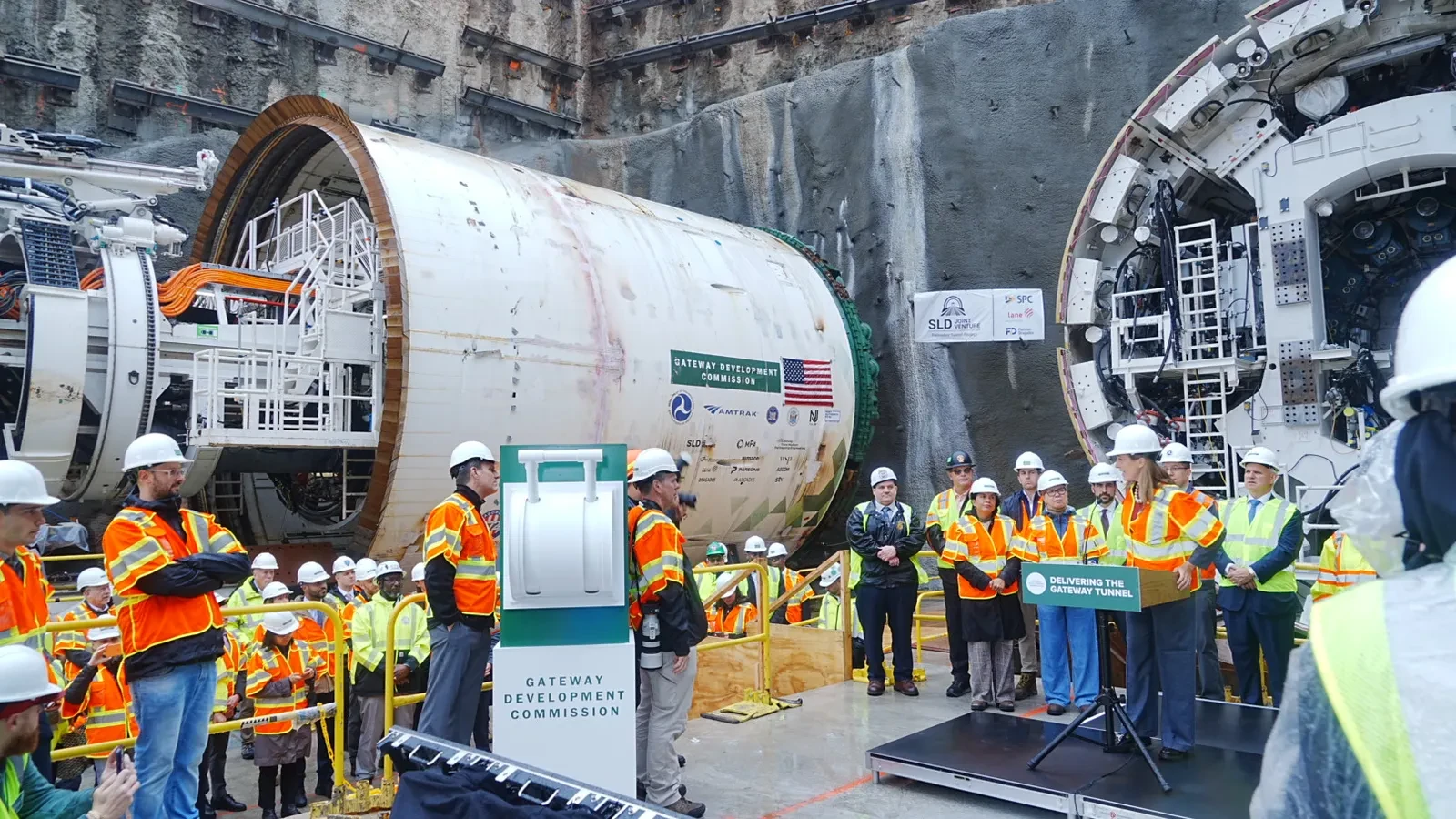
Stakeholders, labor leaders, and high-ranking government officials gathered on a brisk Monday morning for a ceremonial launch celebrating a pivotal milestone for the $16 billion Hudson Tunnel project. According to a news release from the Gateway Development Commission (GDC), the first set of massive, custom-built tunnel boring machines (TBMs) will soon begin chewing through 5,100 feet of formidable rock deep beneath the Palisades Cliffs in New Jersey.
The launch marks the transition of the Palisades Tunnel construction package from preparation to active excavation. In the coming days, the subterranean behemoths will roar to life, initiating a painstaking process that promises to reshape commuter rail transit between New Jersey and New York for generations to come.
Main Facts: The Palisades Excavation Phase
The undertaking currently underway is a marvel of heavy civil engineering. The initial phase of tunnel boring is being executed by a joint venture comprising three major construction heavyweights: Schiavone Construction, Lane Construction, and Dragados. Managing the delivery of this critical construction package is the Port Authority of New York and New Jersey, working in close partnership with the GDC.
The machines are tasked with boring parallel tubes originating from the tunnel portal in North Bergen, New Jersey, and terminating at the Hudson County Access Shaft, situated precisely on the border of Weehawken and Hoboken.
The hardware performing this subterranean feat is staggering in scale. According to GDC specifications, each TBM features a rotating cutterhead measuring 28 feet, 8 inches in diameter. Trailing behind the primary cutting unit is a roughly 500-foot-long gantry system that houses essential mechanical, electrical, and muck-handling infrastructure. In total, each machine weighs an astounding 1,680 tons.
The mechanics of the excavation are equally sophisticated. As the giant rotating cutterheads—fitted with heavy-duty disc cutters—grind the hard Palisades rock into manageable chips, an automated conveyor belt system continuously hauls the debris out of the tunnel. Simultaneously, as the machine inches forward, an onboard erector arm precisely positions precast concrete segments to form the permanent tunnel lining. Hydraulic thrust jacks brace directly against the newly assembled segments, providing the immense forward pressure required to drive the multi-thousand-ton machine deeper into the rock face.
Chronology: Years of Prep and Resilience
Bringing these machines to the starting line has been a grueling, multi-year endeavor marked by localized heavy construction, manufacturing marvels, and intense legal confrontations.
Late 2023 – Early 2024: Laying the Groundwork
The physical groundwork for the launch began in late 2023. Contractors initiated site prep by building a heavy-duty bridge designed to support a critical section of Tonnelle Avenue in North Bergen. This allowed engineering teams to carve out subterranean space directly beneath the highway to accommodate the massive TBM gantries. Concurrently, crews excavated the launch box—the secure subterranean pit from which the tunnel boring machines would officially begin their southward crawl.
Manufacturing and Assembly
While civil teams cleared the path above and below ground, the TBMs themselves were being custom-manufactured. Comprising nearly 100 highly complex, specialized components, the process took more than a year. Once delivered to the site, workers spent months carefully reassembling, calibrating, and testing every hydraulic line, electrical circuit, and structural joint to ensure flawless performance.
Spring 2025: Funding Fights and Legal Victories
The project’s timeline has not been without turbulence. Earlier this year, construction was temporarily disrupted by a high-stakes federal funding dispute. The U.S. Department of Transportation attempted to withhold critical project funding over a disagreement regarding the project’s disadvantaged business enterprise program.
Refusing to back down, project leadership took the matter to the courts. In a decisive victory, a federal judge permanently barred the DOT from withholding the funds. This legal win allowed work to resume with renewed vigor.
Furthermore, in April, the GDC awarded a massive $1.29 billion contract to a joint venture of Traylor Bros., Walsh Construction, and Skanska for the Manhattan Tunnel Project. This milestone pushed all necessary construction packages for the new rail tunnel into active development, ensuring that the entire pipeline of work is moving forward.
Supporting Data: By the Numbers
To fully grasp the magnitude of the Hudson Tunnel Project, one must examine the raw numbers driving the endeavor:
- $16 Billion: The total estimated cost of the overall Hudson Tunnel project, making it one of the largest and most expensive current infrastructure undertakings in the United States.
- 5,100 Feet: The total distance the first pair of TBMs must bore through the hard rock beneath the New Jersey Palisades.
- 28 Feet, 8 Inches: The diameter of the TBM cutterheads, designed to carve out standard rail-sized dual tubes.
- 1,680 Tons: The operating weight of a single tunnel boring machine.
- 500 Feet: The approximate length of the trailing gantry system supporting each machine.
- 30 Feet per Day: The maximum forward progress rate of the TBMs due to the extreme hardness of the Palisades rock.
- 5-0: The record of legal victories achieved by project advocates against federal administrative attempts to stall funding.
Official Responses and Perspectives
Elected officials and project leaders seized the moment on Monday to underscore both the historical significance of the event and the tenacity required to make it happen.
New Jersey Governor Mikie Sherrill reflected on the rarity of the engineering feat currently unfolding beneath her state.
"It’s been more than a century since a rail tunnel was last dug through these cliffs," Gov. Sherrill told attendees during the event. "I was asked how many of these boring machines are there in the world, and the answer is this is it. Each one is purpose-built for the specific job at hand."
Sherrill also highlighted the hard-fought nature of the project’s journey, noting the administration’s willingness to go to the mat for commuter infrastructure.
"We’ve taken the Trump administration to court five times to keep this project going, and we’ve won five times," Sherrill asserted. "We’re going to keep fighting, even if it requires a few more trips to court."
U.S. Senate Minority Leader Chuck Schumer (D-N.Y.) added a touch of humor while emphasizing the relentless physical nature of the work.
"These machines are amazing," Schumer remarked. "They’re certainly not boring."
Diving deeper into the geological challenges, Schumer noted the immense density of the subterranean environment:
"The rock is so hard it only moves 30 feet a day. That’s why we can’t let anybody stop it. We have to keep going and going and going till these machines reach the other side of the river."
U.S. Senator Cory Booker (D-N.J.) cast a visionary eye toward the distant future, reminding the crowd that political friction may persist, but the ultimate legacy of the project transcends partisan squabbles.
"We still have a lot of work to do, and knowing some of the politicians in Washington, there are still going to be attempts to slow this project down," Sen. Booker cautioned. "But I know, when all is said and done, generations not yet born will benefit from the work that we have done."
Implications: The Road Ahead for Northeast Commuters
The launch of the Palisades TBMs is more than just a win for heavy construction; it represents a critical lifeline for the entire Northeast Corridor (NEC).
The existing North River Tunnel—which carries Amtrak and NJ Transit trains beneath the Hudson River—is over a century old, severely degraded by age, and notoriously vulnerable to water damage, most notably the saltwater corrosion sustained during Hurricane Sandy in 2012. Commuters have long suffered from chronic delays caused by aging signaling systems, electrical failures, and structural decay within the antiquated single-tube infrastructure.
Once the current pair of TBMs completes their run to the Hudson County Access Shaft, crews will extract them and deploy a second, specialized pair of machines to tackle the infinitely more complex underwater phase beneath the Hudson River itself.
When the entire project is completed, the new two-tube rail tunnel will operate in tandem with the rehabilitated historic tunnels, effectively doubling track capacity between New Jersey and Penn Station in Manhattan. This added redundancy will transform daily commutes for hundreds of thousands of passengers, safeguard the nation’s most vital economic corridor against catastrophic transit failures, and provide a reliable foundation for regional growth for the next century and beyond.
