

By Stevie Bonifield
Consumer Tech & Hardware Correspondent
Main Facts: A Record-Breaking Quarter Driven by Enterprise AI
Advanced Micro Devices (AMD) has released its financial results for the second quarter of 2026, painting a picture of a company undergoing a profound structural transformation. Fueled by an unrelenting, global corporate appetite for artificial intelligence infrastructure, AMD posted a record-shattering total revenue of $11.5 billion. This figure represents a remarkable 50 percent increase compared to the same period in the previous year.
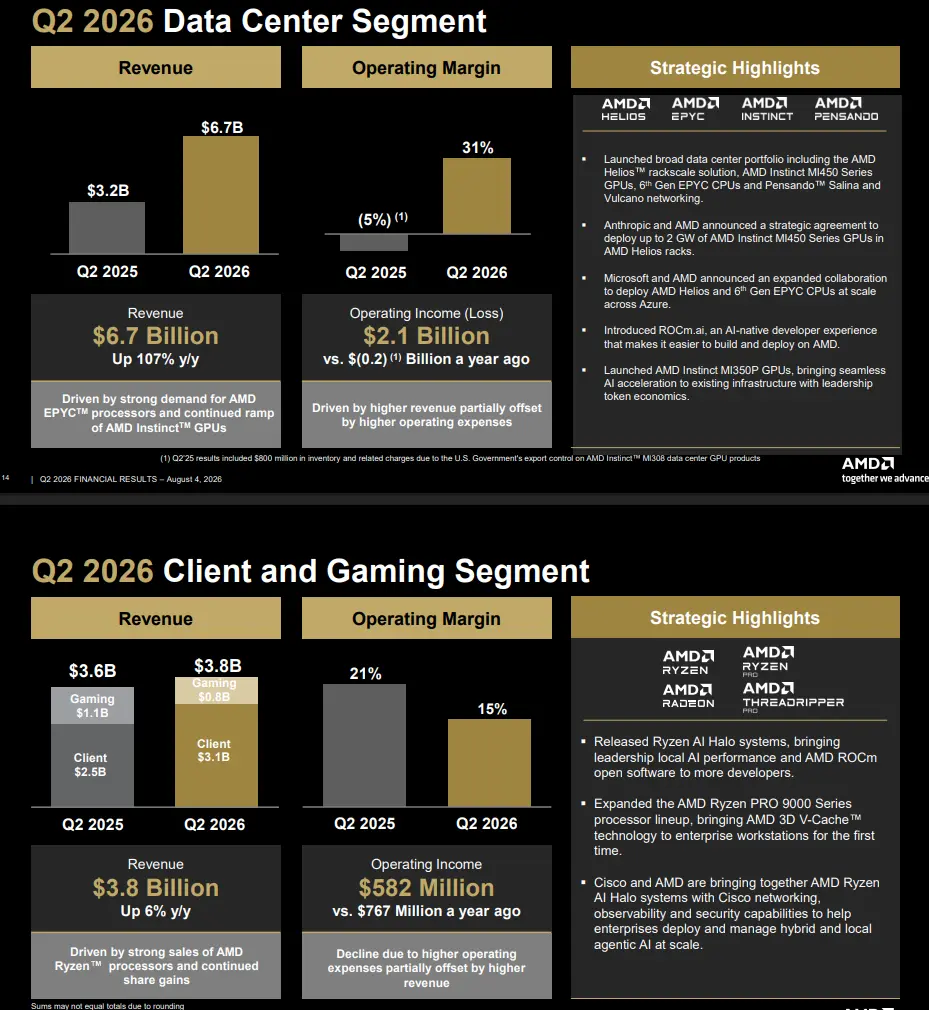
The primary engine behind this monumental financial milestone is AMD’s Data Center segment. Driven by hyperscalers, enterprise cloud providers, and AI research labs purchasing high-performance accelerators and server processors, data center revenue more than doubled year-over-year. It reached an unprecedented $6.7 billion, up significantly from the $5.8 billion reported just a quarter prior in Q1, and marking a staggering 107 percent leap from the $3.2 billion reported in Q2 of the previous fiscal year.
However, the earnings report also highlights a stark divergence in AMD’s fortunes across its diverse hardware portfolios. While enterprise AI and client-side Ryzen processors are thriving, the company’s gaming division experienced a steep downturn. Plagued by component shortages, supply chain bottlenecks, and persistent consumer price hikes, gaming revenue slumped 31 percent year-over-year down to $779 million. This decline directly impacted sales of major gaming hardware platforms relying on AMD silicon, including the Sony PlayStation 5, Microsoft Xbox Series X/S, and Valve’s Steam Deck.
Despite the headwinds in the gaming sector, strength in other divisions—most notably a 23 percent increase in Client revenue driven by robust demand for Ryzen CPUs—helped cushion the blow, allowing AMD to post stellar net results and cement its position as a primary beneficiary of the ongoing generative AI boom.
Chronology of Growth: From Q1 Momentum to Q2 Dominance
To fully understand the magnitude of AMD’s current financial standing, it is necessary to examine the rapid trajectory of the company’s performance over the past year.
- Mid-2025: AMD began seeing early indicators of an enterprise shift toward its high-end enterprise solutions, though traditional PC markets were still recovering from post-pandemic sluggishness. Data center sales hovered around the $3.2 billion mark during Q2 2025, laying the groundwork for what would become an aggressive pivot toward AI-centric manufacturing.
- Early 2026 (Q1 Earnings): AMD reported a strong start to the fiscal year, with total sales buoyed by data center revenue hitting $5.8 billion. Industry analysts noted at the time that the company was successfully eating into competitor market share within cloud computing sectors, though supply chain constraints for advanced packaging technologies remained a looming risk.
- August 2026 (Q2 Earnings Release): In its latest financial disclosure, AMD confirmed that the momentum established earlier in the year had not only continued but accelerated. Data center sales smashed internal and external forecasts to reach $6.7 billion. For the first time in the company’s history, the Data Center business accounted for an absolute majority—58 percent—of total corporate revenue within a single quarter.
This chronology illustrates a lightning-fast corporate pivot. In the span of just twelve months, AMD has successfully transitioned from a diversified semiconductor firm heavily reliant on consumer gaming and PC components into a dominant enterprise AI infrastructure provider.

Supporting Data: Breaking Down the Q2 2026 Financials
A granular analysis of AMD’s Q2 2026 financial presentation reveals both extraordinary triumphs and localized vulnerabilities across its business units.
Revenue Distribution by Sector
- Total Q2 2026 Revenue: $11.5 billion (Up 50% year-over-year)
- Data Center Segment: $6.7 billion (Up 107% year-over-year; represents 58% of total revenue)
- Client & PC Segment (Ryzen Sales): Up 23% year-over-year, bolstered by solid adoption of modern desktop and mobile processors.
- Gaming Segment: $779 million (Down 31% year-over-year)
- Combined PC and Gaming Growth: Up 6% overall compared to Q2 of the previous year, demonstrating that strong Ryzen desktop and laptop sales successfully offset the steep losses in console and handheld gaming hardware.
Comparative Quarter-over-Quarter Analysis
| Metric | Q2 2025 | Q1 2026 | Q2 2026 | YoY Growth |
|---|---|---|---|---|
| Total Revenue | ~$7.6 billion | ~$9.8 billion (est.) | $11.5 billion | +50% |
| Data Center Revenue | $3.2 billion | $5.8 billion | $6.7 billion | +107% |
| Gaming Revenue | ~$1.13 billion | ~Not disclosed separately | $779 million | -31% |
The data clearly indicates that while the gaming market is undergoing a cyclical correction—exacerbated by rising manufacturing costs for semiconductors and a lack of mid-cycle console refreshes driving massive volume—the sheer velocity of enterprise AI spending is more than enough to propel AMD’s financial growth to unprecedented heights.
Official Responses and Executive Insights
Leadership at AMD was quick to emphasize both the validation of their long-term strategic investments and the immense market opportunities that lie ahead.
AMD Chief Financial Officer Jean Hu highlighted the historic nature of the quarter in her formal commentary accompanying the financial results:
"Revenue increased 50 percent year-over-year to a record $11.5 billion, driven by continued strength in our Data Center business, which represented 58% of company revenue in the quarter."
Hu’s comments underscore the degree to which enterprise infrastructure has become the lifeblood of AMD’s modern balance sheet. While consumer-facing divisions remain critical to the brand’s cultural footprint, the financial gravity has decisively shifted toward the enterprise data center.
Echoing this sentiment, AMD CEO Lisa Su pointed to artificial intelligence as an inescapable macroeconomic driver that is fundamentally reshaping the entire technology landscape. In her statement to shareholders and media, Su noted:

"AI is driving a significant expansion in demand for compute across all of our markets, and our leadership portfolio and growing customer visibility position us exceptionally well to capture this expanding opportunity and deliver substantial revenue and earnings growth in the years ahead."
Su’s emphasis on "customer visibility" is particularly telling. In the semiconductor industry, long-term supply agreements and forward-looking purchase orders from major cloud hyperscalers (such as Microsoft, Meta, Google, and Amazon) provide multi-quarter revenue predictability that consumer hardware markets simply cannot match. By securing these long-term commitments, AMD has insulated itself—at least temporarily—against broader consumer spending downturns.
Implications: What AMD’s Pivot Means for the Tech Industry
The seismic shift documented in AMD’s Q2 2026 earnings report carries profound implications for multiple segments of the global technology ecosystem.
1. The Consolidation of the AI Infrastructure Duopoly
For years, the market for high-performance AI accelerators was viewed as a virtual monopoly held by NVIDIA. However, AMD’s explosive data center growth—surging past $6.7 billion in a single quarter—proves that enterprise buyers are actively diversifying their supply chains. Hyperscalers are desperately seeking alternatives to mitigate supply bottlenecks and cost inflation. AMD’s Instinct accelerators and enterprise EPYC processors have firmly established themselves as viable, high-performance alternatives, solidifying a competitive duopoly in enterprise AI compute.
2. The Strain on Consumer Gaming Hardware
The 31 percent drop in AMD’s gaming revenue serves as a warning sign for the broader console and handheld gaming market. As advanced semiconductor fabrication nodes (such as those required for modern GPUs and custom console chips) become increasingly expensive, the economics of hardware manufacturing are shifting. Consumers are feeling the pinch of price hikes on devices like the PlayStation 5, Xbox Series X/S, and Steam Deck. Component shortages further exacerbate the issue, forcing manufacturers to navigate difficult trade-offs between profit margins and unit sales volume. If current trends persist, the next generation of home consoles may face significant pricing and availability hurdles.
3. Resilience in the Personal Computing Market
Despite the struggles in gaming, AMD’s 23 percent growth in Client revenue offers a reassuring counter-narrative for traditional PC enthusiasts. The continued market adoption of Ryzen processors—fueled by improving power efficiency, robust on-device neural processing units (NPUs) for local AI tasks, and competitive multi-core performance—ensures that AMD remains a formidable force against Intel in laptops and desktops.
Looking Forward
As AMD moves into the second half of 2026, the company’s trajectory will depend heavily on its ability to maintain manufacturing allocations at advanced foundries like TSMC while continuing to scale software ecosystems (such as ROCm) to compete directly with NVIDIA’s CUDA platform. If Lisa Su and her executive team can successfully execute on these fronts, AMD is well-positioned to maintain its record-breaking momentum, transforming the temporary gold rush of enterprise AI into a permanent, dominant market position.
