


WASHINGTON — In what has become one of the most perplexing economic puzzles for the American building sector, government data shows that construction job vacancies have climbed on a year-over-year basis for three consecutive months. At first glance, a growing stack of unfilled positions should signal a booming industry characterized by bustling job sites, aggressive infrastructure spending, and an insatiable appetite for human capital.
However, when placed side-by-side with recent construction spending reports and shifting macroeconomic indicators, economists warn that the rising tide of job openings does not reflect robust project demand. Instead, industry analysts suggest the data points to a compounding mixture of structural labor shortages, an aging workforce, widening "skills mismatches," and the immediate downstream effects of stricter federal immigration enforcement policies.
Main Facts
The latest data from the Bureau of Statistics (BLS) highlights a persistent disconnect between labor demand indicators and actual capital deployment across the U.S. construction industry. While open positions continue to trend upward compared to the same period in previous years, overall construction spending has moved in the opposite direction.
According to government figures released in August 2026, total construction spending suffered a sharp 3.2% month-to-month decline. This downward pressure is particularly pronounced in the private nonresidential sector. While private nonresidential spending eked out a modest, almost negligible increase month-over-month in June, it plummeted by a dramatic 4.7% year-over-year.
This juxtaposition has forced economists, contractors, and policymakers to re-evaluate how they interpret traditional labor metrics. Rather than serving as a clean proxy for economic health and construction activity, soaring job openings are increasingly viewed as a symptom of operational friction, diminished workforce productivity, and shrinking labor pools.
Chronology of Events
To understand how the current labor market anomaly materialized, it is necessary to examine the sequence of economic data releases and policy milestones that shaped the landscape leading into mid-2026:
- Early-to-Mid 2025 (Policy Shifts): The implementation and intensification of strict federal immigration policies, spearheaded by the administration of President Donald Trump, begin to alter the demographic makeup of the American workforce. Crackdowns on undocumented workers and targeted deportations begin to reshape job sites, particularly in labor-intensive industries like construction, agriculture, and hospitality.
- Spring 2026 (The Skills Mismatch Emerges): Throughout April and May 2026, contractors report persistent difficulties finding specialized labor, even as bidding pipelines for certain commercial and private projects begin to cool off due to elevated interest rates and tighter lending conditions.
- June 2026 (Diverging Indicators):
- Mid-June: Data reveals a broader cooling in total construction spending, with private nonresidential categories experiencing severe annual contractions.
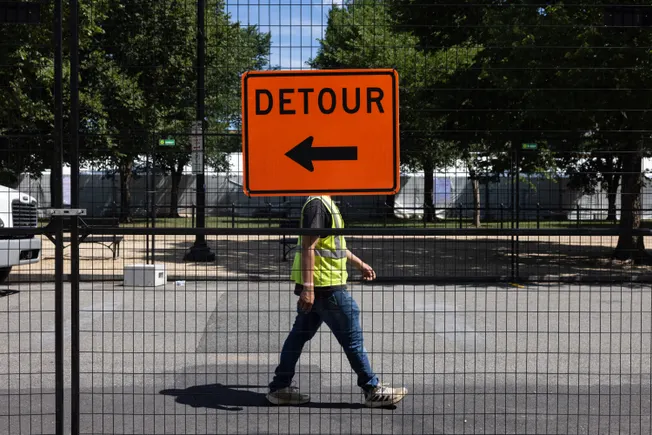
- Late June: Field reports, such as those tracking worker movements in urban centers like the District of Columbia, highlight ongoing project slowdowns and logistical bottlenecks.
- Early August 2026 (The BLS Job Openings Report): The Bureau of Statistics releases its latest monthly report, confirming that construction job vacancies have risen year-over-year for the third consecutive month. This triggers immediate analysis from trade associations and economic forecasters regarding the true health of the construction labor market.
Supporting Data and Metrics
The divergence between construction spending and job openings is captured across several key economic indicators:
- 3.2% Drop: The month-to-month decline in total construction spending recorded in the summer of 2026, underlining a cooling market.
- 4.7% Year-Over-Year Decline: The contraction experienced within the private nonresidential construction spending sector, proving that capital investments are slowing down despite high numbers of advertised job openings.
- 3 Consecutive Months: The duration for which the construction job openings rate has consistently outpaced figures from the same period a year prior, establishing a firm statistical trend rather than a monthly statistical anomaly.
- 14,000+ Openings: Significant monthly spikes in open positions registered by industry-tracking bodies, such as the Associated Builders and Contractors (ABC), which contrast sharply against shrinking project pipelines.
Official Responses and Expert Analysis
Industry leaders and chief economists have been quick to dissect the paradox, cautioning stakeholders against taking headline job metrics at face value.
The Challenge of Data Interpretation
Anirban Basu, chief economist for the Associated Builders and Contractors (ABC), addressed the paradox directly in a release analyzing the BLS data.
"Interpreting these data is often challenging," Basu noted. "One could take these figures at face value and conclude that construction is thriving and driving demand for workers higher."
However, Basu immediately contextualized those figures against Monday’s spending report, which displayed the 3.2% monthly drop in total construction spending and the stark 4.7% annual decline in private nonresidential expenditures. Because spending is dropping while job openings rise, the math simply does not support the traditional thesis that more open jobs equal more new projects.
The Productivity Gap and Generational Turnover
Instead of growth, Basu points to deep structural challenges within the workforce itself. The primary headwind facing modern contractors is not a sudden influx of fresh project demand, but rather a structural shortfall of skilled labor driven by an aging population.
"Many contractors view a structural shortfall of skilled labor as their primary challenge because many highly experienced, productive workers are retiring," Basu explained. "It is conceivable that these workers are being replaced with less skilled and productive workers, thereby requiring a few workers to be replaced by many."
When highly skilled master craftsmen—carpenters, electricians, heavy equipment operators, and project supervisors—retire, they take decades of efficiency with them. If a firm replaces a veteran artisan with two or three less-experienced apprentices to accomplish the same volume of work, the number of open or newly created positions naturally inflates, even if overall project volume remains flat or declines.

The Tightening Labor Market and "Skills Mismatch"
Other analysts view the multi-month streak of rising job openings as a sign of institutional recruiting friction.
"The job openings rate has now been higher than a year ago for three consecutive months," observed labor market analysts. While experts advise against overreacting to single-month data points, a sustained three-month pattern signals that employers are spending significantly more time and resources trying—and often failing—to fill open roles.
This phenomenon is frequently attributed to a "skills mismatch." Firms are aggressively recruiting for specialized, hard-to-fill occupations that require technical certifications, safety credentials, and years of experience. When those workers cannot be found in the local labor pool, the positions remain listed indefinitely, skewing government vacancy metrics upward.
The Impact of Immigration Enforcement
Compounding the demographic retirement cliff and the skills mismatch are the structural impacts of federal immigration policies. The aggressive crackdown on undocumented workers under President Donald Trump has altered the availability of labor on job sites across the United States.
"It may be that certain people who had been working in construction were doing so without proper documentation," Basu stated. "At least some of these workers are no longer available at jobsites, inducing faster hiring and expanding job openings as contractors work to replace them."
Because a significant percentage of framing, drywall, concrete, and general labor roles across major U.S. metropolitan markets historically relied on undocumented or foreign-born labor, sudden regulatory enforcement has created acute labor vacuums. Contractors are forced to post dozens of new job openings simply to restaff projects that were already underway, decoupling the hiring metrics from new project starts.
Implications for the Construction Industry
The realization that rising job openings are born of labor scarcity, workforce churn, and regulatory changes—rather than an economic boom—carries profound implications for construction firms, developers, and the broader economy.

1. Compressed Profit Margins and Schedule Delays
When contractors must hire multiple less-skilled workers to replace a single retiring veteran, productivity per man-hour declines. Combined with the administrative overhead of continuous recruitment and the potential delays caused by sudden workforce shortages resulting from immigration enforcement, contractor profit margins face severe compression. Project timelines stretch out, leading to potential penalty clauses and increased financing costs in a high-interest-rate environment.
2. A Call for Expanded Workforce Development
The data serves as a stark warning to industry associations and educational institutions. Relying on traditional labor pipelines is no longer viable. The construction sector must double down on vocational training programs, high school trade partnerships, and accelerated apprenticeship models. Furthermore, firms must invest in construction technology—such as prefabrication, modular building, and robotics—to offset the human labor deficit through automation.
3. Caution for Investors and Developers
Real estate developers and institutional investors must look past headline employment figures when evaluating market health. While a high volume of job openings might historically have been read as a green light to break ground on new commercial or residential complexes, the current data suggests that the labor market is structurally constrained. Developers must factor in higher labor costs, extended scheduling buffers, and potential workforce availability risks before committing capital to new ventures.
Conclusion
The summer 2026 construction data shatters the illusion that more open jobs automatically equate to a booming industry. As the sector navigates the retirement of its most experienced veterans, adapts to a shifting regulatory and immigration landscape, and grapples with declining nonresidential spending, the industry finds itself in a paradoxical holding pattern. Solving this crisis will require more than just posting job openings; it demands a fundamental transformation in how the American construction sector recruits, trains, and deploys its workforce.
