

Main Facts: The Phase-Out of the Traditional Ladder Cage
For decades, the metallic silhouette of a ladder cage was a ubiquitous sight on the exteriors of commercial buildings, industrial plants, and grain silos. To both building owners and workers, these curved steel enclosures represented the standard of vertical safety. However, a major regulatory shift by the Occupational Safety and Health Administration (OSHA) is rendering these traditional structures obsolete. Under OSHA standard 1910.28(b)(9), the agency has officially recognized what safety engineers have long argued: ladder cages do not prevent falls; they merely contain them.
The core of the regulatory update, which originated from a comprehensive overhaul of OSHA’s Walking-Working Surfaces standard, establishes that cages and wells are no longer considered acceptable primary fall protection for fixed ladders that extend more than 24 feet above a lower level. Instead, the industry is mandated to transition to active engineering controls, specifically personal fall arrest systems (PFAS) or specialized ladder safety systems.
+-------------------------------------------------------------------------+
|                      OSHA FIXED LADDER COMPLIANCE                       |
|        (For ladders extending > 24 feet above a lower level)            |
+-------------------------------------------------------------------------+
|  PRE-NOV 2018 INSTALLATIONS   |  Can use Cage, Well, PFAS, or Ladder    |
|                               |  Safety System                          |
+-------------------------------------------------------------------------+
|  POST-NOV 2018 INSTALLATIONS  |  MUST use PFAS or Ladder Safety System  |
|  (Or repaired/replaced rungs) |  (Cages no longer acceptable alone)     |
+-------------------------------------------------------------------------+
|  POST-NOV 18, 2036 DEADLINE   |  ALL fixed ladders must have PFAS or    |
|  (Universal Enforcement)      |  Ladder Safety System (No exceptions)   |
+-------------------------------------------------------------------------+
This regulatory pivot directly affects two primary types of vertical access points utilized by roofing contractors and maintenance personnel:
- Internal Roof Access (Hatch Ladders): Fixed ladders mounted inside a structure that lead directly to a roof hatch.
- External Roof Access (Exterior Ladders): Fixed ladders mounted to the exterior facade of a building, often spanning multiple stories or terminating at a parapet wall.
For contractors, navigating this transition requires advising building owners on how to bring existing structures into compliance while ensuring all new installations feature modern, compliant fall-arrest technologies.
Chronology: The Multi-Decade Regulatory Transition to 2036
To prevent widespread disruption across the commercial real estate and construction sectors, OSHA established an extended, multi-phase implementation timeline. This 18-year transitional roadmap is designed to allow building owners to amortize the costs of safety upgrades, while ensuring that any new construction immediately adopts modern safety technologies.
Timeline of OSHA 1910.28(b)(9) Implementation:

2018 (Nov 19) -------> Present Day -------> 2036 (Nov 18)
     |                                           |
     +-- New/Replaced ladders                    +-- Universal enforcement:
         must have PFAS/Safety Systems.              ALL fixed ladders >24'
         Cages no longer suffice.                    must be retrofitted.
Phase I: The Nov 19, 2018 Baseline
On November 19, 2018, the amendment to OSHA 1910.28(b)(9) went into effect. From this date forward, any new fixed ladder installed on a structure that exceeds 24 feet in height must be equipped with a personal fall arrest system or a ladder safety system. Cages and wells could still be built, but only as secondary physical barriers—they could no longer serve as the primary means of fall protection.
Phase II: The Maintenance and Replacement Trigger
Under section 1910.28(b)(9)(i)(B), the regulation targets existing infrastructure through maintenance actions. If any section, rung, or side rail of an existing pre-2018 fixed ladder is replaced, the entire ladder must be upgraded. The repaired ladder must immediately be fitted with a personal fall arrest system or a ladder safety system, regardless of its original installation date.
Phase III: The Final Universal Deadline (November 18, 2036)
The final phase of the roll-out is a hard deadline. On and after November 18, 2036, all fixed ladders exceeding 24 feet in height, regardless of their installation date or historical compliance status, must be equipped with a personal fall arrest system or a ladder safety system. On this date, the grandfathering of legacy ladder cages officially ends, making non-compliant structures subject to federal citations and financial penalties.
Supporting Data: Engineering and Technical Specifications
The move away from ladder cages is rooted in biomechanical research and accident recreation data. Historically, it was believed that a worker falling inside a cage would be able to catch themselves on the cage’s hoops or rungs. In practice, however, falling workers often bounce off the hoops, accelerating downward while sustaining severe impact injuries on the way.
To replace this outdated system, OSHA has defined clear engineering parameters for what constitutes compliant protection.
Defining the Ladder Safety System
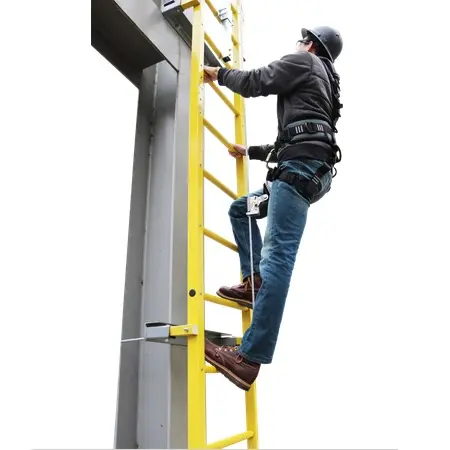
According to OSHA guidelines, a Ladder Safety System is an integrated safety assembly designed to eliminate or significantly minimize the risk of a worker falling from a fixed ladder. The system typically consists of five core components:
- The Carrier: A rigid rail or flexible cable secured vertically along the center of the ladder rungs.
- The Safety Sleeve (or Traveler): A mechanical tracking device that glides smoothly along the carrier as the worker climbs, but instantly locks onto the cable or rail in the event of a sudden downward fall.
- The Lanyard: A short connector linking the safety sleeve to the worker’s harness.
- Connectors: Rated carabiners or snap hooks meeting ANSI standards.
- The Body Harness: A full-body harness designed to distribute fall forces across the thighs, pelvis, waist, chest, and shoulders.
       TYPICAL LADDER SAFETY SYSTEM COMPONENTS

             [Anchor Point]
                   ||
                   || <=== Rigid Rail or Cable Carrier
                   ||
             [Safety Sleeve] <=== Glides on Carrier; locks during fall
                   ||
               [Lanyard]
                   ||
             [Harness D-Ring] <=== Sternal/Waist Mounted (Front)
                   ||
             [Body Harness]
The Sternal Harness Requirement: Overlooked Nuances in 1910.140
A critical point of confusion for contractors is the type of personal protective equipment (PPE) required to use these vertical systems. Many commercial roofers are accustomed to using traditional fall protection kits designed for flat roofs, which feature a single dorsal (back) D-ring connected to a self-retracting lifeline (SRL).
However, using a dorsal D-ring on a vertical ladder system can introduce severe hazards. Under OSHA 1910.140(d)(1)(iv), personal fall arrest systems must be designed to:
"…sustain the employee within the system/strap configuration without making contact with the employee’s neck and chin area."
If a worker falls while attached to a vertical cable system via a back-mounted dorsal D-ring, the pulling force tends to slide the harness straps upward, forcing the chest strap into the worker’s throat and chin. To prevent this hazard, vertical ladder safety systems require harnesses with a sternal (chest) D-ring or a specifically designed waist-mounted D-ring. This configuration keeps the worker in an upright, seated position during a fall, ensuring the harness straps remain securely clear of the airway.
Official Responses and Industry Perspective
The commercial roofing and building maintenance industries have responded to these regulatory shifts with a mixture of proactive adaptation and concern over retrofitting logistics.
The Regulatory Justification
OSHA’s enforcement division has consistently maintained that the transition to active fall protection is a major step forward for workplace safety. According to agency impact assessments, vertical fall arrest systems significantly reduce both the fall distance and the deceleration forces experienced by a worker compared to a fall inside a traditional ladder cage. By stopping a fall within inches of its initiation, these systems prevent the high-velocity impacts that lead to severe trauma or fatalities.
The Manufacturer and Supplier Viewpoint
For industry suppliers like Roofmaster, a company with over 70 years of experience and five national locations, the focus has shifted toward educating contractors on compliant equipment integration.
"Contractors are finding themselves in a consultative role," explains an industry safety specialist. "Building owners often don’t realize that their existing ladder cages will become obsolete, or that simple repairs to an old ladder will trigger an immediate requirement for a complete fall-arrest retrofit. Suppliers are now stocking specialized cable-system kits, such as the 50-foot ladder fall arrest cable systems, to help contractors easily convert legacy ladders into OSHA-compliant systems."
The Contractor’s Dilemma
Many contractors note that while the safety benefits are clear, field implementation requires rigorous training. Unlike passive cages, which require no training to use, a ladder safety system requires active user participation. Workers must be trained on how to inspect their harnesses, verify the integrity of the safety sleeve, and properly attach themselves to the carrier cable before climbing.
Implications: Strategic Planning for Building Owners and Contractors
The ongoing phase-out of legacy safety systems has wide-ranging implications for commercial property management, liability exposure, and construction planning.
                         UPGRADE PATH FOR PROPERTY OWNERS

  Identify Fixed Ladders > 24' ---> Assess Current System ---> Plan Retrofit/Replacement
                                                                        |
    +-------------------------------------------------------------------+
    |
    v
  Option A: Install Cable-Based System          Option B: Complete Ladder Replacement
  - Cost-effective retrofit                     - Best for structurally degraded ladders
  - Keeps existing ladder frame                 - Integrates internal safety track
  - Adds flexible cable + traveler              - High durability, low profile
1. Capital Expenditure Planning for Property Owners
With the 2036 deadline steadily approaching, building owners should avoid waiting until the final years to upgrade their facilities. Proactive owners are incorporating ladder safety upgrades into their annual capital improvement budgets. Retrofitting an existing ladder with a cable-based personal fall arrest system is highly cost-effective compared to completely tearing down and replacing structural concrete or steel wells later on.
2. Liability and Risk Management
If an accident occurs on a fixed ladder that has undergone repairs but was not upgraded to meet 1910.28(b)(9)(i)(B) standards, building owners and employers could face severe legal liability. Insurance carriers are increasingly scrutinizing building access points during risk assessments, often requiring compliance with modern OSHA standards as a condition of policy renewal or premium reduction.
3. Structural and Architectural Considerations
When designing new facilities, architects and engineers are shifting away from external caged ladders in favor of sleek, low-profile vertical safety tracks. These systems improve the aesthetic appeal of modern commercial buildings while offering superior safety. For internal hatches, compact vertical cable systems ensure that the path through the ceiling opening remains unobstructed, allowing maintenance staff to transition safely from the ladder to the roof deck.
Ultimately, the transition away from ladder cages represents a fundamental shift in how the construction industry views height safety. By replacing passive, unreliable enclosures with engineered, active fall arrest technology, OSHA and industry leaders are establishing a higher standard of protection for the workforce.
