

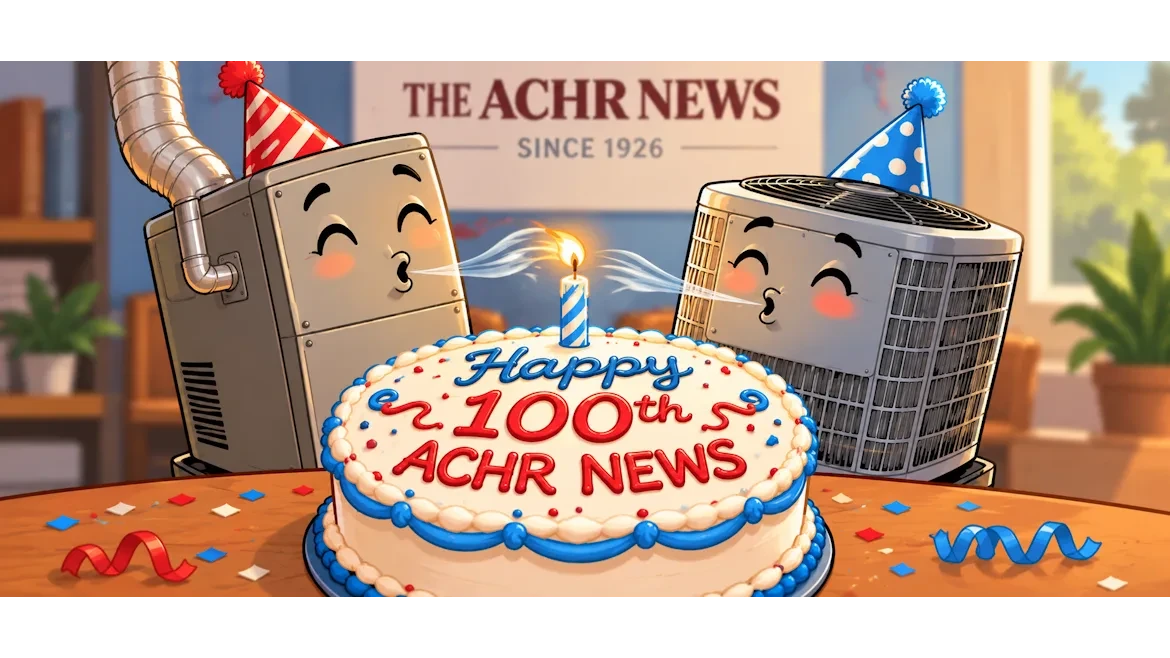
TROY, Mich. — For a full century, the modern world has relied on a quiet, invisible miracle: the ability to artificially control indoor climate. Whether it is preserving perishable food through scorching summer heatwaves, protecting delicate server rooms from thermal overload, or providing life-saving comfort in hospitals and homes, the heating, ventilation, air conditioning, and refrigeration (HVACR) industry serves as the unseen backbone of modern civilization.
And for every step of that journey, The ACHR NEWS has been there to record it.
Founded on September 11, 1926, under the banner of Electric Refrigeration News, the publication marks its landmark 100th anniversary this year. As the publication crosses this historic threshold, it does so not merely to celebrate its own longevity, but to honor the contractors, technicians, manufacturers, distributors, engineers, and educators who built a multi-billion-dollar global trade from the ground up.
Main Facts: A Century of Trade Journalism and Technological Evolution
At its core, The ACHR NEWS has spent 100 years documenting the intersection of human ingenuity, thermodynamic science, and commercial enterprise. From the early days of bulky, toxic-gas-dependent iceboxes to the modern era of smart thermostats, variable-refrigerant-flow (VRF) systems, artificial intelligence, and low-GWP (Global Warming Potential) A2L refrigerants, the publication has functioned as the industry’s paper trail.
Key pillars defining the publication’s legacy include:
- Foundational Origins: Launched on September 11, 1926, as Electric Refrigeration News by visionary publisher George F. Taubeneck, the publication was designed to give a nascent industry a collective voice.
- Scope of Coverage: The publication tracks technological breakthroughs, regulatory shifts, economic trends, labor dynamics, and safety protocols across residential, commercial, and industrial sectors.
- The Human Element: Beyond gears, coils, and compressors, The NEWS has always prioritized the stories of the people—the blue-collar technicians and forward-thinking engineers—who apply these technologies in the field every single day.
- Modern Integration: Entering its second century, the publication bridges traditional print journalism with cutting-edge digital platforms, including specialized AI search tools like Ask ACHR NEWS, designed to deliver rapid technical answers to working professionals.
Chronology: Milestones in HVACR and The NEWS
To understand the trajectory of The ACHR NEWS, one must understand the parallel evolution of the HVACR industry itself. The past 100 years can be broken down into distinct eras of monumental change:
The Era of Mechanical Refrigeration (1920s–1930s)
When Electric Refrigeration News published its inaugural issues in the late 1920s, mechanical refrigeration was largely an industrial novelty or an expensive luxury for elite households. Commercial ice-making and early domestic refrigerators relied on hazardous substances like sulfur dioxide, methyl chloride, and ammonia.
The publication played a vital role in educating early tradespeople on the safe handling of these chemicals and the transition toward safer synthetic alternatives, most notably the development of chlorofluorocarbons (CFCs) by Thomas Midgley Jr. in 1928.
The Post-War Comfort Cooling Boom (1940s–1960s)
Following World War II, the American economy experienced an unprecedented housing and commercial building boom. Air conditioning transitioned from theaters and industrial plants into residential tract homes and sprawling office complexes.
During this era, Carrier, Trane, York, and other manufacturing giants scaled up production. The NEWS tracked the rapid adoption of central air conditioning, the expansion of ductwork fabrication, and the birth of modern air distribution standards. It was during this period that the publication broadened its editorial aperture to reflect the holistic integration of heating, cooling, and ventilation, cementing its identity as a comprehensive trade resource.
The Energy Crises and Efficiency Reckoning (1970s–1980s)
The geopolitical oil shocks of 1973 and 1979 fundamentally altered how the world viewed energy consumption. Comfort cooling and heating could no longer rely on brute-force energy use.
The NEWS documented the industry’s pivot toward energy efficiency. This era saw the introduction of the Energy Efficiency Ratio (EER) and the Seasonal Energy Efficiency Ratio (SEER), forcing manufacturers to redesign compressors, improve heat exchanger surface areas, and introduce early iterations of electronic controls. The trade transitioned from simply making buildings "cool" to making them "efficient."
The Ozone Layer and Global Environmental Pacts (1987–1990s)
In 1987, the international community signed the Montreal Protocol, setting a phased timeline for the elimination of ozone-depleting CFCs and hydrochlorofluorocarbons (HCFCs).
For the HVACR industry, this was nothing short of an existential crisis. Entire equipment lines had to be re-engineered to run on alternative refrigerants like HFCs (hydrofluorocarbons). The NEWS served as a critical lifeline for contractors and technicians scrambling to understand new recovery laws, retrofitting procedures, and oil compatibilities, proving its value as an indispensable educational tool.
Decarbonization, Smart Tech, and the Modern Era (2000s–Present)
Entering the 21st century, the industry faced dual pressures: mitigating climate change and embracing the digital revolution.
The focus shifted toward global warming potential (GWP) and energy decarbonization. Regulations like the AIM (American Innovation and Manufacturing) Act set strict phasedowns for HFCs, ushering in mildly flammable A2L refrigerants. Concurrently, the electrification movement—spurred by state-level policies and federal incentives—pushed cold-climate heat pumps to the forefront of residential and commercial heating.
Today, The NEWS covers not just mechanical hardware, but building automation systems (BAS), internet-connected thermostats, predictive maintenance powered by artificial intelligence, and workforce development initiatives aimed at solving the industry’s chronic labor shortage.
Supporting Data: The Scale of Modern HVACR
The industry that The ACHR NEWS covers today is vastly different from the handful of refrigerator salesmen who gathered in the 1920s. According to recent market research and economic data:
- Market Valuation: The global HVAC system market size is valued at well over $200 billion, with projections indicating steady compound annual growth rates (CAGR) driven by urbanization, climate change, and rising global living standards.
- Workforce Impact: In the United States alone, hundreds of thousands of HVACR mechanics, installers, and contractors form the backbone of the domestic service economy.
- Regulatory Compliance: Over 90% of commercial buildings in developed nations rely on centralized HVAC systems to meet indoor air quality (IAQ) and Occupational Safety and Health Administration (OSHA) standards.
- Energy Consumption: Commercial and residential buildings account for nearly 40% of global energy consumption, with HVAC systems making up the single largest share of that energy use—underscoring why the innovations covered by The NEWS are central to global carbon reduction goals.
Official Perspectives: Honoring a Century of Service
As The ACHR NEWS commemorates its centennial, industry leaders have stepped forward to reflect on the publication’s enduring impact on the trade.
Sarah Jenkins, president of a major national HVAC contractor association, noted the vital educational bridge the publication provides:
"In our line of work, technology changes faster than local building codes can sometimes keep up. For decades, The NEWS has been the trusted filter that takes complex regulatory shifts—whether it’s the phaseout of R-22 or the current adoption of A2L refrigerants—and translates them into practical, actionable knowledge for the guy in the truck. You cannot overstate what that means for a small business owner trying to stay compliant and profitable."
Dr. Marcus Vance, a professor of mechanical engineering specializing in thermal systems, emphasized the publication’s historical value:
"When researchers look back at how mechanical comfort transformed human civilization from an engineering perspective, The ACHR NEWS archive is the primary source. It captures the exact moment theories became patents, and patents became commercial products. It is living industrial history."
Current editorial leadership at the publication emphasizes that while the formats have evolved—moving from ink-stained newsprint to digital newsletters, webinars, and AI-driven search portals—the core philosophy remains unchanged.
"What began as Electric Refrigeration News in 1926 has grown alongside the industry itself," said a senior editor reflecting on the milestone. "Through every decade of change, our mission has remained remarkably consistent: support the trade, share knowledge, and tell the stories of the contractors, technicians, manufacturers, distributors, engineers, and educators who keep HVACR moving forward."
Implications: The Road Ahead for HVACR and Trade Media
As The ACHR NEWS steps into its second century, the HVACR industry stands at another historic crossroads. The challenges and opportunities defining the next 100 years are profound:
- The Energy Transition and Electrification: With global mandates shifting away from fossil-fuel heating toward high-efficiency heat pumps, the technical competency required of field technicians has never been higher. The industry faces an urgent educational imperative to train a new generation of workers on inverter-driven compressors, thermal storage, and complex electrical loads.
- Refrigerant Transition Realities: The ongoing adoption of A2L (mildly flammable) and natural refrigerants (such as CO2 and propane) requires a cultural shift in safety practices, tool investments, and field installation standards. Publications like The NEWS remain essential in debunking myths and promoting rigorous safety standards.
- The Labor Paradox: Even as demand for indoor air quality, energy efficiency, and climate control skyrockets, the HVACR trade faces a persistent labor deficit as veteran technicians retire. Attracting digital-native youth to the trades through modern training pathways is an existential priority for the sector.
- The Rise of Smart Tech and AI: The integration of IoT sensors, machine learning, and automated diagnostics means that modern HVAC systems are no longer just mechanical boxes—they are edge-computing nodes. Tools like Ask ACHR NEWS exemplify how trade media must adapt to provide instantaneous, data-driven support to professionals in the field.
Conclusion
For 100 years, The ACHR NEWS has chronicled the invisible art and science of comfort. It has documented the triumphs of engineers, the resilience of small business owners, and the quiet dedication of technicians working in scorching attics and freezing basements.
As the industry faces the complex climate and technological demands of the 21st century, one thing remains certain: as long as humanity seeks to control its indoor environment, The ACHR NEWS will be there to report how it’s done.
