

By Terrence O’Brien
Updated September 6, 2026, 8:56 PM UTC
Main Facts
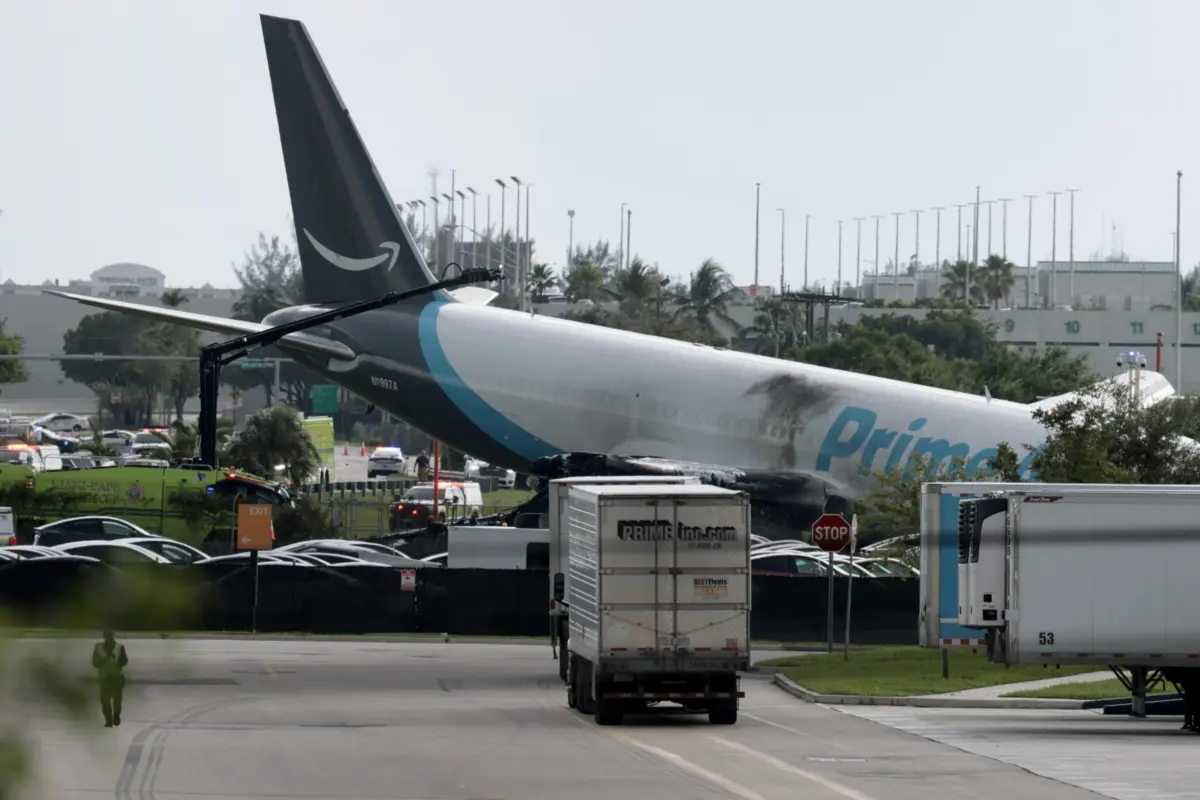
An Amazon-branded cargo aircraft met with disaster on Sunday afternoon, September 6, 2026, when it violently overran the runway during landing at Miami International Airport (MIA). The aircraft, a widebody Boeing 767-300 operating as 21 Air Flight 7598, careened past the paved confines of the runway, breached airport perimeter boundaries, and collided with vehicles on a nearby roadway before finally coming to a halt.
The terrifying incident triggered a massive emergency response. More than 60 units from Miami-Dade Fire Rescue (MDFR) were rapidly deployed to the scene, where first responders encountered heavy plumes of black smoke and active flames engulfing sections of the aircraft. Ground operations at Miami International Airport—one of the busiest cargo and passenger hubs in the United States—were immediately suspended, causing cascading flight delays and cancellations as aviation authorities scrambled to secure the perimeter and manage the unfolding crisis.
Initial reports from the scene confirmed that multiple individuals sustained injuries during the crash, though comprehensive details regarding the precise number of casualties and the severity of the injuries remained fluid at the time of publication. Federal regulators, local emergency services, and corporate representatives have mobilized task forces to determine the root cause of the runway excursion.
Chronology of Events
Departure from San Juan
The fateful journey of 21 Air Flight 7598 began hours earlier on Sunday afternoon. The Boeing 767-300 cargo freighter pushed back from its gate at Luis Muñoz Marín International Airport (SJU) in San Juan, Puerto Rico. The routine cargo flight, integrated into Amazon Air’s extensive logistical network, was loaded with commercial goods bound for the mainland United States. The flight took off without incident, cruising at standard altitude across the Caribbean toward South Florida under typical operational conditions.
Approach and Landing at MIA
As the aircraft neared the South Florida coast, flight crew members established communication with air traffic control (ATC) at Miami International Airport. Weather conditions at the time of arrival were under evaluation by investigators, though no immediate severe weather warnings had grounded other flights in the immediate window prior to the incident.
Flight 7598 lined up for its final approach and touched down on the tarmac at approximately 2:00 PM local time. However, rather than decelerating safely within the designated runway safety area, the heavy cargo jet failed to stop. Witnesses and preliminary telemetry data suggest the aircraft maintained excessive forward momentum, sliding through the remaining pavement and overrunning the runway threshold.
The Breach and Impact
Unable to brake or reverse thrust in time, the Boeing 767 punched through perimeter fencing and safety barriers surrounding the airport grounds. The aircraft crossed a public roadway adjacent to the airport property, colliding directly with civilian vehicles traversing the perimeter road. The kinetic force of the multi-ton cargo jet heavily crushed the impacted vehicles, igniting immediate concerns for motorists in the vicinity.
Emergency Response and Fire Suppression
Within minutes of the breach, automated alerts and frantic 911 calls mobilized Miami-Dade Fire Rescue. The first wave of emergency apparatus arrived to find the jet resting outside the airport boundary, spewing thick, toxic smoke as flames licked at its fuselage and wings.
Firefighters deployed high-capacity foam and water lines to beat back the fire, working furiously to cool the aircraft’s fuel tanks and secure the area against secondary explosions. Simultaneously, paramedics established triage zones to treat individuals pulled from the impacted vehicles and any flight crew members evacuated from the cockpit.
Supporting Data and Operational Context
The Aircraft: Boeing 767-300 (Cargo Configuration)
The aircraft involved in the incident is a Boeing 767-300, a twin-engine widebody jet that has served as a reliable workhorse for both commercial passenger airlines and global cargo carriers for decades. Converted freighters like the one operated by 21 Air play a vital role in modern e-commerce supply chains, capable of hauling tens of thousands of pounds of freight across domestic and international routes.
The Operator: 21 Air
21 Air is a certificated U.S. air carrier operating cargo services on behalf of major logistics providers, including Amazon Air. The airline operates a dedicated fleet of Boeing 767 freighters, connecting major fulfillment hubs. While 21 Air maintains a standard commercial safety record, this incident represents a critical stress test for the carrier’s operational oversight, maintenance protocols, and flight crew training procedures.
Miami International Airport (MIA) Infrastructure
As a premier gateway between North America, Latin America, and the Caribbean, Miami International Airport handles immense daily volumes of both passenger and cargo traffic. Runway excursions—while statistically rare—pose unique spatial challenges at MIA due to the airport’s dense urban surroundings, intersecting expressways, and high-density commercial zones immediately bordering airfield perimeters.

Official Responses and Stakeholder Statements
Federal Aviation Administration (FAA)
The Federal Aviation Administration was quick to acknowledge the severity of the accident. In an official statement released Sunday evening, the agency confirmed the fundamental parameters of the event:
"21 Air Flight 7598 overran the runway after landing at Miami International Airport around 2 p.m. local time on Sunday, Sept. 6. The Boeing 767-300 cargo aircraft departed from Luis Muñoz Marín International Airport in San Juan, Puerto Rico."
The FAA announced that a multidisciplinary team of investigators, alongside personnel from the National Transportation Safety Board (NTSB), would spearhead the official inquiry into why the aircraft failed to decelerate.
Amazon Air
As the primary lessee utilizing the logistics capacity of the aircraft, Amazon issued a formal response acknowledging the tragedy. Amazon spokesperson Kelly Nantel provided a statement to The Verge:
"We can confirm that an Amazon Air plane operated by 21 Air experienced an incident while attempting to land at Miami International Airport today. This is a fast-moving situation and we’re still gathering details. We’re working closely with local authorities and officials to understand exactly what happened. Right now, our absolute priority is the safety, well-being, and care of everyone involved. We’re doing everything we can to support those affected."
Local Authorities and Emergency Services
Miami-Dade Fire Rescue utilized social media platforms, including X (formerly Twitter), to broadcast safety warnings, coordinate traffic re-routings, and update the public on the massive mobilization of over 60 emergency units. Local law enforcement established secure perimeters to facilitate ongoing rescue operations and prevent civilian interference with active investigative zones.
Visual documentation of the aftermath quickly circulated across news networks. Broadcast footage from local outlets, including NBC 6, showed the distinct Amazon corporate logo emblazoned across the tail of the wrecked aircraft, with billowy black smoke rising against the South Florida skyline from the roadway where the plane came to rest.
Implications of the Incident
Immediate Disruptions to Aviation and Logistics
The temporary grounding of flights at Miami International Airport created immediate logistical bottlenecks. Dozens of incoming passenger flights were placed into holding patterns, diverted to alternative airports in Fort Lauderdale or Orlando, or canceled outright. For Amazon Air and its network partners, the loss of an operational Boeing 767-300 cargo jet—coupled with temporary disruptions to MIA’s cargo handling facilities—threatens to cause localized supply chain ripples across regional delivery networks.
Heightened Scrutiny on Runway Safety and Perimeter Protection
Runway overruns are among the most dangerous hazards in aviation, often categorized by safety regulators under Runway Safety Area (RSA) compliance. This incident will likely renew intense regulatory scrutiny regarding:
- Braking Performance: Investigations will analyze runway friction coefficients, braking systems, thrust reversers, and weather-related hydroplaning risks at the moment of touchdown.
- Performer Infrastructure: The fact that the aircraft successfully breached perimeter barriers and struck civilian vehicles on a public road will prompt municipal and federal infrastructure planners to reevaluate the physical safety buffers surrounding high-capacity airports located in densely populated urban centers.
Regulatory and Legal Aftermath
In the days and weeks ahead, the National Transportation Safety Board (NTSB) will recover the aircraft’s cockpit voice recorder (CVR) and flight data recorder (FDR)—commonly known as the "black boxes." Their analysis will reconstruct the final seconds of Flight 7598, shedding light on pilot inputs, mechanical responses, and environmental conditions.
Simultaneously, legal experts anticipate rigorous liability assessments. The collision with civilian vehicles on public property opens the door to extensive civil litigation regarding property damage, bodily injury, and institutional accountability across all involved corporate and municipal entities.
As the investigation unfolds, the aviation and logistics industries watch closely, mindful that the lessons learned from Flight 7598 will help define future safety mandates for both cargo operations and airport infrastructure design worldwide.
