

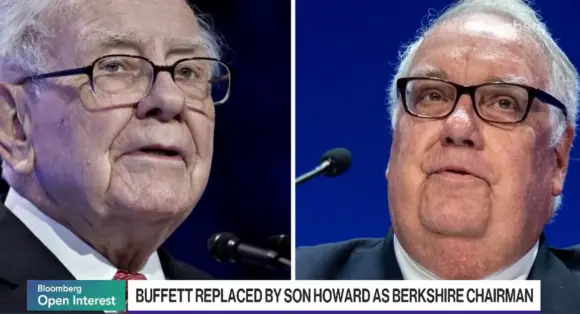
OMAHA, Neb. — In a watershed moment for global finance, Warren Buffett is officially stepping down as the chairman of Berkshire Hathaway Inc., bringing to a close a legendary six-decade tenure that fundamentally reshaped the landscape of American capitalism.
According to an official corporate statement released on Friday, the 96-year-old billionaire visionary will transition immediately into the role of chairman emeritus. While he will relinquish his executive chairmanship, Buffett will retain his seat on the company’s board of directors. To fill the monumental vacancy left by his departure, the board has elevated Howard Buffett—Warren’s son and a dedicated Berkshire director since 1993—to the position of chairman.
This strategic realignment marks the final, definitive stage in a meticulously planned succession process at one of the world’s most storied and revered conglomerates. It follows closely on the heels of Greg Abel’s ascension to the chief executive officer role earlier this year, a transition that handed the day-to-day operational reins of the $1 trillion enterprise over to a trusted lieutenant.
"Warren’s impact on Berkshire and its owners is without parallel in the history of American business," Abel said in a statement following the announcement. "The culture Warren built and the values he championed will remain at the heart of Berkshire, and Howard will be their guardian."
Main Facts: The Passing of the Torch
The restructuring at the top of Berkshire Hathaway signifies the formal conclusion of the "Oracle of Omaha’s" hands-on reign, though his shadow of wisdom will undoubtedly loom large over the enterprise.
- The Leadership Transition: Warren Buffett steps down as chairman, effective immediately, assuming the honorary title of chairman emeritus while remaining on the board.
- The New Chairman: Howard Buffett, who has served on the Berkshire board for 33 years, assumes the role of chairman. His primary mandate will be safeguarding the corporate culture and core values of the conglomerate.
- The Operational Chief: Greg Abel, who took over as CEO earlier this year, continues to steer the business operations, capital allocation, and strategic growth of the firm.
- The Legacy: Over six decades, Buffett transformed Omaha-based Berkshire Hathaway from a struggling, mid-century New England textile mill into a sprawling, multi-trillion-dollar global economic powerhouse spanning insurance, rail transport, energy, retail, and manufacturing.
Despite stepping back from public-facing duties—such as missing the annual shareholders’ meeting in May and ceding the authorship of his iconic annual shareholder letter to Abel—Buffett remains intimately connected to the firm’s ethos. In a separate letter to shareholders, Buffett revealed that his decision to formally step down was precipitated by Abel’s exceptional performance, noting that the new CEO has consistently exceeded his "sky-high" expectations.
"He has been making the decisions that matter for some time now, and I have not had to think twice about any of them," Buffett wrote. "So the timing is right to complete the transition."
Chronology: Six Decades of Wealth Creation and Succession Planning
To understand the magnitude of Friday’s announcement, one must look back at the extraordinary timeline that turned a modest textile operation into an economic titan, and the methodical, unhurried way Buffett engineered his eventual departure.
1965–1980s: The Genesis of an Empire
Warren Buffett took control of Berkshire Hathaway in 1965. At the time, it was a failing textile manufacturing firm facing secular decline. Buffett utilized the company as a vehicle to acquire undervalued businesses and deploy float generated by insurance subsidiaries, notably National Indemnity and GEICO. This laid the groundwork for a decentralized holding company model that prioritized long-term intrinsic value over short-term earnings management.
1990s–2010s: The Oracle’s Golden Era
Over the next several decades, Berkshire grew through legendary acquisitions—including BNSF Railway, Dairy Queen, Fruit of the Loom, and Lubrizol—alongside massive, highly profitable equity stakes in iconic American brands like Coca-Cola, American Express, and later, Apple. Buffett achieved near-mythic status, drawing tens of thousands of pilgrims to Omaha every spring for the annual shareholder meeting, affectionately dubbed "Woodstock for Capitalists."
2021–2025: The Succession Blueprint Takes Shape
As Buffett entered his nineties, questions surrounding succession reached a fever pitch. In 2021, Berkshire publicly confirmed what many insiders had long suspected: Greg Abel, the brilliant executive who built Berkshire Hathaway Energy, had been designated as Buffett’s successor to run the day-to-day business.
The transition accelerated notably in 2025. At the annual shareholder meeting that year, it was formally announced that Abel would step into the CEO role. In the months that followed, Buffett systematically pared back his public footprint. He stopped appearing onstage at the annual meetings, handed over the pen for the legendary annual shareholder letter, and faced personal health challenges, including a broken leg earlier this year. Furthermore, in July, Buffett made waves by pledging to completely dispose of his roughly $140 billion personal stake in Berkshire Hathaway through philanthropic donations by 2034.
Today: The Final Chapter
With Friday’s announcement, the long-anticipated corporate handover is complete. The operational reins rest entirely with Greg Abel, the cultural and values stewardship rests with Howard Buffett, and Warren Buffett assumes a reflective, advisory emeritus status.
Supporting Data: Berkshire’s Financial Footprint and Market Realities
While the leadership shift is primarily cultural and structural, it occurs against a backdrop of unique financial dynamics and shifting macroeconomic tides for Berkshire Hathaway.
Cash Hoard and Capital Deployment
Under Abel’s early tenure as CEO, Berkshire has begun actively deploying portions of the company’s legendary, historically massive cash pile. For years, analysts and investors fretted over Berkshire’s inability to find "elephant-sized" acquisitions large enough to move the needle for a trillion-dollar enterprise.
However, regulatory filings show that Berkshire’s cash and short-term U.S. Treasury bill hoard dropped to $365.5 billion in the second quarter. This is a notable retreat from the record-shattering peak of nearly $397 billion reached in the prior reporting period, driven in part by strategic share buybacks and targeted investments initiated by Abel.
Stock Performance and Market Context
Berkshire Hathaway’s stock price has experienced a relatively quiet period. Class B shares of Berkshire Hathaway closed at $509.20 on Thursday and saw little change during early trading hours in New York on Friday.
For the year, Berkshire’s stock has remained largely flat, posting a modest gain of 1.3%. This performance notably lags behind the broader market; the benchmark S&P 500 stock index has surged 11.6% over the same timeframe. Historically, Buffett frequently utilized the S&P 500 as a benchmark to tout Berkshire’s superior long-term compounding capabilities, making the recent divergence a point of discussion among institutional analysts.
Official Responses and Market Reactions
The corporate world and Wall Street analysts reacted swiftly to the news, universally praising the structured nature of the handoff while assessing what it means for the future of the conglomerate.
Christopher Davis, a partner at Hudson Value Partners, offered an insightful perspective on the announcement, emphasizing Berkshire’s commitment to institutional stability.
"While the share price performance has been frustrating this year despite positive trends in the underlying business, the announcement that Warren Buffett will shift to chairman emeritus is the latest example in the textbook of good governance at Berkshire," Davis noted.
Within the company, the sentiment is one of profound reverence combined with absolute confidence in the new leadership team. Greg Abel underscored that while Warren Buffett will no longer hold the title of chairman, the institutional DNA of the firm remains immutable.
"The culture Warren built and the values he championed will remain at the heart of Berkshire, and Howard will be their guardian," Abel reiterated in his official remarks.
Howard Buffett, who brings over three decades of institutional knowledge to his new post as chairman, inherits a specific mandate. Rather than involving himself in the day-to-day capital allocation or operational management—duties firmly anchored by Abel—Howard’s primary focus will be protecting the intangible assets of the firm.
As Warren Buffett articulated in his shareholder letter regarding his son’s new role: "Howard cares deeply about Berkshire, as do all of our directors. No company has been or will be more shareholder-minded than Berkshire." The younger Buffett will be directly responsible for preserving the ethical bedrock and long-term shareholder alignment that "are worth more than anything on our balance sheet."
Implications: What Lies Ahead for Berkshire Hathaway?
The formal exit of Warren Buffett from the chairman’s office closes out the most illustrious career in modern investment history, but it also forces a critical evaluation of Berkshire Hathaway’s future in a post-founder era.
1. Decentralization as an Immortal Shield
Berkshire’s decentralized operating model—where dozens of disparate businesses ranging from insurance to candy manufacturing operate autonomously with minimal interference from corporate headquarters—was Buffett’s masterstroke. This structure is designed to outlive its creator. Because Abel has spent years working within this framework, day-to-day operations are expected to continue without a hitch.
2. Capital Allocation Pressure
One of the most significant challenges facing Greg Abel is the efficient deployment of Berkshire’s immense liquidity. Sitting on over $365 billion in cash and equivalents provides unmatched financial security and dry powder to capitalize on systemic market panics. However, it also creates a drag on return on equity if left unspent. Abel’s early willingness to utilize share buybacks signals a pragmatic approach to returning value to shareholders when external acquisition targets are too expensive.
3. The Cult of Personality vs. Institutional Strength
For decades, the annual general meeting in Omaha was fueled by the magnetic wit and folksy wisdom of Warren Buffett (often alongside his late, equally revered business partner, Charlie Munger). While Abel and Howard Buffett do not command the same level of global celebrity as Warren, the institutional loyalty of Berkshire’s shareholders—many of whom are multi-generational retail investors—runs deep. The dual-leadership structure, separating operational execution (Abel) from cultural guardianship (Howard Buffett), provides a reassuring continuity of ethos.
As the trading bell rang in New York on Friday, Wall Street did not panic, nor did it celebrate wildly; instead, it processed the news with a quiet solemnity befitting the end of an era. The transition that investors had debated, analyzed, and anticipated for decades has finally arrived, executed with the trademark precision, transparency, and care that has defined Berkshire Hathaway for sixty extraordinary years. Warren Buffett may no longer hold the title of chairman, but the foundation he poured will support the house of Berkshire for generations to come.
