

By Anthony Capkun
Published September 26, 2026
Main Facts
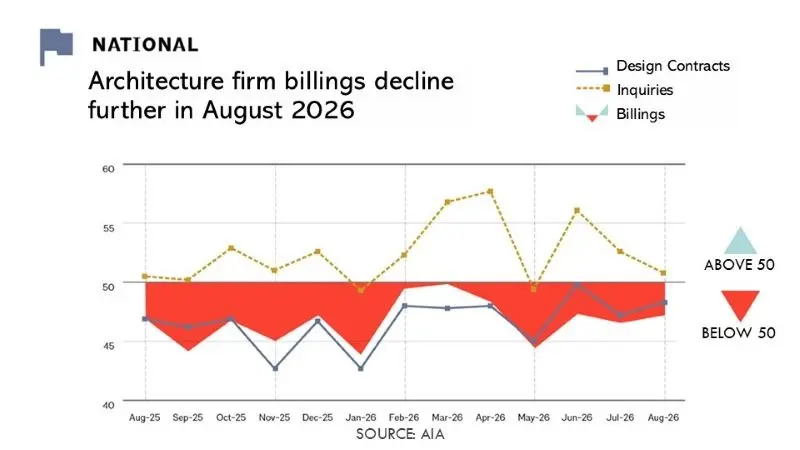
The architectural and nonresidential construction sectors in the United States continue to navigate a protracted period of economic adjustment, according to the latest data released by the American Institute of Architects (AIA) and Deltek. The Architecture Billings Index (ABI) for August 2026 registered at 47.2. While this figure represents a minor numerical improvement from July’s reading of 46.6, it remains firmly entrenched below the critical 50.0 benchmark.
In the architecture and construction industries, the ABI functions as a premier leading economic indicator, designed to forecast nonresidential construction activity roughly nine to 12 months into the future. Because design work precedes actual construction, movements in billings provide developers, contractors, and financial institutions with a vital window into future market conditions. A score above 50.0 denotes an increase in billings from the previous month, whereas a score below 50.0 indicates a contraction in business activity.
August marked yet another consecutive month where the majority of U.S. architecture firms experienced soft business conditions. Beneath the headline billings figure, ancillary metrics painted a similarly cautious picture. While inquiries into new prospective projects maintained modest growth, the actual value of newly signed design contracts continued to slip downward. Furthermore, forward-looking sentiment among firm leadership has noticeably soured as the industry prepares to enter the final quarter of the year.
Geographic and sector-specific bifurcations continue to define the current landscape. While firms in the Midwest achieved a brief respite with modest growth—their first in nearly a year—and Western firms held relatively steady, institutions in the Northeast suffered a steep decline. Similarly, while commercial and industrial practices experienced a slight uptick, multifamily residential and institutional specializations faced persistent headwinds, underscoring a fragmented recovery across the broader built environment.
Chronology: The Trajectory of the 2026 Architectural Market
To fully grasp the significance of the August 2026 ABI report, it is necessary to examine the timeline of economic shifts that have shaped the architecture and construction sectors over the past year, culminating in the current market environment.
Late 2025 to Early 2026: Lingering Stagnation
Entering the final months of 2025, commercial and industrial architecture billings had already experienced prolonged flatness, with many industry analysts noting that growth had effectively stalled for several years. When the AIA surveyed firm leaders at the conclusion of the first quarter of 2026, optimism—though guarded—remained relatively intact. Approximately 31% of responding firm leaders expressed confidence that billings would increase during the second quarter of the year, pointing to a resilient pipeline of commercial and infrastructure projects.
Spring to Summer 2026: Cracks in the Pipeline
As Q2 transitioned into Q3, optimism held surprisingly steady on paper. When surveyed regarding their expectations for the third quarter, 30% of firm leaders maintained that business conditions would improve. However, reality on the ground proved more challenging. July 2026 recorded an ABI score of 46.6, reflecting the cumulative weight of high borrowing costs, tighter lending standards for commercial real estate, and cautious corporate spending. Despite these contractionary figures, the broader labor market for architectural services showed moments of resilience; after shedding 100 positions in June, the sector rebounded slightly by adding 700 new jobs in July (the most current employment data available at the time of the August report).
August 2026: A Minor Rise, But Growing Pessimism for Q4
The release of the August 2026 data brought a headline score of 47.2—a fractional improvement over July, yet fundamentally indicative of ongoing contraction. More importantly, the survey revealed a distinct psychological shift among firm executives regarding the fourth quarter. Expectations for Q4 billings plummeted to just 25%, down significantly from the 30%+ optimism seen earlier in the year. Concurrently, the percentage of firm leaders anticipating a decline in billings in the coming quarter escalated from 21% at the close of Q1 to 29% by the end of August. This expanding gap between optimists and pessimists highlights a growing weariness within the design community as high interest rates and economic uncertainty continue to delay capital deployment.
Supporting Data and Deep-Dive Metrics
The Architecture Billings Index is calculated from a monthly panel of AIA member-owned architecture firms, measuring changes in billings for architectural services and project inquiries. A granular analysis of the August 2026 data reveals several distinct underlying trends across metrics, regional divisions, and firm specializations.
Component Metrics: Billings, Contracts, and Inquiries
- National Billings (47.2): Continuing a prolonged downward or flat trend, national billings remain below the growth threshold. Firms across the country report that clients are deliberately slowing down the progression of projects from the design phase to construction documents.
- Design Contracts: The value of newly signed design contracts continued to contract in August. This metric is particularly critical because it represents legally binding commitments between clients and architects, signaling that future cash flows for firms will likely remain constrained in the near term.
- Project Inquiries: Inquiries into new projects remain the sole bright spot among the core index components, showing modest positive growth. While potential clients are actively exploring future developments, the conversion rate from initial inquiry to signed contract has slowed considerably due to financing hurdles and budget re-evaluations.
Regional Disparities
Business conditions varied drastically depending on geographic location in August, illustrating a deeply uneven national economy:
- The Midwest: In a welcome surprise, firms located in the Midwest reported modest growth in billings for the first time in nearly a year. This uptick suggests localized industrial investments and public infrastructure spending may be beginning to take root in America’s heartland.
- The West: Architectural practices in the Western region reported essentially flat billings, reflecting a stabilization after months of fluctuating performance, though growth remained elusive.
- The Northeast: Conversely, firms in the Northeast experienced a sharp and painful softening of billings, driving regional activity down to its lowest level since the disruptive market shocks of 2020. High commercial real estate vacancy rates in major metropolitan hubs like New York and Boston continue to cast a long shadow over northeastern design work.
Firm Specializations
Specialization played a major role in determining which firms weathered August more successfully than others:
- Commercial and Industrial: Contrary to broader trends, firms specializing in commercial and industrial design saw a slight uptick in billings. Driven largely by ongoing demand for advanced manufacturing facilities, data centers, and select logistics hubs, this sector demonstrated notable resilience.
- Institutional and Multifamily Residential: While firms focusing on institutional projects (such as healthcare and education) and multifamily housing experienced brief periods of slight growth earlier in the year, business conditions for these specializations remained generally soft in August. High costs of capital for developers and tighter municipal budgets have delayed large-scale institutional expansions.
Official Responses and Industry Commentary
Representatives from the American Institute of Architects and associated economic analysts have emphasized the need for caution as the industry evaluates the trajectory of the remainder of 2026.
In official commentary accompanying the release, AIA spokespeople highlighted the widening divergence between client interest and actual project execution. While prospective clients continue to make inquiries—demonstrating a healthy long-term appetite for development—the reality of securing financing in a persistently restrictive monetary environment continues to put the brakes on project execution.
Industry economists note that the drop in Q4 billing expectations to 25%—paired with a jump in projected declines to 29%—suggests that business leaders are no longer banking on an imminent macroeconomic pivot. Instead, firms are actively restructuring operations, managing overhead, and preparing for a prolonged plateau in nonresidential construction demand.
Furthermore, workforce data highlights the delicate balancing act architecture firms must maintain. Despite consecutive months of weak billings, the sector added 700 jobs in July following a minor correction in June. This retention of skilled talent indicates that firm leaders are hesitant to shed valuable architectural staff—knowing firsthand the severe labor shortages that characterized previous expansionary cycles—even as current project pipelines shrink.
Implications for the Architecture, Engineering, and Construction (AEC) Sector
The implications of an August 2026 ABI score of 47.2 extend far beyond architecture firms, rippling across the entire Architecture, Engineering, and Construction (AEC) ecosystem.
1. Nonresidential Construction Slowdown Ahead
Because the ABI leads nonresidential construction spending by nine to 12 months, the persistent sub-50 readings throughout mid-2026 strongly signal that general contractors, subcontractors, and building product manufacturers will experience a cooling construction market well into 2027. Developers are expected to remain hyper-selective, prioritizing projects with guaranteed end-user demand or robust public-private backing while shelving speculative builds.
2. Supply Chain and Material Specifiers Under Pressure
For manufacturers of building materials—ranging from structural steel and commercial glass to interior finishes—the prolonged contraction in design contracts means fewer product specifications are being written into new blueprints. Companies supplying the commercial and industrial sectors may find relative stability, whereas those heavily reliant on multifamily residential or northeastern regional projects will likely experience softer order volumes.
3. Strategic Adaptation by Architecture Firms
To survive and thrive in a sub-50 ABI environment, architecture firms are increasingly diversifying their service offerings. Firms are leaning into adaptive reuse, sustainable energy retrofits, and technological integration (such as AI-driven design workflows and advanced BIM management) to capture revenue from existing building stock rather than relying solely on ground-up construction.
4. Labor Market Resilience vs. Margin Compression
The decision by architecture firms to hold onto professional staff—evidenced by the July employment gains—reflects a long-term strategic view. However, prolonged low billings inevitably compress profit margins. Firms will need to carefully balance labor retention against operational efficiency as they steer through what appears to be an extended plateau in design demand heading into 2027.
