

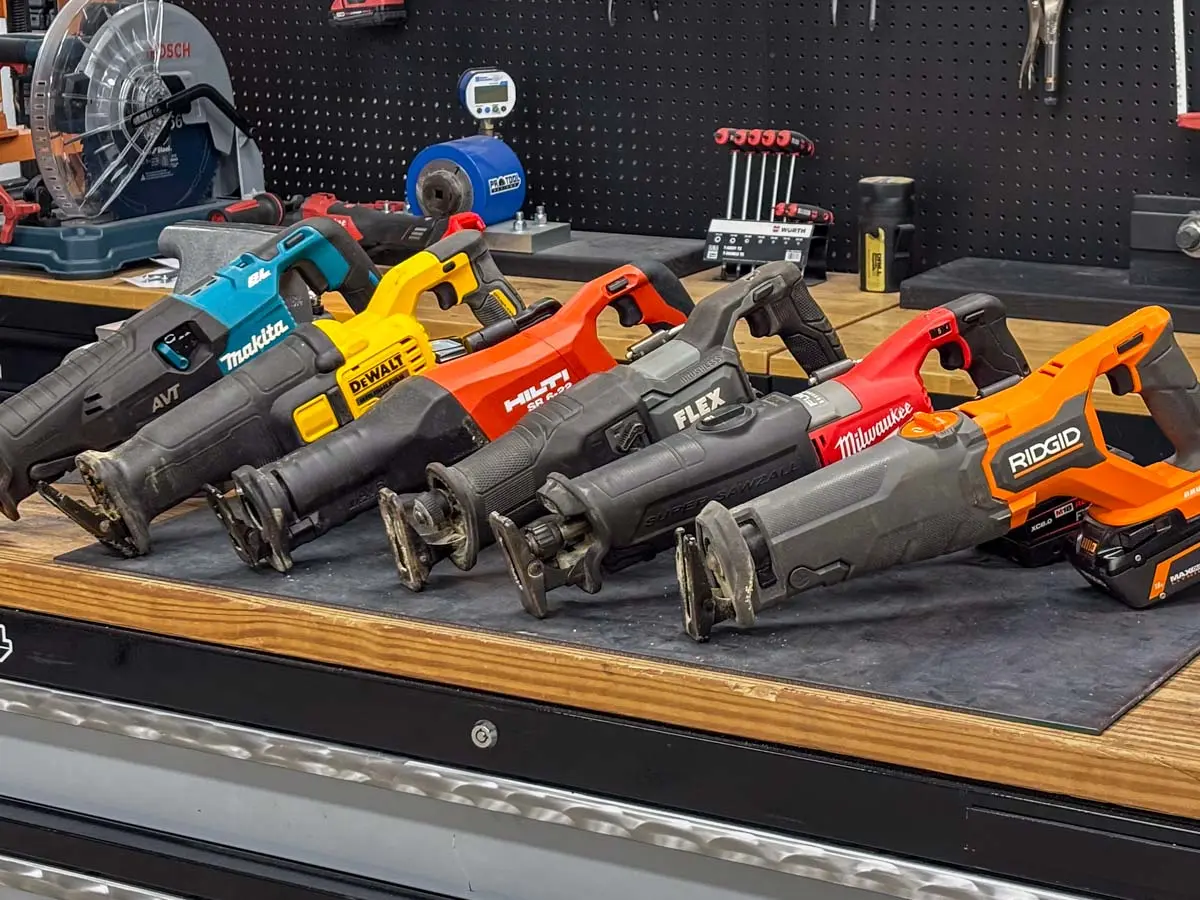
When trade professionals and DIYers read a head-to-head tool review, they see the final numbers: cutting speeds, runtimes, and podium finishes. However, a lot of meticulous science, physical endurance, and standardization happen behind the scenes before a single saw is crowned the winner.
While standard review formats are packed with vital specs, they often leave out the granular details of how and why those evaluations are conducted. This deep dive lifts the curtain on the testing protocols used by Pro Tool Reviews, offering a transparent look into the rigorous methodology behind our cordless reciprocating saw evaluations.
Main Facts: The Anatomy of a Reciprocating Saw Benchmark
Reciprocating saws—often colloquially referred to by the pioneering brand name "Sawzall"—are among the most brutal, versatile power tools on any job site. From gentle pruning to aggressive structural demolition, they endure extreme abuse. To evaluate them fairly, Pro Tool Reviews relies on a strict testing matrix designed to simulate real-world job site conditions while eliminating variables that could skew the data.
Core Testing Standards
- Max-Charge Consistency: Every test iteration begins with a battery freshly pulled off the charger. This provides each saw with an initial maximum charge boost before the battery settles into its nominal working voltage.
- Fresh Blade Lifecycle: Tests are initiated using brand-new blades. Because certain materials—particularly those cut with carbide-tipped teeth—actually become more efficient after the initial break-in period, this ensures every saw progresses through the exact same blade wear curve.
- Error Mitigation and Redos: Testing teams actively monitor for outlier results, material inconsistencies, and user error. If an anomaly occurs during a cut, the run is immediately discarded and repeated.
Chronology: The Evolution of a Test Rig
Designing a repeatable, objective testing process for reciprocating saws did not happen overnight. It is the result of years of refinement, shifting away from subjective "gut-feeling" reviews toward standardized, quantifiable metrics.
- Phase One (Subjective Era): Early tool testing relied heavily on freehand cutting through random scrap wood. While this gave a general impression of power, it lacked scientific repeatability. Different operators applied different downforce, leading to inconsistent data.
- Phase Two (Introduction of Mechanical Consistency): Testers introduced uniform dead-weights to control downforce. This removed human muscle fatigue and pressure variances from the equation, leveling the playing field for all competing brands.
- Phase Three (Multi-Material Simulators): Recognizing that real demolition is rarely homogeneous, reviewers developed composite test rigs—combining wood, nails, oriented strand board (OSB), and fiber-cement siding—to test saws under multi-density stress.
- Phase Four (Modern Benchmarking): Today’s protocol balances standardized mechanical rigs (for high-speed wood and PVC) with specialized freehand stress tests (like cast-iron pipe cutting) to mirror the exact demands modern contractors face in the field.
Supporting Data: The 5-Test Performance Battery
To evaluate a reciprocating saw comprehensively, Pro Tool Reviews subjects contenders to five distinct material tests, each targeting a specific operational capability.
1. PVC Pipe Cutting (Precision and Smoothness)
- The Material: 4-inch Schedule 40 PVC pipe.
- Why We Test It: While cutting plastic is relatively easy for modern saws, it is a daily task for plumbers, irrigation technicians, and facility maintenance crews.
- The Challenge: Saws with excessive vibration or aggressive, "always-on" orbital action struggle to make clean, accurate starts. This can leave jagged edges even when paired with high-tooth-count blades. Features like a soft-start mechanism become paramount here.
- The Method: Testers apply a 5 lb weight to maintain equal downforce, run the saw at maximum speed with orbital action turned off, and average the results across three runs.
2. Clean Wood Cutting (Pure Speed)
- The Material: 2 x 12 pressure-treated pine.
- The Challenge: While wider than standard wall studs, this lumber allows for longer, uninterrupted cuts, magnifying minute differences in cutting speed between competing models.
- The Method: Using the same 5 lb downforce weight, saws are operated at high speed with orbital action enabled (if available). Scores are derived from the average of three successful cuts.
3. Wall Demo Simulation (Real-World Multi-Density Stress)
- The Material: A specialized composite rig built from three horizontal 2 x 4 pine studs (each embedded with three framing nails, totaling nine nails per test), capped with a layer of 7/16-inch OSB sheathing and a layer of HardieBoard fiber-cement siding.
- The Challenge: Remodeling projects require cutting through mixed assemblies containing wood, fasteners, and abrasive masonry materials simultaneously.
- The Method: Horizontal stud orientation allows the application of the standard 5 lb weight. Saws run at high speed with orbital action active, and the final metric is an average of three cuts.
4. Cast Iron Pipe Cutting (Extreme Endurance)
- The Material: 3-inch cast iron pipe sourced from local suppliers.
- The Challenge: Remodeling older structures often forces contractors to cut cast iron—arguably the most punishing, fatiguing material a reciprocating saw can encounter.
- The Method: Because mechanical weighting cannot be safely or effectively applied to this heavy-duty freehand application, operators use whatever technique maximizes cutting speed in high-speed mode with orbital action turned off. Due to extreme physical fatigue, data is recorded from a single rigorous cut.
5. Vibration Analysis (Ergonomics and User Fatigue)
- The Metric: Evaluated on a 1-to-5 scale (1 being the lowest vibration, 5 being the highest).
- The Challenge: While laboratory-grade vibration sensors are ideal, field evaluations rely on extensive professional experience to gauge relative vibration levels. Crucially, vibration is measured during active cuts with the blade and shoe fully engaged, rather than under idle, no-load conditions.
Classifications: Testing Outside the Head-to-Head Arena
Not all reciprocating saws belong in the same weight class. The market is broadly segmented into three primary sizes—one-hand, mid-range, and high-performance—alongside niche compact models, categorized further into professional, prosumer, and DIY tiers.
Head-to-head reviews typically focus on high-performance professional and prosumer models. However, when evaluating saws outside this primary tier, Pro Tool Reviews applies an adaptive comparative approach:
- Benchmark Comparisons: Out-of-class or newly released saws are tested side-by-side with established benchmark models.
- Targeted Metrics: For instance, a fleet of one-hand compact saws might be timed cutting clean 2×4 studs to establish relative performance metrics.
- Transparent Reporting: Review disclosures explicitly state the exact blades used, materials cut, and baseline comparisons so readers can contextualize the results.
Implications: What This Means for Contractors and DIYers
Understanding the methodology behind tool testing transforms how consumers shop for equipment. A saw that wins a speed test on clean pine might rank poorly in a vibration assessment, making it a liability for all-day demolition work.
By standardizing battery voltage, blade wear progression, and downforce mechanics, Pro Tool Reviews strips away marketing hype. For the professional contractor, this data ensures that tool investments translate to real-world job site efficiency, reduced operator fatigue, and long-term durability. Whether you are slicing through thick cast iron or making delicate plunge cuts in PVC, knowing how the tool earned its score gives you the confidence to choose the right implement for the job.
