


By Investigative & Industry Reporting Desk
Special Commentary Integration by Trevor Vick, CEO of UMIP
1. Main Facts: The Manhattan Collapse and the Crisis of Continuity
When two massive steel columns buckled on the 21st floor of a prominent Manhattan construction project this July, the structural safety industry witnessed the unfolding of a frighteningly familiar sequence of events. Emergency responders, municipal engineers, and independent forensic investigators scrambled to reconstruct the timeline of what went wrong inside the 37-story high-rise.
The building was undergoing a massive, high-stakes adaptive reuse project—a modern trend converting aging commercial office space into more than 1,600 luxury residential apartments. Yet, as engineers picked through the debris and digital schematics, they were forced to issue a sobering warning: visible damage rarely marks the full extent of structural failure. In high-rise engineering, major structural elements are deeply and inextricably interconnected. A catastrophic failure in one concentrated zone almost invariably signals hidden, systemic stress elsewhere throughout the frame.
Early forensic accounts traced the root cause of the buckling to a glaring omission: a missing steel reinforcement plate. According to engineering reports cited by The Real Deal, this critical structural detail was supposed to be integrated into the project’s engineering blueprints, but it was never physically bolted or welded to the columns.
To the untrained observer, this looks like a simple documentation failure—a drafting error or a miscommunication on the floor. But according to infrastructure identity experts, dismissing this as a mere paperwork mistake profoundly misses the point. The tower’s documentation didn’t strictly fail; rather, it suffered from a fatal lack of continuity.
Every renovation, every building code cycle, and every material alteration over the decades was tied strictly to whatever isolated software system, independent contractor, or individual employee happened to be tracking it at the moment the work occurred. When those professional links inevitably broke, the connective tissue of the asset’s entire operational history shattered right along with them.
The missing layer in modern real estate and construction isn’t another digital document repository, a larger cloud folder, or a more expensive enterprise software suite. What is fundamentally missing is a persistent, immutable history of the physical structure—a unifying thread that connects every record, inspection, municipal permit, renovation, owner, engineer, and software platform back to the exact same physical asset across its entire multi-decade lifecycle.
2. Chronology of a Vulnerability: From Blueprint to Collapse
To understand how a multi-million-dollar modern construction project can suffer from missing structural reinforcement plates, one must examine the fragmented timeline of a building’s lifespan.
- Phase 1: Initial Construction and Early Operations. The 37-story tower was originally erected decades ago under a specific set of architectural and structural standards. During this phase, blueprints were drafted, physical sign-offs were recorded on paper, and the building functioned strictly as intended—an office hub.
- Phase 2: Decades of Alterations and Code Shifts. Over the span of 30 to 40 years, the building underwent dozens of minor tenant improvements, HVAC overhauls, and localized structural adjustments. Each project was handled by different architectural firms, engineering consultants, and general contractors. Each generation used proprietary software platforms, localized servers, and paper filing systems.
- Phase 3: The Adaptive Reuse Pivot. Facing declining commercial real estate demand, developers initiated a massive adaptive reuse project to convert the tower into residential apartments. Engineers and architects pulled legacy documents to evaluate load-bearing capacities. However, because historical modifications were siloed across different vendors and software formats, crucial structural evolution details—such as the loads added during a 1990s HVAC retrofit or a 2000s partition wall shift—remained obscure.
- Phase 4: The July Failure. During heavy construction activity associated with the residential conversion, structural loads shifted unexpectedly. Without the crucial, missing steel reinforcement plate on the 21st floor—an omission unflagged because historical oversight was fragmented—the steel columns buckled under the unmodeled stress.
- Phase 5: The Forensic Scramble. Investigators rushed to piece together the building’s history, discovering that piecing together a modern high-rise’s past is akin to doing archaeological excavation rather than querying a reliable database.
3. Supporting Data: The Looming Institutional Memory Drain
The vulnerabilities exposed in Manhattan are not isolated anomalies; they represent a systemic ticking clock for the global built environment.
Document management systems excel at answering one basic question: What digital files or paper records currently exist in our filing cabinets or cloud servers? However, they are entirely incapable of answering the far more critical operational question: What has physically happened to this specific asset across its entire operating life?
This disconnect is severely exacerbated by human capital trends. According to industry analyses from the Continuity Insights Management Conference, decades of undocumented building knowledge are routinely lost as veteran facility managers, senior engineers, and project leads retire, change jobs, or transition out of the industry. Operating history is locked inside the human brain rather than securely anchored to a persistent infrastructure system.
This problem is compounded by demographic shifts highlighted by the International Facility Management Association (IFMA):
- Over 45% of all facility management professionals worldwide are projected to retire within the next decade.
- This massive wave of departures will stress-test how effectively institutional memory can survive extreme personnel turnover.
Trevor Vick, CEO of UMIP, points out that this is fundamentally the exact same systemic failure viewed through two different lenses:
- The Human Lens: A retiring senior engineer walks out the door taking decades of undocumented, tribal building knowledge with them.
- The Digital Lens: A corporate document repository sits paralyzed, unable to accurately inform stakeholders what a complex structural frame can or cannot support after 50 years of undocumented alterations.
The root cause is identical in both scenarios: Nothing in current industry systems persistently follows the physical asset itself. The record lives with the software vendor, the third-party consulting firm, or the individual employee—it never permanently belongs to the infrastructure.
4. Official Responses and Industry Insights
In the wake of the Manhattan incident, municipal building safety regulators, structural engineering associations, and insurance underwriters have intensified scrutiny over how adaptive reuse projects are vetted.
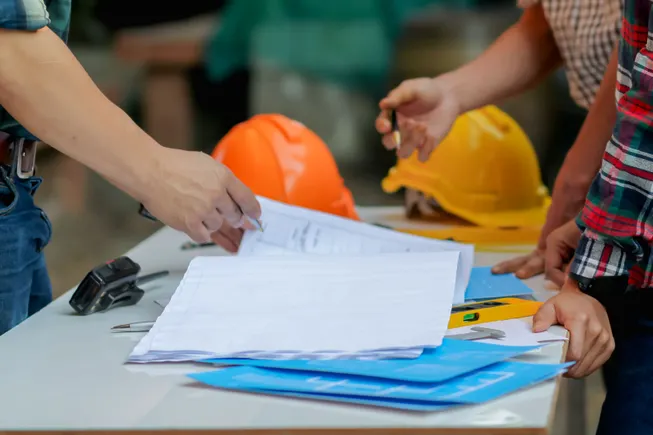
The New York City Department of Buildings (DOB) launched sweeping safety checks across major high-rise conversion sites citywide, aiming to root out latent structural deficiencies before they manifest as catastrophic failures. Regulators are increasingly questioning whether current permitting processes adequately account for the cumulative weight of historical modifications.
What Emergency Response Actually Requires
When a structural failure occurs, the stakes elevate instantly. In post-incident scenarios, structural engineers, forensic investigators, and insurance adjusters are not simply looking for a neat folder of initial architectural drawings. They require a reliable, continuous, and verifiable chain of custody for every single material change made to the structure over its lifespan.
Investigators must be able to trace every modification back to:
- Exactly who made the change.
- The precise date the modification occurred.
- The specific building code cycle in effect at that moment.
A static binder handed off during a property turnover or a legacy PDF stored on an outdated server cannot provide this level of forensic clarity.
Instead, emergency responders and asset managers need something equivalent to a Vehicle Identification Number (VIN) for physical infrastructure—a persistent, unalterable identifier that every contractor, engineering firm, municipal permitting office, and software platform can reference over decades. Think of it as a Carfax Vehicle History Report built specifically for commercial real estate and major civil infrastructure.
5. Implications: The Missing Layer the Industry Never Standardized
Over the past several decades, the global built environment has methodically standardized layer after layer of how infrastructure is designed, built, and managed:
- CAD standardized digital design and drafting.
- BIM (Building Information Modeling) standardized rich spatial information.
- GIS standardized global location tracking.
- IFC (Industry Foundation Classes) standardized cross-platform interoperability.
- Digital Twins standardized real-time digital representation.
- Artificial Intelligence (AI) is now beginning to standardize predictive intelligence.
Yet, despite these monumental technological leaps, none of these layers ever standardized a structure’s history and identity.
There is currently no universal, persistent, portable reference that follows a piece of infrastructure across every one of these software systems throughout its entire operational lifecycle. Each new generation of proptech and contech platforms has vastly improved how information about an asset is captured, but none have successfully solved what happens to that information once the platform, the vendor, or the original employee moves on.
A digital twin of a building cannot remain accurate or continuous if the core identity of the physical asset it represents is broken or fractured.
Interoperability vs. Identity
There is a vital distinction that the construction and real estate sectors must recognize:
- Interoperability tells disparate software systems how to exchange information.
- Identity tells those same systems what they are exchanging information about.
The global built environment has spent the last 50 years perfecting interoperability while leaving identity essentially unaddressed.
Conclusion: Asking a Better Question
The Manhattan adaptive reuse conversion serves as an invaluable wake-up call—not because a single document failed at a single point in time, but because the continuity of the building’s documentation and identity likely disintegrated across a multi-decade history of continuous changes.
The most productive question for the future of construction and real estate is not simply how thoroughly a new building gets documented on day one. The real question is: Why does so little of our critical infrastructure carry a persistent, unalterable identity across decades of ownership changes, complex renovations, and inevitable software migrations?
The built world has successfully standardized nearly every way information is created, exchanged, and analyzed. The next great industry standard will not be another proprietary data format or another cloud storage repository.
The future standard will be the persistent tracking of a structure’s true identity and history, ensuring that the physical asset and its digital footprint remain inseparable from foundation to demolition.
