


By Blake Stimac
Published: Tech & Innovation Desk
Main Facts: The Unveiling of Solaris
In a major leap forward for artificial intelligence and user experience design, AI pioneer Runway has officially unveiled a breakthrough architecture known as an interface world model. Named Solaris and announced on Monday, this novel system allows users to create interactive websites, applications, and dynamic digital environments simply by directly interfacing with elements on a screen—completely eliminating the need for hard programming knowledge.
Unlike traditional software development or the recently popularized trend of "vibe coding"—where users prompt large language models to write lines of backend code—Solaris operates on an entirely different paradigm. It is a live-rendering, real-time AI engine that generates functional, highly responsive interfaces frame by frame. By marrying advanced machine reasoning with cutting-edge visual rendering, Solaris blurs the line between viewing static media and interacting with live software, opening up a staggering array of design possibilities for creators, non-coders, and enterprises alike.
Chronology: The Journey to Interface World Models
To understand the significance of Solaris, it is necessary to trace the rapid evolution of generative AI over the past several years.
1. The Era of Text-to-Image and Large Language Models (2022–2023)
The generative AI boom kicked off with text-to-image generators (like Midjourney and Stable Diffusion) and text-based conversational models (such as OpenAI’s ChatGPT). While revolutionary, these tools operated in silos. LLMs generated text and code, while image generators produced static visuals. Building an interactive application still required human developers to stitch these assets together using traditional programming languages like HTML, CSS, JavaScript, or Python.
2. The Rise of "Vibe Coding" (2024–Early 2025)
As AI coding assistants became more sophisticated, tech circles embraced "vibe coding." Users could describe an app in plain English, and the AI would write the code, manage dependencies, and deploy it. While this democratized software creation to an extent, it remained fundamentally tethered to the underlying architecture of code syntax, debugging errors, and text-based iteration.

3. The Shift to World Models (Late 2024–Present)
AI researchers quickly realized that the next frontier of artificial intelligence lay in "world models"—systems designed not just to mimic text or generate isolated images, but to simulate physical and digital physics, reasoning through how environments change over time. Companies began building models capable of predicting video frames and spatial dynamics.
4. The Arrival of Solaris (Monday Announcement)
Building upon its legacy in video generation (such as the Gen-3 Alpha model), Runway bridged the gap between video simulation and interactive software. On Monday, Runway introduced Solaris, an interface world model that treats user inputs—such as clicks, drags, and text prompts—as real-time conditioning signals to render interactive applications on the fly.
Supporting Data: How Solaris Works Under the Hood
The technical ingenuity behind Solaris lies in its dual-engine architecture: a seamless fusion of machine reasoning and neural rendering.
- Frame-by-Frame Generation: Unlike conventional web applications that rely on pre-compiled code and vector graphics, Solaris generates digital environments visually, frame by frame, in real time.
- The Language Model Bridge: While the rendering engine handles the visual physics and spatial transformations, an integrated large language model operates in the background, determining how the interface should evolve based on user actions.
- Conditioning Signals: When a user clicks, drags, or resizes an element on screen, Solaris interprets these physical gestures as "conditioning signals." The model immediately calculates the new state of the environment and generates the subsequent frames to reflect that interaction.
- Livestream Simulation: The end result feels less like navigating a traditional website and more like interacting with a live-streaming video feed that dynamically mutates, updates, and responds to your exact touch or cursor movement.
Runway’s demonstrations highlight the sheer versatility of this mechanism. In one use case, a user uploads a reference photo of themselves to simulate a virtual clothing store. Instead of navigating drop-down menus or sizing charts, the user simply clicks on a shirt hanging on a digital rack and drags it directly onto their onscreen reference image. Solaris instantly renders the garment wrapping around the user’s likeness, accounting for fit, draping, and lighting.
Beyond drag-and-drop actions, users can issue natural language text prompts to fine-tune the environment—such as commanding the model to change the color of a specific object, rearrange furniture in a virtual room, or teleport an element to a different coordinate within the frame.
Official Responses and Industry Context
As of press time, Runway has maintained a measured public posture regarding the rollout of Solaris. The company’s official announcement outlines the research philosophy behind the model, emphasizing a future where human-computer interaction is driven by intuition rather than syntax.
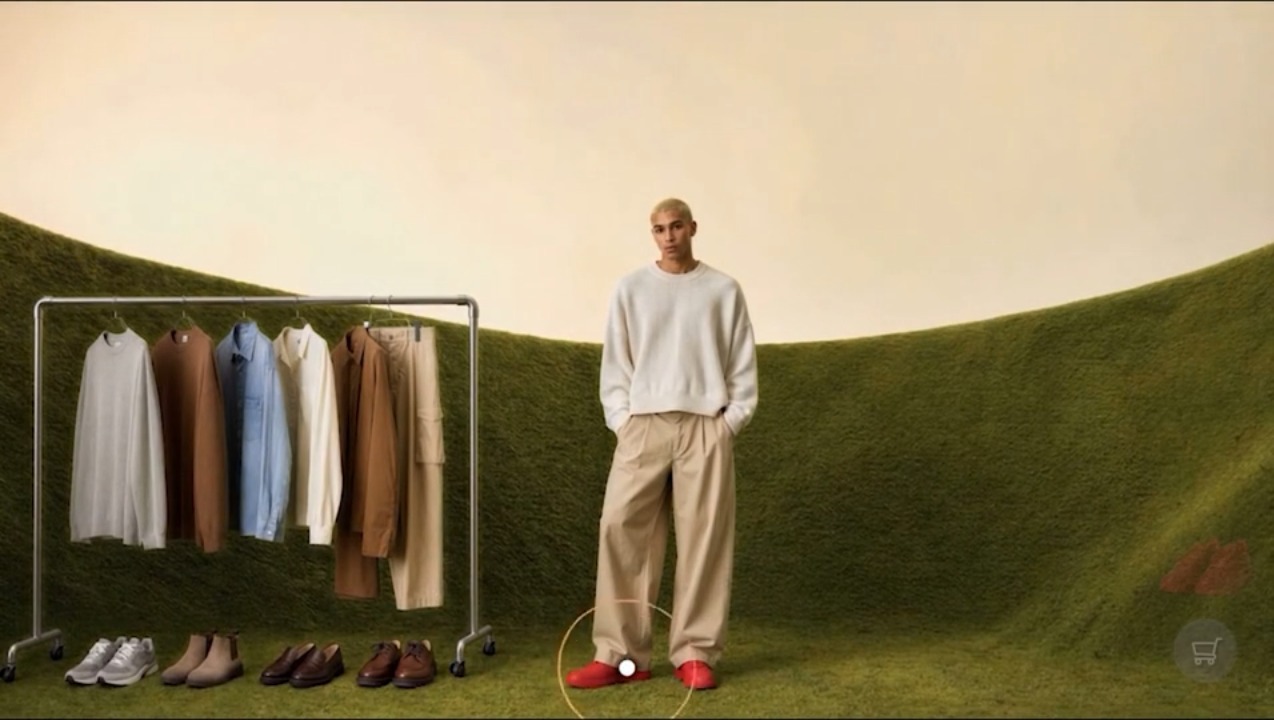
However, when pressed on commercial availability, Runway did not specify when Solaris would be made available to customers, nor did representatives immediately respond to requests for comment from major tech publications.
Industry analysts note that this cautious approach is standard practice for Runway and other frontier AI labs. Because real-time frame generation and spatial reasoning demand immense computational power—often requiring clusters of specialized GPUs—scaling such a model for public consumption involves significant infrastructure hurdles and latency management.
Despite the lack of a concrete release date, the tech community has reacted with a mixture of awe and speculation. Competitors in the UI/UX and spatial computing spaces are closely watching how Runway plans to commercialize the technology, especially as tech giants like Google and Apple continue to experiment with their own computer-vision and virtual-try-on systems.
Implications: A New Frontier for Design and Beyond
The introduction of Solaris carries profound implications across multiple industries, signaling a paradigm shift in how humans build, design, and consume digital media.
1. The Democratization of Design
For decades, bringing a digital product to life required mastering complex toolchains—from Adobe Creative Suite and Figma to full-stack programming frameworks. Solaris points toward a future of effortless design. If an AI can generate fully functional, interactive interfaces purely through visual demonstration and natural language, the barrier to entry for app creation, web design, and digital prototyping drops to near zero. Anyone with an idea will be able to "paint" an application into existence.
2. Redefining E-Commerce and Retail
The virtual try-on demonstration hints at a massive disruption in online shopping. Current solutions—such as Google’s AI clothing features—often rely on algorithmic overlays that can appear static, rigid, or computationally disjointed. An interface world model like Solaris offers a fluid, hyper-realistic shopping experience where garments respond dynamically to user interaction, potentially slashing return rates and transforming digital storefronts into immersive simulation spaces.

3. The Evolution of Software Engineering
While traditional software engineering will not disappear overnight, the nature of coding is evolving. As AI models transition from writing text-based code to rendering functional applications visually, the value of human labor may shift away from syntax and debugging toward conceptual architecture, user experience direction, and prompt choreography.
4. Broader Horizons for World Models
Beyond user interfaces, the underlying technology of Solaris represents a stepping stone toward generalized world models. These systems are ultimately designed to understand, translate, and transform not just digital pixels, but our physical reality. As world models mature, the boundary between the physical world and simulated environments will continue to blur, paving the way for advancements in robotics, autonomous systems, and mixed-reality computing.
Looking Ahead
Whether Solaris becomes a commercially viable mainstream tool or remains a groundbreaking research prototype, it has successfully redefined our expectations of what AI-driven interfaces can achieve. As we await further word from Runway regarding availability, one thing is certain: the era of static websites and rigid software interfaces is rapidly drawing to a close.
