By Stevie Bonifield Consumer Tech & Hardware Correspondent
Main Facts: What is John Deere’s "JD" AI Assistant?
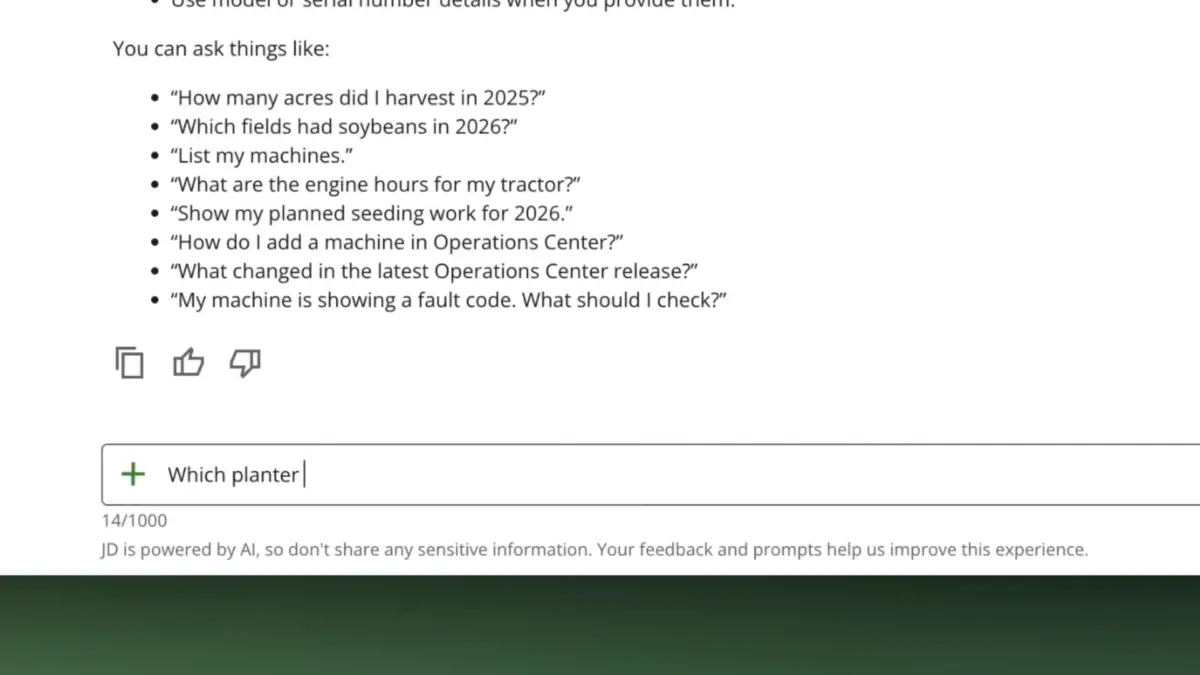
Agricultural machinery giant John Deere has officially launched an Early Access Program for a new generative artificial intelligence platform, internally and publicly referred to as the “JD” AI assistant. Designed to function as an all-encompassing operational advisor for modern farmers, the tool leverages proprietary field, machine, and operational data to help agricultural producers maximize their profitability, optimize fuel efficiency, and determine precise harvest windows.
The AI assistant integrates directly into the existing John Deere Operations Center, currently rolling out to a select group of pilot users in the United States. While John Deere’s initial press releases have closely guarded the identity of the underlying foundational model powering the software, the company has laid out ambitious roadmaps for its deployment. Following the initial web- and mobile-based testing phases, John Deere plans to embed the AI assistant directly into the in-cab display units of tractors, combines, and heavy machinery. Furthermore, the agricultural titan intends to expand the tool’s specialized capabilities beyond traditional farming into adjacent sectors, including turf care, construction, roadbuilding, and forestry.
However, introducing an artificial intelligence model that relies heavily on intimate farm telemetry arrives with significant baggage. In light of historical industry friction regarding digital rights, proprietary software locks, and federal regulatory pressure—most notably protracted legal battles with the Federal Trade Commission (FTC) and disgruntled farmers over the "Right to Repair"—John Deere has coupled the launch of the JD AI assistant with a strict, newly emphasized 10-point Farmer Data Commitment.
This foundational pledge attempts to reassure agricultural producers that their proprietary metrics, crop yields, and equipment diagnostics will not be commercialized, traded, or exploited without explicit consent.
Chronology: The Road to AI Integration and Digital Friction
To understand the strategic significance of John Deere introducing an AI assistant, it is necessary to examine the timeline of how the company transformed from a traditional mechanical manufacturer into a data-driven ag-tech conglomerate, as well as the friction that accompanied that shift.
The Precision Agriculture Boom (2010s): John Deere pivots heavily toward smart farming, outfitting tractors, sprayers, and combines with advanced GPS, telematics, and sensors. These tools begin collecting massive streams of real-time agronomic and mechanical data, laying the groundwork for future cloud-based services.
The Rise of the Operations Center: The John Deere Operations Center becomes the centralized digital hub for farmers to monitor fleet health, map fields, and analyze crop performance. However, critics and farmers grow increasingly concerned about data ownership, cloud lock-in, and the inability to service their own machinery.
The Right to Repair Battles (2020–2023): Farmers, independent mechanics, and consumer advocacy groups file class-action lawsuits and petition the FTC, arguing that John Deere’s software restrictions prevent owners from repairing their own tractors. The FTC applies mounting pressure, forcing equipment manufacturers to re-evaluate their software policies.
Memorandums of Understanding (2023–2024): John Deere signs memorandums of understanding (MOUs) with organizations like the American Farm Bureau Federation, promising to ensure farmers have access to diagnostic tools and documentation. Trust, nevertheless, remains fragile as machinery becomes increasingly software-dependent.
The Unveiling of "JD" AI (Late 2025 – Early 2026): John Deere announces the Early Access Program for its JD AI assistant. Recognizing deep-seated grower skepticism regarding data privacy, the company proactively launches its updated 10-point Farmer Data Commitment alongside the tool’s debut.
The Rollout Phase (Present): Select US customers test the AI assistant via the Operations Center web and mobile portals. Future development targets in-cab tractor screen integrations and multi-industry expansions into forestry and construction.
Supporting Data: The 10-Point Farmer Data Commitment
The introduction of generative AI into agriculture introduces profound questions regarding data governance. Because large language models require vast datasets to deliver tailored, context-aware insights, farmers naturally worry that their proprietary yield data could be commodified or used to influence agricultural markets.
To preemptively counter these anxieties, John Deere’s Early Access rollout is anchored by a formal 10-point governance framework. The commitments outlined by the company are designed to establish clear boundaries between helpful operational insights and corporate data harvesting:
Absolute Data Control: Farmers retain sovereign control over their farm data.
No Data Sales: John Deere explicitly states it does not sell raw farm data to third parties.
Transparent Usage Policies: Data will only be utilized as detailed in official agreements, with clear, advance communication regarding any policy modifications.
Dealer and Partner Accountability: John Deere mandates that affiliated dealers and connected ecosystem partners adhere to the same transparent data handling practices.
Measurable Value Generation: Farm data—alongside aggregated, anonymized metrics—will be used strictly to enhance machine performance and provide actionable decision-making insights for the grower.
Third-Party Sharing Discretion: Producers have the autonomy to choose which external entities, if any, receive access to their operational data.
Instant Opt-Out Capabilities: Farmers retain the technical freedom to sever the flow of data to third-party integrations at any moment.
Prohibition on Commodity Trading: John Deere explicitly pledges not to use farm telemetry for agricultural commodity trading, futures speculation, or market forecasting.
Clear Return on Investment (ROI): Growers should derive tangible financial and operational value from sharing their data with John Deere ecosystems.
Continuous Adaptation: The company commits to ongoing dialogue with agricultural producers, refining its data practices to match the evolving needs of the farming community.
Official Responses and Industry Reception
Reactions from the agricultural community and industry analysts to the JD AI assistant are a mixture of technological optimism and cautious skepticism.
From a technological standpoint, proponents point out that modern farming is a high-stakes, data-heavy enterprise. Agricultural producers must manage volatile input costs—ranging from diesel and fertilizers to seeds and pesticides—while battling unpredictable weather patterns and supply chain disruptions. An AI assistant capable of instantly parsing historical equipment telemetry to recommend optimal engine timing, precise fertilizer application rates, or ideal harvesting days could save individual operations tens of thousands of dollars annually.
However, the shadow of past regulatory battles looms large. Agricultural advocates and digital rights organizations have noted that trust cannot be restored through a press release alone. Speaking anonymously due to ongoing commercial relationships with equipment suppliers, several members of regional farming cooperatives expressed a desire to see independent audits of John Deere’s cloud infrastructure.
"We want smarter machines, and nobody turns down tools that increase profit margins," noted a representative from a Midwest agricultural advocacy network. "At the same time, when a tractor manufacturer controls the software, the hardware, and now the AI advising you on when to sell your crop, the power dynamic is inherently lopsided. The 10-point commitment is a step in the right direction, but enforcement and transparency will dictate whether farmers trust it."
John Deere executives, meanwhile, maintain that the AI assistant is fundamentally designed as an empowering tool rather than a surveillance mechanism. By keeping the insights hyper-localized to the individual farm and utilizing anonymized, aggregated pools for broader macroeconomic machine improvements, the company hopes to prove that digital innovation and data privacy can coexist.
Implications: The Future of Smart Farming and AI
The deployment of the JD AI assistant marks a watershed moment not just for John Deere, but for the broader ag-tech sector. As artificial intelligence rapidly permeates heavy industry, agriculture is emerging as one of the most compelling testing grounds for localized, high-stakes enterprise AI.
As the JD AI assistant transitions from web dashboards and mobile screens into in-cab tractor displays, it will fundamentally change how day-to-day decisions are made in the field. Rather than poring over dense spreadsheets or calling agronomists for delayed consultations, operators will be able to converse naturally with their equipment. Questions such as, "Why is this specific combine burning 15% more fuel than it did yesterday across the north ridge?" or "Based on moisture levels and upcoming rain forecasts, should we push harvest up by 48 hours?" can be answered instantaneously using local telemetry.
2. The Trust Economy in Ag-Tech
John Deere’s pivot highlights a critical reality for modern technology companies: hardware sales are increasingly tethered to software trust. Following years of acrimony over repair restrictions, the company cannot afford a parallel consumer backlash regarding AI data privacy. If John Deere successfully builds trust through its 10-point commitment, it could establish a golden standard for how industrial conglomerates handle proprietary user data. Conversely, any security lapse or perceived breach of data sovereignty could trigger fresh regulatory scrutiny from the FTC and accelerate the adoption of open-source or independent agricultural software alternatives.
3. Cross-Industry Expansion
While farming is the initial proving ground, John Deere’s stated intention to scale the AI assistant into turf care, construction, roadbuilding, and forestry signals a broader corporate strategy. Heavy machinery across all these sectors faces identical operational challenges: high equipment maintenance costs, severe labor shortages, and razor-thin profit margins. If the "JD" AI model proves successful in optimizing crop yields and diesel consumption, it could easily be adapted to coordinate fleet management for commercial construction crews or timber harvesting operations.
Ultimately, the success of John Deere’s AI initiative will not be measured solely by the sophistication of its underlying algorithms or the smoothness of its interface. It will be determined by whether the agricultural community believes the company has truly shifted from locking down their machinery to genuinely empowering their businesses.