

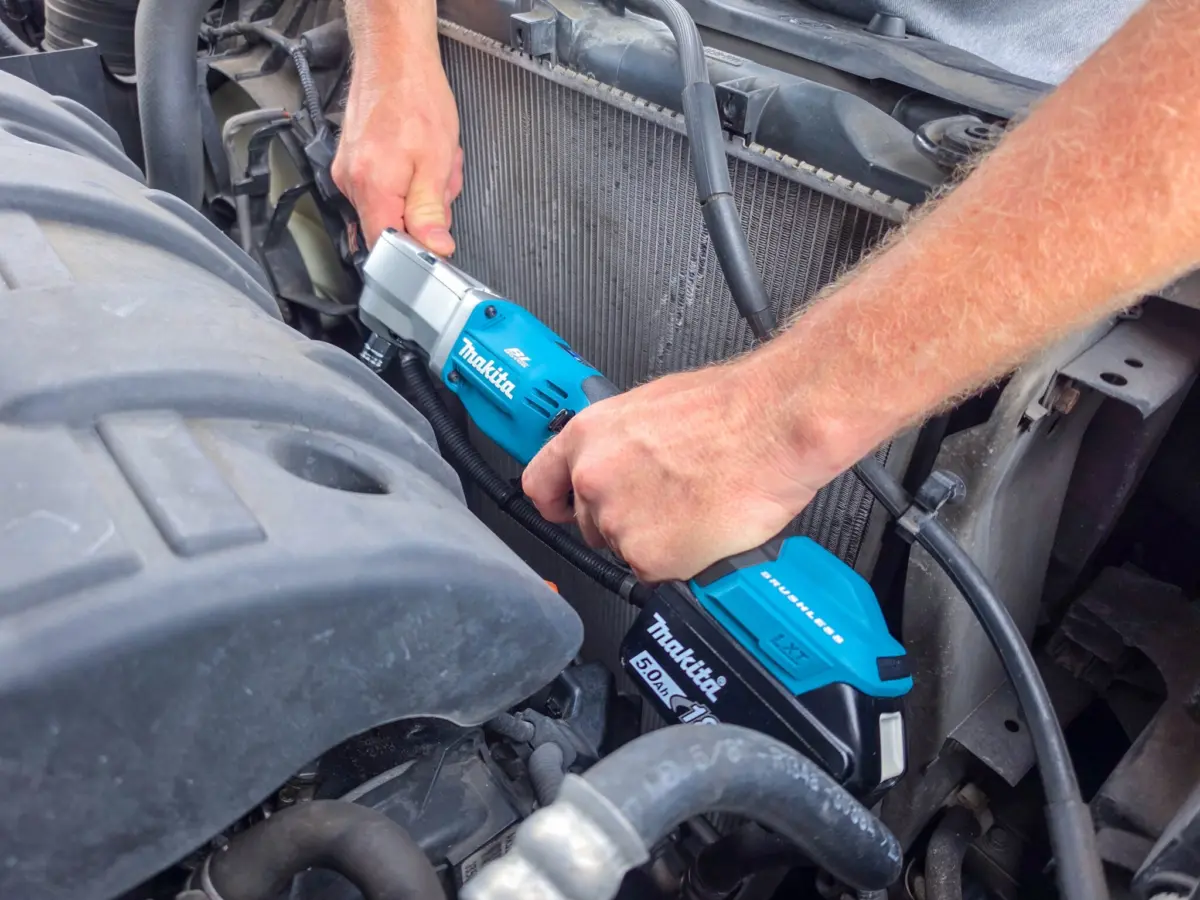
Right-angle impact wrenches have long occupied a unique and essential niche within the professional cordless tool ecosystem. Striking a fine balance between spatial accessibility and brute mechanical force, these specialized tools offer technicians and tradespeople something neither traditional impact wrenches nor standard manual ratchets can deliver on their own. They provide significantly more muscle than a hand ratchet while fitting into spaces that would stop a standard pistol-grip impact driver dead in its tracks.
Makita has long been a dominant force in the cordless power tool market, known for engineering reliable, high-performance equipment tailored to professional job sites and automotive shops. With the introduction of the Makita 18V LXT XLT03 Right-Angle Impact Wrench, the manufacturer takes that established concept and pushes it forward. Featuring an advanced brushless motor, high-speed output, and intelligent electronic safeguards, the XLT03 aims to redefine what mechanics can expect from a 90-degree fastening tool.
To help professionals determine whether this heavy-duty driver deserves a spot in their toolbox, we put the XLT03 through rigorous hands-on testing, evaluating everything from raw power and speed to vibration control and ergonomics.
Main Facts: At a Glance
The Makita 18V LXT XLT03 is a specialized right-angle impact wrench engineered primarily for automotive technicians, heavy-equipment mechanics, and industrial maintenance professionals.
- Core Motor: High-efficiency brushless motor
- Anvil Size: 3/8-inch standard (also available with a 1/2-inch friction ring and pin detent anvil)
- Maximum Speed: Up to 3,200 RPM
- Maximum Impact Rate: Up to 4,000 IPM
- Performance Metrics: 250 ft-lbs of fastening torque and 390 ft-lbs of breakaway torque
- Pricing & Availability: Retails for $279 as a bare tool, backed by a 3-year limited manufacturer’s warranty
Unlike low-torque cordless ratchets designed merely for spinning fasteners on and off under low resistance, the XLT03 is a true impact wrench built to tackle stubborn, frozen, or overtightened bolts in confined areas.
Chronology of Development and Testing
The evolution of right-angle fastening tools has been driven by the increasing complexity of modern engine bays and industrial machinery. As component density increases, automotive engineers pack more parts into tighter spaces, leaving technicians with minimal clearance to maneuver standard tools.
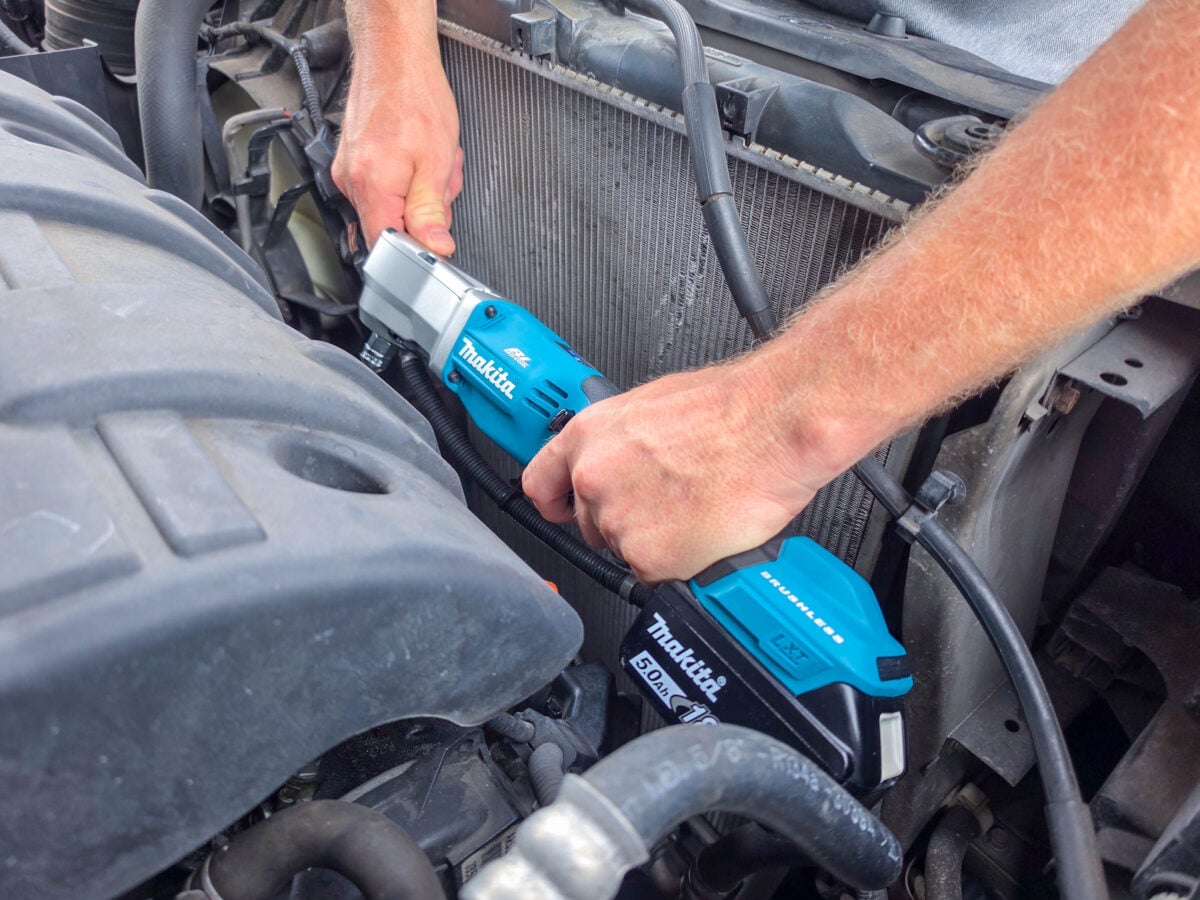
Historically, mechanics relied on pneumatic right-angle impacts or manual ratchets paired with extension bars and universal joints—methods that often led to lost power, rounded bolt heads, and hand fatigue. The shift toward high-voltage cordless platforms over the past decade opened the door for battery-powered alternatives that matched or exceeded pneumatic performance without the tether of an air hose.
Recognizing the demand for a heavy-duty, high-speed cordless solution within its massive 18V LXT ecosystem, Makita engineered the XLT03. Following its initial announcement and rollout to industrial distributors, we secured a production model to subject it to standardized field evaluations.
Our testing process included timing fastener removal on a calibrated bolt-break rig, measuring vibration feedback during prolonged operations, and evaluating the precision of its electronic auto-stop features under realistic shop conditions.
Power and Performance: Speed Meets Muscle
At the heart of the Makita XLT03 is an advanced brushless motor that drives a 3/8-inch anvil with staggering velocity. The tool boasts a maximum speed of 3,200 RPM and an impact rate reaching 4,000 IPM. More importantly, it churns out 250 ft-lbs of fastening torque and an impressive 390 ft-lbs of breakaway torque.
This performance profile places the XLT03 in a unique category. To understand how it stacks up against competing models in the professional space, we can examine its multi-mode performance data alongside comparable tools like the Milwaukee M12 FUEL Right-Angle Impact Wrench:
| Performance Metric | Makita 18V LXT XLT03 | Milwaukee M12 FUEL (Model 2564) |
|---|---|---|
| Speed – Mode 1 | 1,000 RPM | 1,550 RPM |
| Speed – Mode 2 | 1,500 RPM | 2,300 RPM |
| Speed – Mode 3 | 3,200 RPM | 3,000 RPM |
| Impact Rate – Mode 1 | 1,800 IPM | 1,350 IPM |
| Impact Rate – Mode 2 | 2,800 IPM | 2,700 IPM |
| Impact Rate – Mode 3 | 4,000 IPM | 3,600 IPM |
Interestingly, Makita’s rotational speed numbers outpace many traditional mid-torque impact wrenches on the market. While its raw fastening torque specs are intentionally calibrated lower to maintain structural safety in tight configurations, the immense speed is a massive asset. It allows users to rapidly run down long bolts or quickly thread fasteners in awkward, restricted orientations.
Hands-On Stress Testing
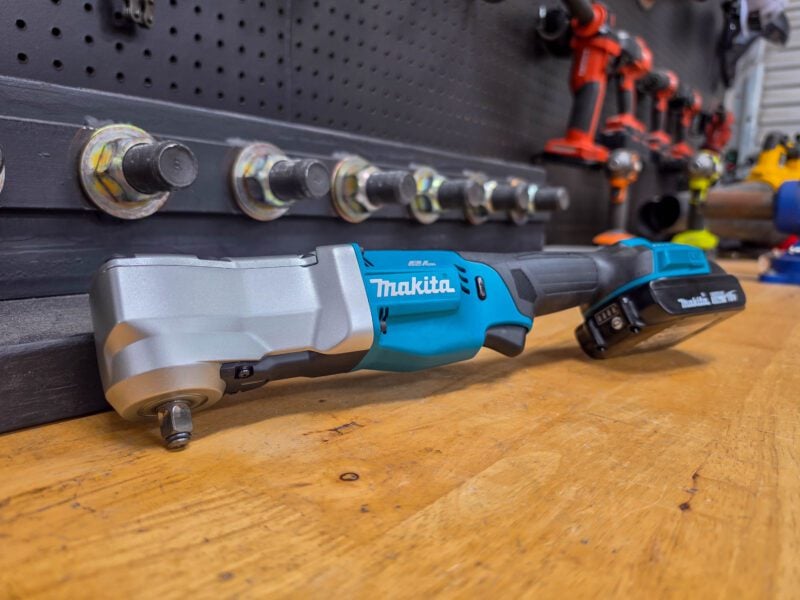
To push the tool to its absolute limits, we devised a real-world strength test using our shop bolt-break rig. We secured 1 1/2-inch semi-truck lug nuts and torqued them precisely to 250 ft-lbs using a Gearwrench Electronic Torque Wrench. We then timed how long it took the XLT03 to completely loosen a series of eight nuts.
While semi-truck lug nuts are far heavier than the typical fasteners you would encounter in an engine bay, this stress test provided vital data regarding the tool’s thermal management, vibration output, and overall capability under pressure.
The Makita XLT03 completed the eight-nut removal test in a total time of 46.63 seconds—averaging roughly 5.83 seconds per nut. For a compact right-angle tool operating outside its primary design parameters, this result is exceptionally respectable. It proved that the XLT03 possesses deep reserves of power, making it more than capable of handling demanding automotive suspension work and heavy machinery maintenance.
Ergonomics, Size, and Design Notes
Power is only valuable if the tool is comfortable and manageable during an eight-hour shift. The XLT03 features a well-balanced chassis, though its physical footprint depends heavily on your choice of battery pack.
- Bare Tool Weight: 3.25 lbs
- Weight with 2.0Ah Battery: 4.0 lbs
- Weight with 5.0Ah Battery: 4.61 lbs
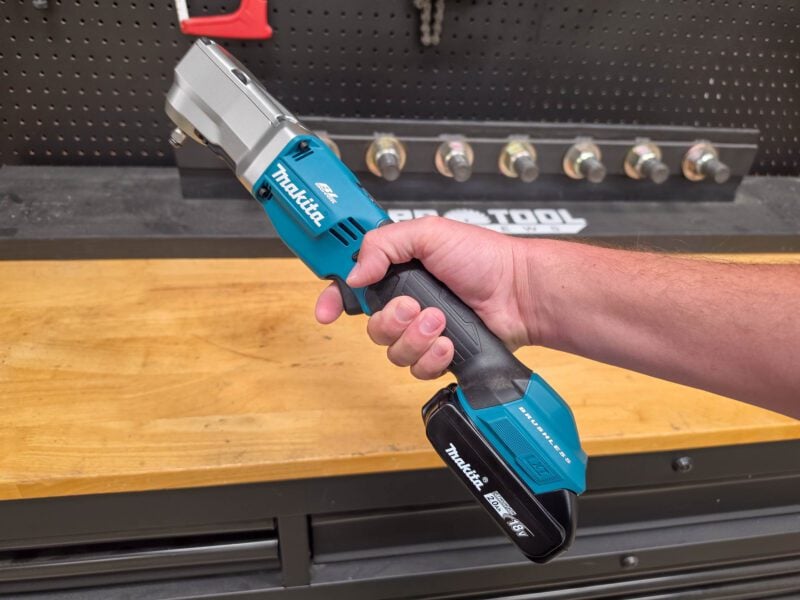
During our hands-on evaluation, we found that pairing the impact wrench with a larger 5.0Ah battery actually improved the tool’s handling. While it adds marginal weight, the larger pack shifts the center of gravity, preventing the tool from feeling front-heavy and reducing strain on the wrist. The grip ergonomics follow Makita’s proven design philosophy, featuring deep contouring that fits securely in the hand and places the electronic control switches within easy thumb reach.
Spatial Constraints and Profile
When evaluating a right-angle tool, dimensions are critical. The XLT03 features a head width of 2.2 inches, with a total depth of 3.1 inches measured from the back of the head to the tip of the anvil.
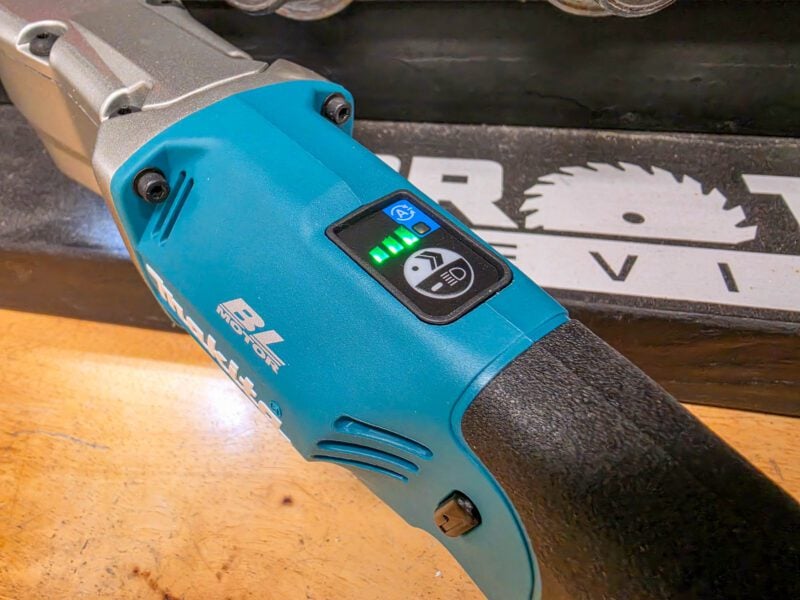
While this profile offers vastly superior clearance compared to a standard pistol-grip impact wrench, it is still a substantial heavy-duty tool. In extremely tight, congested engine compartments, technicians may occasionally find the head too bulky. In those ultra-confined scenarios, a traditional cordless ratchet remains the slimmer choice—though the user must accept a significant sacrifice in raw breakaway torque.
Intelligent Features and Safety Controls
One of the standout highlights of the Makita XLT03 is its suite of electronic operation modes, specifically its dual Auto-Stop features.
When working in complex assemblies, overtightening can strip threads, and dropping a loose nut deep into an unrecoverable section of an engine bay can cost hours of labor. Makita addressed these common frustrations with specialized digital logic:
- Clockwise (Forward) Auto-Stop: When driving fasteners to the right, the tool matches Mode 1 impact force and automatically cuts power the absolute moment the mechanism begins to impact. This prevents accidental over-torquing on sensitive components.
- Counterclockwise (Reverse) Auto-Stop: When spinning fasteners out to the left, the tool utilizes maximum power (Mode 3) to break the bolt free, then automatically halts rotation the millisecond the fastener breaks loose and unloads. This keeps the nut from flying off unexpectedly into crowded surroundings.
In practice, these Auto-Stop modes function seamlessly. They represent some of the most reliable and genuinely useful electronic automation we have tested on a cordless impact wrench, granting precision control during delicate mechanical procedures. Additionally, the integrated LED work light illuminates dimly lit workspaces directly beneath the anvil, ensuring clear visibility where shadow and obstruction are constant challenges.
Supporting Data and Comparative Analysis
When analyzing the broader landscape of cordless impact tools, professionals must weigh the compromise between physical dimensions and output performance.
- The Ratchet Alternative: Cordless ratchets excel in narrow spaces because their elongated, slender shafts allow deep insertion into engine bays. However, their internal gear mechanisms typically limit breakaway torque to well under 100 ft-lbs, requiring manual hand-breaking of stubborn bolts.
- The Right-Angle Compromise: The Makita XLT03 bridges this gap. By utilizing a hammer-and-anvil impact mechanism scaled down into a 90-degree head, it delivers up to 390 ft-lbs of breakaway torque. This allows mechanics to skip the step of manually cracking bolts loose with a breaker bar before switching to a power tool.
Vibration feedback during heavy use is another critical metric for professional tradespeople. Throughout our testing, the XLT03 exhibited vibration levels comparable to Makita’s larger 18V and 40V max pistol-grip impact wrenches. While vibration is inherently present due to the high-frequency impacts, it remains tightly controlled and non-exhausting, preventing premature hand fatigue over long maintenance shifts.
Official Responses and Industry Reception
Industry response to the XLT03 has been overwhelmingly positive, particularly among professional automotive technicians and mobile fleet mechanics. Field reviewers have praised Makita for avoiding the trap of simply rebranding a low-powered ratchet with an impact label. Instead, the engineering team built a dedicated, heavy-duty impact driver optimized for high-torque applications in restrictive spaces.
Tool safety advocates and shop foremen have also highlighted the inclusion of the Auto-Stop modes as a major win for productivity. By minimizing human error—such as sheared bolt threads or lost hardware—the tool directly addresses everyday shop inefficiencies that cost businesses both time and money.
Implications for Professionals: Should You Buy It?
The Makita 18V LXT XLT03 is a specialized, highly competent addition to the 18V LXT lineup. It is not designed to completely replace a standard mid-torque impact wrench, nor is it meant to substitute for a slim cordless ratchet in every scenario. Rather, it occupies a strategic middle ground that caters directly to professional mechanics, automotive technicians, and industrial equipment maintainers.
The Verdict
- Who it is for: Technicians already invested in the Makita 18V LXT battery platform who regularly battle stubborn fasteners in tight automotive, truck, or industrial maintenance environments. If your daily routine involves suspension components, tight engine bays, or machinery assembly where a straight impact gun won’t fit, this tool is an absolute game-changer.
- Who should pass: DIYers or tradespeople with infrequent mechanical needs who can easily manage with standard socket extensions and manual ratchets, or those working in spaces so confined that a 2.2-inch wide head cannot physically enter.
Priced at $279 as a bare tool with a 3-year limited warranty, the XLT03 represents a sound investment for working professionals. Its combination of blistering speed, robust breakaway torque, and intelligent auto-stop safeguards ensures that it delivers real, measurable value where it matters most: under the hood and on the job site.
