

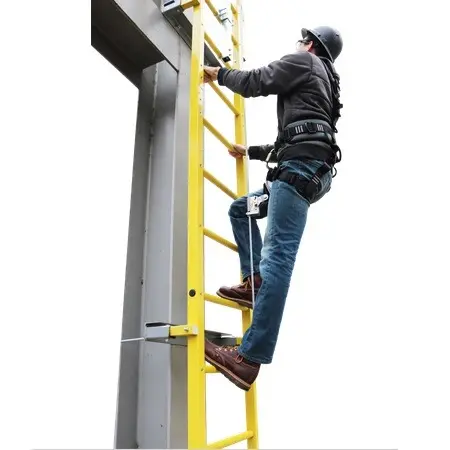
For decades, the silhouette of a commercial building’s exterior or its interior service shaft has featured a familiar safety fixture: the caged fixed ladder. To building owners, facilities managers, and even many roofing contractors, the steel cage surrounding these ladders represented the gold standard of fall protection.
However, a quiet but profound regulatory shift has been underway since late 2018. Under the Occupational Safety and Health Administration’s (OSHA) updated walking-working surfaces standards, the traditional ladder cage is no longer recognized as an acceptable means of fall protection for high-climb fixed ladders.
This regulatory overhaul represents a major transition for the commercial roofing and construction industries. Contractors are now tasked with guiding building owners through a complex compliance landscape. Whether dealing with internal access systems, such as a roof hatch ladder, or external systems like a roof access ladder, the questions of the past—such as "Do we need a cage?" or "Will this require a well?"—have been replaced by a strict federal mandate for personal fall arrest systems (PFAS) and specialized ladder safety devices.
Main Facts: The Death of the Ladder Cage
The core of this regulatory shift lies in OSHA standard 29 CFR 1910.28(b)(9), which governs fall protection on fixed ladders. Historically, OSHA permitted the use of cages or wells to mitigate fall hazards on fixed ladders extending more than 24 feet above a lower level. The revised standard, which took effect on November 19, 2018, completely changed this approach.
The New Standard of Fall Protection
Under the revised rules, cages and wells are no longer considered fall protection on fixed ladders that extend more than 24 feet above a lower level. Instead, OSHA requires the installation of either a Ladder Safety System or a Personal Fall Arrest System (PFAS).
While existing cages installed prior to the 2018 amendment are temporarily grandfathered in, any new fixed ladder installation, or any modification/repair to an existing ladder, must immediately comply with the new standard. Furthermore, a hard deadline has been set for the complete phase-out of all grandfathered cages. By November 18, 2036, every fixed ladder over 24 feet in height across the United States must be equipped with an active ladder safety system or PFAS, regardless of when it was built.
Defining Acceptable Systems
To comply with the updated standards, contractors and building owners must understand what OSHA deems an acceptable alternative:
- Ladder Safety System: Defined by OSHA as an engineered system attached to a fixed ladder designed to eliminate or reduce the possibility of a worker falling. Typically, this system includes a carrier (such as a solid rail or a cable), a safety sleeve (cable grab), a connector (carabiner), and a body harness. An example of this technology is the ladder fall arrest cable system, which provides a continuous vertical lifeline.
- Personal Fall Arrest System (PFAS): A system used to arrest an employee in a fall from a working level. It consists of an anchorage, connectors, and a body harness, and may include a lanyard, deceleration device, lifeline, or a suitable combination of these.
Chronology: The Multi-Decade Compliance Timeline
OSHA’s implementation of the walking-working surfaces rule is structured over a multi-decade timeline. This approach was designed to give building owners sufficient time to amortize the costs of retrofitting their facilities, while immediately raising safety standards for new construction.
[Pre-Nov 2018] ------------> [Nov 19, 2018] ------------> [Post-Nov 2018 Repairs] ------------> [Nov 18, 2036]
Cages/wells accepted         New ladders >24'             Any repaired ladder section           All ladders >24'
as sole fall protection      must feature PFAS/LSS        must be upgraded to PFAS/LSS          must have PFAS/LSS
November 19, 2018: The Starting Line
This date marked the official implementation of the amended OSHA 1910.28(b)(9).
- New Installations: Any fixed ladder installed on or after this date that extends more than 24 feet above a lower level must be equipped with a ladder safety system or a personal fall arrest system upon installation. Cages are no longer permitted as a primary safety measure on new builds.
- Existing Installations: Ladders installed prior to this date were allowed to remain in service with existing cages or wells, acting as a temporary grandfather clause.
The Maintenance and Replacement Trigger (Post-November 19, 2018)
The grandfather clause for older ladders comes with a significant condition. Under 1910.28(b)(9)(i)(C), if any portion of an existing fixed ladder, cage, or well is damaged and requires replacement, the entire ladder must be retrofitted with a compliant ladder safety system or PFAS. Contractors must communicate this "repair trigger" to building owners: a simple repair can initiate a mandatory safety upgrade for the entire vertical run.
November 18, 2036: The Absolute Sunset Clause
This is the final deadline for nationwide compliance. As dictated by 1910.28(b)(9)(i)(D), on and after November 18, 2036, all fixed ladders that extend more than 24 feet above a lower level must be equipped with a personal fall arrest system or a ladder safety system. After this date, grandfathered cages will no longer be recognized as compliant, rendering any building still relying solely on cages subject to immediate OSHA citations and severe liability.
Supporting Data: The Physics of Falls and Regulatory Realities
To understand why OSHA enacted such a sweeping regulatory change, it is necessary to examine the physical realities of falls from heights and the mechanical limitations of traditional ladder cages.
Why Cages Fail
For decades, the industry operated under the assumption that ladder cages provided a physical barrier that would catch a falling worker or allow them to wedge themselves against the enclosure to arrest their descent. However, forensic safety engineering studies conducted during the rulemaking process revealed a different reality:
- The "Plinko" Effect: Rather than stopping a fall, a cage often acts as a chute. A falling worker can bounce off the steel hoops and rungs of the cage on the way down, resulting in severe deflection injuries, fractures, and traumatic brain injuries before they reach the ground.
- Rescue Obstruction: When a worker falls and becomes injured or unconscious inside a ladder cage, the cage physically restricts emergency responders from reaching them or safely lowering them to the ground.
- False Sense of Security: Cages can encourage workers to bypass standard three-point contact climbing techniques, under the mistaken belief that the enclosure will protect them in a fall.
Critical Harness Dynamics: OSHA 1910.140(d)(1)(iv)
One of the most frequently overlooked aspects of the updated standards is the hardware requirements for personal fall arrest systems used on fixed ladders.
Standard 1910.140(d)(1)(iv) states that a personal fall arrest system must be designed to "sustain the employee within the system/strap configuration without making contact with the employee’s neck and chin area."
This performance standard has major implications for equipment selection:
- The Sternal D-Ring Requirement: Traditional fall protection harnesses feature a single dorsal (back) D-ring. If a worker falls from a vertical ladder while attached to a dorsal D-ring, the force of the arrest pulls the worker’s body forward and downward, causing the harness straps to ride up violently against the neck and throat.
- The Solution: To comply with OSHA’s criteria, climbers must use a harness equipped with a sternal (chest) or waist-mounted D-ring connected to the ladder safety system. This configuration keeps the climber’s body upright and positioned close to the ladder during a fall, distributing deceleration forces across the torso and away from the neck.
| Feature | Traditional Ladder Cage | Modern Ladder Safety System (LSS) |
|---|---|---|
| Primary Mechanism | Physical containment enclosure | Active mechanical fall arrest |
| Fall Distance | Uncontrolled until hitting a landing or wedging | Arrested within inches of slippage |
| Harness Required? | No | Yes (specifically with front/sternal D-ring) |
| Post-Fall Trauma | High risk of impact injuries on cage steel | Suspension trauma risk (mitigated by prompt rescue) |
| OSHA Compliance Status | Phase-out by 2036; forbidden on new builds | Fully compliant under current standards |
Official Responses and Industry Perspectives
The transition away from ladder cages has drawn responses from safety advocates, regulatory bodies, and industry experts.
OSHA’s Stance
In its regulatory impact analysis, OSHA emphasized that aligning its walking-working surfaces standards with national consensus standards—specifically those of the American National Standards Institute (ANSI) and the American Society of Safety Professionals (ASSP)—would significantly reduce workplace fatalities. OSHA estimates that the updated walking-working surfaces rule will prevent dozens of fatalities and thousands of lost-workday injuries annually across all industries.
The Contractor’s Challenge
While safety advocates have welcomed the regulations, commercial roofing contractors face practical hurdles on the ground. Many building owners are unaware of the 2018 amendment and the 2036 sunset clause.
"Contractors frequently run into situations where a building owner requests a simple patch-up of an old rusted ladder cage," says an industry safety consultant. "We have to explain that as soon as we touch that ladder for repairs, we are legally required to bring the entire system up to modern safety standards. It changes a minor maintenance expense into a major capital improvement project, which requires clear communication and education."
Manufacturer Innovations
Safety equipment manufacturers have responded by developing modular, retrofittable cable and rail systems. Rather than requiring the demolition of existing ladders, systems like the ladder fall arrest cable system can be clamped directly to the rungs of existing ladders. This allows facility managers to achieve compliance without the cost of complete structural replacement.
Implications: Risk Management, Liability, and Action Steps
The shift in OSHA enforcement has significant implications for both building owners and the contractors who service them.
Liability and Insurance Risks
Failing to address non-compliant fixed ladders carries substantial financial and legal risks. In the event of a fall-related injury or fatality on an outdated ladder system:
- OSHA Citations: Fines for "willful" or "repeat" violations can exceed $150,000 per occurrence.
- Civil Litigation: Plaintiff attorneys can argue that building owners and property managers were negligent by failing to upgrade safety systems during the multi-year transition period leading up to 2036.
- Insurance Ramifications: Commercial property and liability insurers are increasingly auditing facilities for OSHA compliance. Non-compliant ladders can lead to premium increases or the denial of claims following an accident.
Recommended Compliance Checklist for Building Owners and Contractors
To navigate this regulatory transition smoothly, facility managers and contractors should implement a proactive ladder safety audit program:
- Inventory All Fixed Ladders: Document every fixed ladder on the property, noting its height, installation date, and whether it features an existing cage or well.
- Identify Trigger Points: Note any ladders over 24 feet that are currently scheduled for maintenance, relocation, or structural repair. Plan to upgrade these systems to modern ladder safety systems immediately.
- Evaluate Existing PPE: Ensure that workers and maintenance staff climbing these ladders are equipped with compliant harnesses featuring sternal or waist-mounted D-rings, along with compatible cable grabs.
- Develop a Retrofit Schedule: Do not wait until the 2036 deadline. Develop a phased capital expenditure plan to systematically replace or retrofit grandfathered ladder cages with cable or rail-based fall arrest systems over the next decade.
Partnering for Safety
As the commercial roofing sector continues to adapt to these safety standards, relying on experienced industry partners is essential. With over 70 years of experience and five locations across the country, organizations like Roofmaster provide the technical expertise, equipment, and compliance guidance required to keep contractors and facility owners safe, compliant, and climbing securely.
