

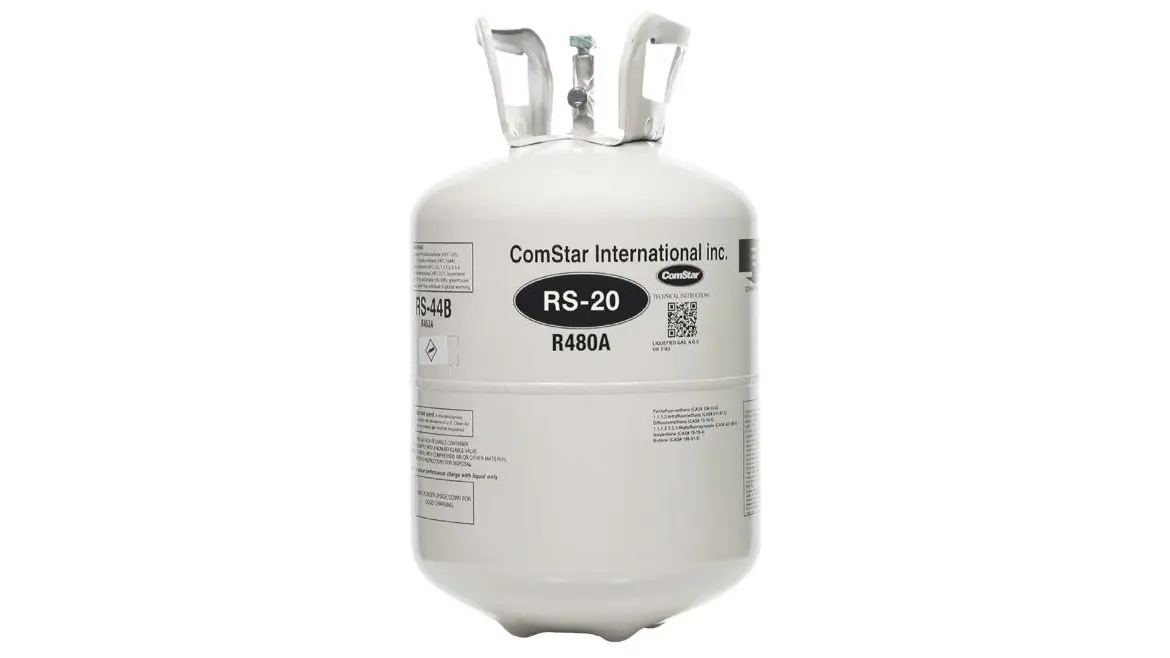
COLLEGE POINT, N.Y. — In a significant development for the global heating, ventilation, air conditioning, and refrigeration (HVACR) industry, ComStar International Inc. has officially announced the rollout of RS-20, an innovative, lower-global-warming-potential (GWP), non-flammable alternative to R-134a. Designated officially as R-480A under ASHRAE’s established refrigerant naming and classification system, RS-20 arrives at a critical juncture as regulatory pressures mount on legacy high-GWP hydrofluorocarbons (HFCs).
Engineered for seamless integration into both brand-new equipment and pre-existing R-134a systems, RS-20 boasts a GWP of just 291. This represents an extraordinary 80% reduction in greenhouse gas impact compared to standard R-134a, which carries a GWP of approximately 1,430. Furthermore, RS-20 holds an ASHRAE safety classification of A1—signifying non-flammability and low toxicity—making it an exceptionally attractive drop-in or OEM solution across a wide spectrum of commercial, industrial, and automotive applications.
As regulatory frameworks worldwide continue to phase down high-GWP substances in alignment with environmental protocols, engineering firms, original equipment manufacturers (OEMs), and facility managers are actively seeking ways to balance stringent environmental mandates with the unyielding demand for safety, efficiency, and reliability. ComStar International’s introduction of RS-20 provides the industry with a practical, high-performance bridge to a more sustainable future.
Main Facts at a Glance
To fully understand the scope and technical viability of ComStar International’s newest offering, it is helpful to examine the core specifications that define RS-20 (R-480A):
- ASHRAE Designation: R-480A
- Safety Classification: A1 (Non-flammable, low toxicity)
- Global Warming Potential (GWP): 291 (an ~80% reduction relative to R-134a’s GWP of ~1,430)
- Ozone Depletion Potential (ODP): Zero (contains no chlorine)
- Cooling Capacity: Slightly higher than R-134a under comparable test conditions (approx. 2,545 Btuh versus 2,507 Btuh)
- Regulatory Approvals: Fully approved by the U.S. Environmental Protection Agency (EPA) under the Significant New Alternatives Policy (SNAP) program for new equipment, stationary retrofits, and motor vehicle air-conditioning (MVAC) applications.
- Lubricant Compatibility: Compatible with lubricants commonly used with R-134a, largely eliminating the need for costly and labor-intensive oil changes during retrofits.
Chronology of Development and Market Introduction
The journey toward low-GWP alternatives like RS-20 has been decades in the making, driven by escalating international environmental treaties and domestic regulatory mandates aimed at mitigating climate change.
The Regulatory Push for Lower-GWP Alternatives
For years, R-134a served as a cornerstone refrigerant in automotive air conditioning, medium-temperature commercial refrigeration, chillers, and specialized industrial cooling. However, its high GWP placed it squarely in the crosshairs of environmental regulators. The adoption of the Kigali Amendment to the Montreal Protocol, alongside regional regulations such as the American Innovation and Manufacturing (AIM) Act in the United States, established aggressive baselines for phasing down HFC consumption and production.
During the initial waves of the HFC phasedown, the industry saw a significant pivot toward A2L refrigerants (mildly flammable alternatives). While A2Ls offer low GWP profiles, their introduction has required extensive redesigns of equipment safety architecture, specialized technician training, and strict building code updates to handle flammability risks. Consequently, a distinct gap remained in the market for a lower-GWP solution that retained the absolute safety profile of traditional A1 refrigerants.
The Rise of the RS Series and EPA Approvals
Refrigerant Solutions Ltd., a pioneer in proprietary refrigerant formulations, developed the RS series to address these exact industry pain points. Through an exclusive U.S. licensing, production, and marketing agreement, ComStar International Inc. took charge of bringing these advanced technologies to the American marketplace.
The development of RS-20 was specifically targeted at matching the physical and thermodynamic properties of R-134a as closely as possible. Following rigorous laboratory testing, thermodynamic modeling, and safety evaluations, RS-20 successfully cleared federal hurdles. The U.S. EPA officially granted SNAP approval for RS-20 as an acceptable substitute for applicable new equipment and stationary retrofit uses, as well as for motor vehicle air-conditioning retrofits. This regulatory clearance cleared the path for commercial distribution, enabling contractors, facility managers, and automotive technicians to begin adopting the fluid immediately.
Supporting Data and Technical Performance
One of the most critical challenges in transitioning away from a legacy refrigerant is maintaining system capacity, efficiency, and material compatibility without requiring a complete redesign of existing infrastructure. RS-20 was meticulously engineered to mirror the operational DNA of R-134a.
Thermodynamic Comparison
Under controlled, comparable laboratory test conditions, RS-20 demonstrates stellar thermal performance:
- Cooling Capacity: RS-20 yields a cooling capacity of approximately 2,545 Btuh, marginally outperforming R-134a’s baseline of 2,507 Btuh. This ensures that end-users experience no degradation in cooling performance upon switching.
- Operating Pressures and Temperatures: Discharge pressures and discharge temperatures for RS-20 remain closely aligned with those of R-134a.
- Efficiency and Mass Flow: The coefficient of performance (COP) and mass-flow characteristics closely parallel R-134a, meaning compressors and heat exchangers operate under familiar thermal loads.
Retrofit Simplicity and Lubricant Compatibility
For existing equipment owners, the economic hurdle of a refrigerant transition typically involves labor, downtime, and component replacement costs. RS-20 minimizes these financial friction points through its plug-and-play nature:
- No Component Swaps: Existing expansion devices, pressure controls, and major system components can remain entirely in place.
- Oil Retention: Because RS-20 is chemically compatible with standard lubricants utilized alongside R-134a, a complete oil flush and replacement is generally unnecessary during a typical system conversion. This dramatically cuts down labor hours and eliminates disposal costs associated with waste oil.
Official Responses and Industry Perspectives
The introduction of RS-20 has drawn praise from industry leaders who recognize the immense value of combining ultra-low GWP metrics with an uncompromised A1 safety classification.
Steven Mella, Chief Executive Officer at ComStar International, emphasized the strategic importance of the new refrigerant during the launch announcement:
"RS-20 provides manufacturers and equipment owners with a straightforward path to a much lower-GWP refrigerant without giving up A1 non-flammability, performance, or established R-134a equipment technology," Mella stated. "With a GWP of only 291 and applications ranging from new equipment to existing R-134a systems and automotive retrofit, RS-20 provides a practical solution for the industry’s transition to lower-GWP refrigerants."
Industry analysts note that Mella’s remarks highlight a core anxiety among commercial property owners and equipment engineers: the fear that transitioning to eco-friendly alternatives will compromise safety or necessitate exorbitant capital expenditures for entirely new machinery. By bridging the gap between ecological responsibility and operational continuity, RS-20 directly resolves this tension.
Broader Implications for the HVACR Industry
The commercialization of RS-20 (R-480A) carries far-reaching implications across multiple verticals within the heating, ventilation, air conditioning, and refrigeration sectors.
1. Enhanced Safety in Sensitive Environments
The combination of a low GWP (291) and an A1 safety rating is particularly invaluable in applications where safety, strict building codes, and long-term asset management are paramount. Unlike A2L alternatives, which introduce a degree of flammability that requires complex mitigation strategies (such as leak detection sensors and enhanced ventilation), RS-20 introduces zero risk of refrigerant-fed fires. This makes it an ideal choice for:
- Healthcare Systems: Hospitals and medical facilities where patient safety is absolute and chemical hazards must be strictly minimized.
- Data Center Cooling: Mission-critical server environments where uninterrupted uptime and fire prevention are top priorities.
- Commercial Chillers: Large-scale commercial building climate control systems often installed in densely populated urban zones.
2. Streamlining Refrigerated Transportation
The refrigerated transport sector—comprising refrigerated trucks, trailers, and intermodal containers—relies heavily on robust, vibration-resistant cooling loops traditionally built around R-134a. The ability to retrofit these mobile units with RS-20 without changing out core hardware or lubricants gives fleet operators a rapid, cost-effective compliance strategy under tightening HFC phasedown schedules.
3. Automotive Air Conditioning Retrofits
With specific EPA SNAP approval for motor vehicle air-conditioning (MVAC) retrofits, RS-20 opens a viable pathway for servicing and extending the operational lifecycle of older mobile platforms that were originally engineered for R-134a, easing the economic burden on vehicle owners and independent service shops.
Conclusion
As environmental regulations continue to tighten around the globe, the HVACR industry stands at a permanent crossroads. The introduction of RS-20 (R-480A) by ComStar International Inc. marks a milestone achievement in refrigerant technology. By delivering an 80% reduction in GWP alongside an uncompromised A1 non-flammable safety rating, zero ozone depletion potential, and seamless drop-in compatibility with existing R-134a infrastructure, RS-20 bridges the gap between regulatory compliance and operational pragmatism.
For OEMs designing the next generation of cooling equipment, and for facility managers striving to sustainably maintain legacy systems, RS-20 offers a reliable, safe, and future-proof path forward.
