

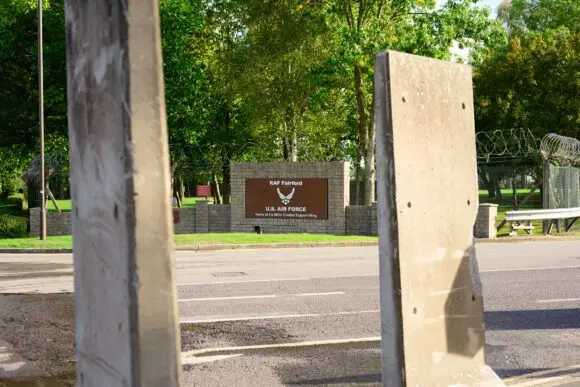
LONDON — British counter-terrorism police have arrested a sixth individual in connection with a high-stakes security incident near a strategic Royal Air Force base in Gloucestershire, deepening an international investigation that has drawn the scrutiny of both Downing Street and the White House.
The latest suspect, a 27-year-old British-Iranian dual national, was taken into custody in London on Thursday on suspicion of the preparation of terrorist acts. The arrest follows a fast-moving series of raids and inquiries that began late last week near RAF Fairford, a critical military installation utilized by the United States Air Force for strategic long-range operations, including recent strikes on Iranian targets.
Authorities confirmed that in addition to Thursday’s arrest, another man—a British national—was questioned under caution by investigators, while specialist search teams executed warrants at two properties in the greater London area.
The unfolding security crisis has laid bare simmering geopolitical tensions between Western allies and Tehran, prompting high-level diplomatic exchanges, public friction over police bail decisions, and unprecedented security lock-downs at vital military installations across the United Kingdom.
Main Facts
The core of the police investigation centers on a late-night security breach near RAF Fairford in Gloucestershire, England, which occurred on Sunday. While initial reports and subsequent police statements confirmed that no explosives were discovered at or near the facility, officers did recover a significant quantity of fuel from the scene, raising immediate concerns regarding a potential sabotage or arson plot targeting military assets.
Counter Terrorism Policing (CTP) has formally taken charge of the case, designating it as a matter of national security. According to senior law enforcement officials, the probe is operating on multiple fronts, with investigators closely examining whether the incident was orchestrated by, or received material support from, a hostile foreign intelligence service.
- The Sixth Suspect: A 27-year-old British-Iranian dual national arrested in London under Section 5 of the Terrorism Act 2006 (preparation of terrorist acts).
- Prior Arrests: Five other men were detained on Sunday night near the Gloucestershire airbase. Although they were subsequently released on police bail, the decision sparked intense debate and public criticism from international allies.
- The Target: RAF Fairford, a vital Ministry of Defence facility frequently used by US strategic bombers and support aircraft for overseas power projection.
- Seized Materials: While bomb-disposal teams and forensic units found no explosive devices, the recovery of fuel containers at the scene remains a central piece of physical evidence being analyzed by counter-terrorism forensic labs.
- Foreign State Dimension: Both UK leadership and US officials have publicly acknowledged that the investigation is actively weighing the probability of direct Iranian state sponsorship.
Chronology of Events
The sequence of events leading up to the sixth arrest has unfolded rapidly over the course of a tense week, moving from a localized security breach in rural Gloucestershire to a major international intelligence investigation.
Sunday Night: The Gloucestershire Breach
Security personnel stationed at RAF Fairford detected suspicious activity near the perimeter of the airbase. Local police forces were dispatched, quickly backed by specialized units. Five men were intercepted and arrested in the immediate vicinity of the base. Initial sweeps of the area by explosive ordnance disposal technicians ruled out the presence of conventional explosives, but the recovery of fuel containers prompted a wider security alert over fears of an arson attack or targeted sabotage against parked aircraft or fueling infrastructure.
Monday and Tuesday: Forensic Sweeps and Initial Interrogations
As the five suspects were held under counter-terrorism legislation for questioning, forensic teams cordoned off sections surrounding RAF Fairford. Investigators began piecing together the movements, digital communications, and financial backgrounds of the detained men. Intelligence agencies, including MI5, were brought in to analyze potential overseas links.
Wednesday: Political Revelations and Bail Controversy
The investigation spilled over into the political arena on Wednesday when UK Prime Minister Andy Burnham publicly addressed the case. In a briefing to lawmakers, Burnham confirmed that the British government’s working hypothesis included direct Iranian state involvement in the plot.
However, the decision by police to release the initial five suspects on bail sparked immediate controversy. The move drew sharp rebukes from across the Atlantic, where US security officials and political leaders questioned the wisdom of releasing individuals suspected of plotting against a joint military installation. Prime Minister Burnham defended the operational independence of the police, emphasizing that the bail conditions imposed upon the five men were the "strictest possible" under British law, involving electronic tagging, curfews, and travel restrictions.
Thursday: The Sixth Arrest and Global Fallout
The pressure surrounding the case intensified on Thursday. Vicki Evans, senior national coordinator for Counter Terrorism Policing, issued a strongly worded public statement outlining the complexity of the operation. Shortly after, counter-terrorism officers moved in to arrest the 27-year-old British-Iranian dual national in London, alongside the questioning of the second man under caution and the execution of property searches.
Later that day, when questioned by reporters regarding potential Iranian state orchestration, US President Donald Trump remarked that "it’s looking like that," while exercising diplomatic caution by noting that Washington could not yet state it "with confirmation."
Supporting Data and Operational Context
The gravity of the Gloucestershire incident is inextricably linked to the strategic value of RAF Fairford. As one of only two European airbases capable of supporting the United States Air Force’s heavy bomber fleet (alongside RAF Bruntingthorpe and historically RAF Mildenhall), Fairford serves as a vital hub for transatlantic defense cooperation. In recent months, the base has seen heightened activity and elevated security posture in tandem with escalating military operations and retaliatory strikes involving US and allied forces targeting Iranian-backed proxies and strategic assets in the Middle East.
Following Sunday’s breach, the Ministry of Defence, in coordination with civil aviation authorities and local police, significantly upgraded security protocols around the perimeter. Photographic evidence from the airbase perimeter on October 1 showed the rapid installation of heavy concrete anti-vehicle blocks, reinforced checkpoints, and heightened patrols by armed military police and civil law enforcement.
Law enforcement data highlights a growing trend of hostile state-backed reconnaissance and sabotage attempts across European critical national infrastructure (CNI). Over the past twenty-four months, intelligence agencies in the UK, Germany, and Poland have disrupted numerous covert operations attributed to foreign intelligence services—notably Russia and Iran—utilizing local proxies, criminal networks, and dual nationals to conduct surveillance, reconnaissance, and low-level sabotage against military and logistics hubs.
Official Responses
The intersection of domestic counter-terrorism law enforcement, international military alliances, and state-level espionage has prompted measured yet firm statements from senior officials on both sides of the Atlantic.
Speaking on Thursday evening, Vicki Evans, Senior National Coordinator for Counter Terrorism Policing, emphasized the grueling nature of the ongoing investigation:
“The investigation into circumstances surrounding events in Gloucestershire is hugely complex, and our specialist teams are interrogating multiple lines of inquiry. We’re looking at all possible angles — including possible foreign state involvement.”
Evans reiterated that public safety remains paramount, urging communities to remain vigilant while allowing investigators the space to pursue leads without speculation.
UK Prime Minister Andy Burnham addressed the geopolitical ramifications during his Wednesday address, confirming the government’s assessment regarding foreign actors. Addressing criticisms over the initial release of the five suspects, Burnham underscored the separation of powers between the executive branch and independent police operations, noting that the investigative threshold required strict adherence to statutory guidelines before formal charges could be brought, even as he vouched for the severity of the imposed bail restrictions.
In Washington, US President Donald Trump responded to press inquiries on Thursday regarding the likelihood of Iranian state backing. While acknowledging the alignment between US and British intelligence assessments, Trump maintained a cautious diplomatic stance:
“It’s looking like that… but we cannot say so with confirmation just yet.”
Defense analysts suggest that Washington is closely monitoring how London handles the prosecution, viewing the case as a litmus test for Western resilience against asymmetric hybrid warfare conducted by adversarial states on allied soil.
Implications
The thwarted or disrupted plot near RAF Fairford carries profound implications for national security, intelligence sharing, and diplomatic relations between the United Kingdom, the United States, and Iran.
1. Heightened Vulnerability of Dual Nationals and Open Societies
The involvement of British-Iranian dual nationals in suspected hostile state activity highlights a persistent counter-intelligence challenge for Western democracies. Open societies rely heavily on freedom of movement and multicultural integration, yet hostile intelligence services routinely exploit these very open channels to recruit agents of influence, spotters, or saboteurs who possess local language skills, travel documents, and the ability to blend seamlessly into civilian populations.
2. The Evolution of Hybrid Warfare
Traditional warfare relies on overt military engagements, but modern geopolitical conflict increasingly plays out in the "gray zone" of hybrid warfare. Sabotage, reconnaissance, cyber-attacks, and localized disruption campaigns allow hostile states to inflict strategic friction on their adversaries while maintaining a fragile veneer of plausible deniability. The presence of fuel containers rather than high explosives at RAF Fairford suggests that perpetrators may have been aiming for localized disruption, arson, or the facilitation of a secondary attack rather than a catastrophic mass-casualty event—hallmarks of classic state-directed sabotage operations.
3. Strain and Coordination within the Special Relationship
While intelligence-sharing between London and Washington remains exceptionally tight, minor friction over tactical decisions—such as the police bail granted to the initial five suspects—underscores differing cultural and legal approaches to counter-terrorism. While UK policing relies strictly on evidentiary thresholds governed by the Crown Prosecution Service, American national security leadership often favors a more preventative, zero-tolerance detention posture when dealing with threats to strategic military assets. Navigating these differences successfully will require seamless diplomatic and operational communication as the investigation progresses.
As British counter-terrorism teams continue to interrogate the sixth suspect, analyze seized digital devices, and sift through financial trails across London and Gloucestershire, the shadow of foreign state aggression looms large over Britain’s military infrastructure. The coming weeks will likely determine whether the Crown Prosecution Service finds sufficient evidence to bring formal terrorism charges against the suspects, potentially setting the stage for one of the most significant state-sponsored espionage and sabotage trials in recent British history.
