

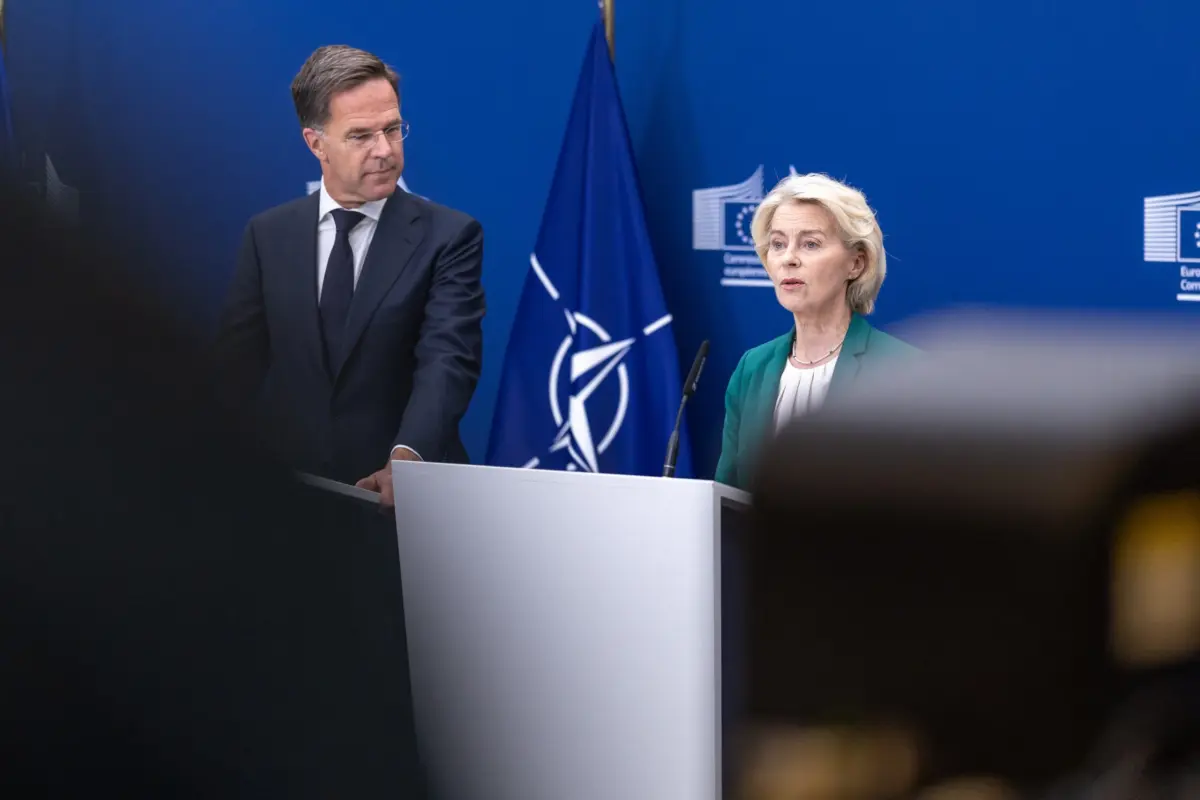
BRUSSELS — The morning after the German government formally pointed the finger at Moscow for a harrowing, near-miss drone attack targeting cargo planes at Leipzig-Halle airport, European Commission President Ursula von der Leyen delivered a tacit, sobering admission. The continent, she conceded, is failing to keep pace with an aggressive, evolving threat.
"We have to step up," von der Leyen declared alongside newly minted NATO Secretary General Mark Rutte. "And that means being ready to respond to Russia’s recklessness faster and better."
Yet, behind the resolute rhetoric lies a paralyzed continent. The attack at Leipzig-Halle—a critical logistical lifeline for Western military aid moving into Ukraine—was far from an isolated incident. Instead, it forms the bleeding edge of what intelligence officials describe as a rapidly expanding, increasingly brazen campaign of "hybrid warfare." Ranging from industrial sabotage and targeted assassinations to airspace violations and critical infrastructure destruction, Moscow’s grey-zone tactics are systematically designed to erode European resolve, undermine support for Kyiv, and expose deep fractures within the Western alliance.
As the frequency of these provocations hits alarming new highs, European and transatlantic leaders find themselves trapped in a perilous strategic conundrum: how to mount a defense forceful enough to deter the Kremlin, without triggering a catastrophic, full-scale military conflict.
Main Facts: The Anatomy of an Unconventional War
The contours of Russia’s shadow war against Europe are defined by plausible deniability, targeted disruption, and psychological intimidation. Moscow consistently denies direct involvement in these operations, but Western intelligence agencies have charted a clear blueprint of escalating hostility.
The aborted drone strike at Leipzig-Halle airport serves as a harrowing case study. The incident involved an armed drone discovered near Ukrainian aircraft, alongside a mid-air hazard with a cargo plane that narrowly averted fatalities. For Germany, which has historically been more cautious in its direct confrontations with Moscow, the attack was a watershed moment. Berlin responded by threatening fresh EU-wide sanctions, tightening entry requirements for Russian nationals, and shuttering several Russian diplomatic and cultural facilities over active espionage concerns.
However, the Leipzig attack is merely the most visible manifestation of a broader, systemic assault on European stability. The primary objectives of the Kremlin’s campaign are threefold:
- Disrupting Logistics: Targeting vital transport nodes, railways, and supply chains utilized to funnel humanitarian and military aid into Ukraine.
- Eroding Public Support: Generating anxiety among European populations regarding the personal safety and economic costs associated with backing Ukraine.
- Exploiting Transatlantic Fractures: Leveraging political shifts in Washington and the rise of European nationalist movements to paralyze collective decision-making.
Despite these high-stakes provocations, the European response has frequently lagged behind the pace of the threat, exposing structural limitations in the EU and NATO’s security architectures.
Chronology of Escalation: A Timeline of Provocations
To understand the current crisis, one must trace the steady, deliberate escalation of hybrid incidents that have unfolded across Europe over the past year. What began as sporadic disruptions has transformed into a relentless, multi-front campaign.

- October 2025: Following a wave of unauthorized drone and fighter jet incursions into European airspace, European Commission President von der Leyen warns the European Parliament of a "coherent and escalating campaign" by Moscow, signaling that the continent’s outer boundaries are being actively tested.
- November 2025: Polish Prime Minister Donald Tusk publicly declares that Europe is "dealing with an escalation" after a mysterious explosion severely damages a critical railway route linking Poland to Ukraine—a vital arterial pathway for regional logistics.
- February 2026: EU High Representative Kaja Kallas explicitly characterizes Russia’s escalating actions as a series of "reckless and deliberate" provocations designed to probe the bloc’s defensive boundaries.
- August 2026: Analysts at Bloomberg Economics record a staggering 20 distinct incidents of suspected Russian hybrid warfare in a single month—the highest monthly total since October 2025 and the third-highest frequency recorded since the full-scale invasion of Ukraine in 2022.
- Late August / Early September 2026: The foiled drone attack at Leipzig-Halle airport occurs, prompting Germany to formally accuse Moscow and triggering emergency high-level consultations in Brussels between von der Leyen and NATO Chief Mark Rutte.
Supporting Data: Mapping the Scale of the Threat
The subjective feeling of insecurity among European citizens is increasingly backed by hard data. Intelligence assessments and economic analyses confirm that Russia’s shadow war is accelerating rather than abating.
According to Bloomberg Economics tracking, the frequency of hybrid attacks has surged dramatically. August 2026 registered at least 20 verified or highly suspected incidents across Europe, reflecting a deliberate intensification by Moscow. This surge coincides with Ukraine’s long-range drone counter-offensives targeting Russian energy infrastructure, suggesting that the Kremlin is utilizing grey-zone tactics to exert asymmetric pressure on Western capitals in retaliation.
Geographically, the scope of these operations has also widened. While Eastern European frontline states—such as Poland, the Baltic states, and Finland—have long borne the brunt of border provocations, GPS jamming, and cyberattacks, Western European nations are increasingly logging direct threats. Airports, logistics hubs, subsea communication cables, and energy pipelines across Germany, Scandinavia, and the Baltic region are now operating under a persistent state of heightened alert.
Lieutenant Colonel Thilo Geiger, a hybrid warfare researcher at the Institute for Peace Research and Security Policy in Hamburg, notes that this geographic diffusion is serving its intended psychological purpose. "Countries that did not previously see Russia as an immediate threat, or which had not experienced hybrid threats directly, are now learning firsthand how vulnerable open societies are," Geiger observes.
Official Responses: Between Rhetoric and the "Fear of Escalation"
The reaction from European capitals has been characterized by a widening chasm between stark rhetorical warnings and tangible, decisive countermeasures.
High-ranking officials have not minced words. Just last week, the EU’s top military official formally designated Russian hybrid warfare as the bloc’s "most significant strategic threat." Yet, turning diagnostic clarity into practical defense mechanisms has proven extraordinarily difficult.
"The simple reason why we aren’t reacting stronger is that it’s very difficult to find stronger tools," explains Teija Tiilikainen, director of the European Centre of Excellence for Countering Hybrid Threats. "We are targeted, we look helpless, and we don’t necessarily have the countermeasures because we don’t want to have a full-scale war against them."
This hesitation is deeply rooted in the memory of past confrontations. In September 2025, Poland and Estonia took the rare step of invoking NATO Article 4—demanding formal consultations over direct threats to their territorial integrity following brazen airspace violations. Yet, the tangible outcome of this diplomatic mobilization was limited to Eastern Sentry, an open-ended, defensive operation designed merely to bolster air defenses along NATO’s eastern flank, rather than imposing proactive costs on Moscow.
Meanwhile, diplomatic channels remain fraught with mixed messaging. During a phone call, Russian President Vladimir Putin assured U.S. President Donald Trump that Moscow harbors no "aggressive plans" toward Europe. Simultaneously, Russian Foreign Minister Sergei Lavrov adopted a starkly different tone during a state television appearance, issuing a thinly veiled reference to Russia’s nuclear capabilities by warning that any direct conflict with Europe would be "completely different and very short."

Implications: Intra-Alliance Divisions and the Credibility Crisis
The ultimate success of Russia’s hybrid campaign may not rely solely on the physical damage inflicted by drones or saboteurs, but on its ability to fracture the political architecture of the West.
Moscow’s strategy exploits two major vulnerabilities within the transatlantic community: friction between Washington and European capitals, and the rising political influence of nationalist, EU-skeptic political parties across the continent.
President Donald Trump’s transactional foreign policy approach and repeated demands that European nations shoulder a much larger share of their own defense financing have cast a long shadow over NATO’s deterrence credibility.
"NATO lost its credibility with the Trump administration messaging that they might not support a NATO nation if it doesn’t pay enough," notes researcher Thilo Geiger. This rhetoric creates profound uncertainty in capitals like Tallinn, Riga, and Warsaw regarding the ironclad nature of Article 5 mutual defense guarantees.
Compounding these external pressures is domestic political volatility. In Germany, the far-right, pro-Putin Alternative for Germany (AfD) party recently secured a landmark state election victory, reflecting a growing political constituency sympathetic to Moscow’s narratives or weary of sustained economic support for Ukraine. By cultivating these political movements and stoking public anxieties over the risks of a wider war, the Kremlin aims to paralyze European decision-making.
As Latvian President Edgars Rinkevics warned at the recent Riga Security Conference, Europe can no longer afford to rely on reactive bureaucracy. "We must find new ways how to actually respond to this new wave of provocations," Rinkevics urged.
For now, however, Europe remains caught in a dangerous interregnum: a space where peace has officially ended, but where the political will to fight an unconventional war on equal terms has yet to be fully forged.
